


Distance Vector vs Link State Routing Protocols: A Complete Comparison
Lab Objective
- Understand the two main categories of routing protocols: Distance Vector and Link State
- Compare their update methods, convergence behavior, and scalability
Routing Protocol Categories
Routing protocols fall into two main categories:
- Distance Vector
- Link State
Distance Vector
Distance Vector Protocols
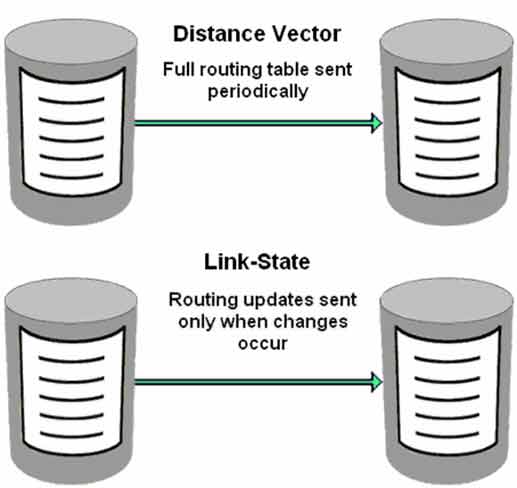
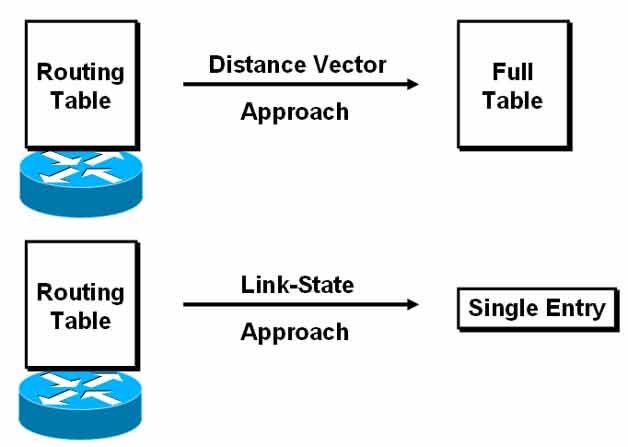
Examples include RIP version 1 and IGRP. One key trait: these protocols send their entire routing table as a broadcast to neighboring routers at regular intervals — for example, every 30 seconds. Neighbors receive the advertised routes and update their own routing tables. This behavior is often called routing by rumor.
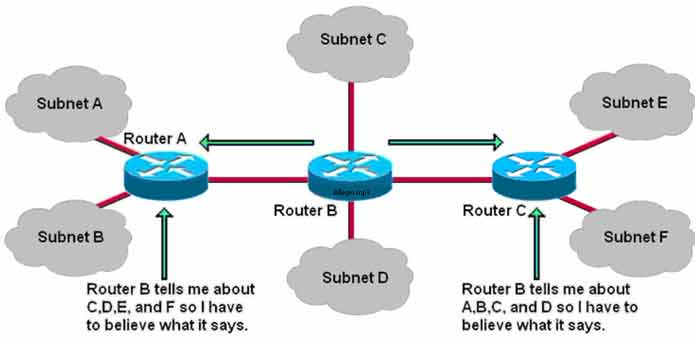
Distance Vector routers trust what they hear from neighbors — they don’t verify the topology themselves.
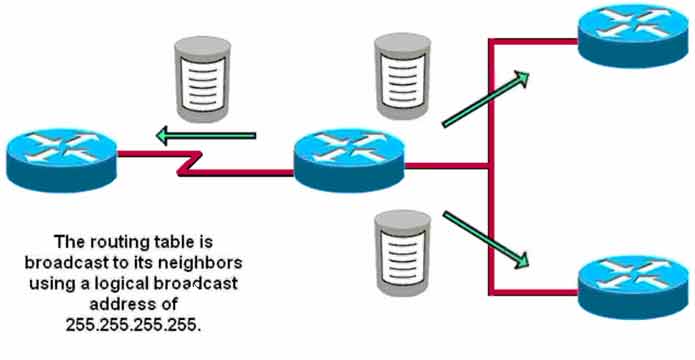
For example, in a routing-by-rumor scenario: Router C accepts information about Subnet A, Subnet B, and Subnet C from Router B — even though Router C didn’t verify that topology directly.
Distance Vector Protocol Comparison
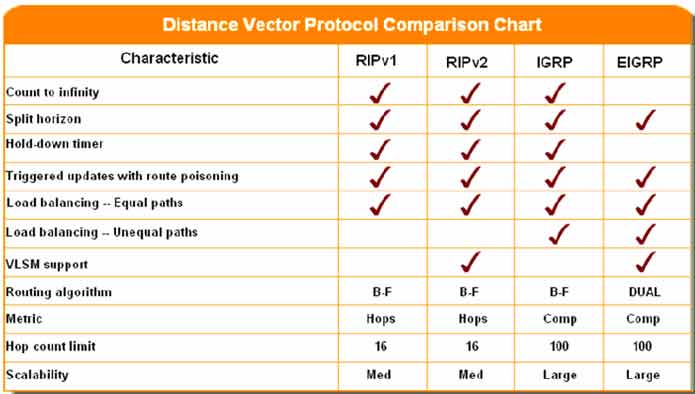
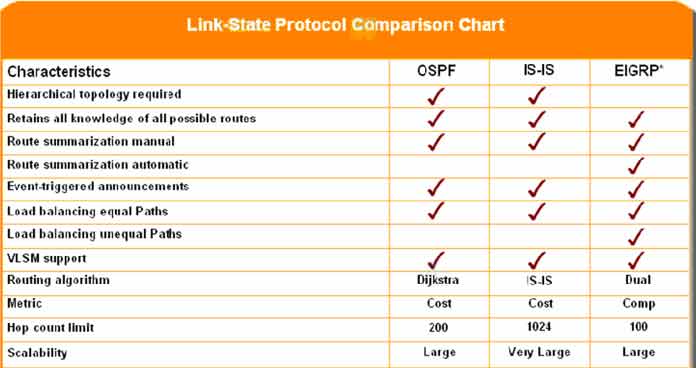
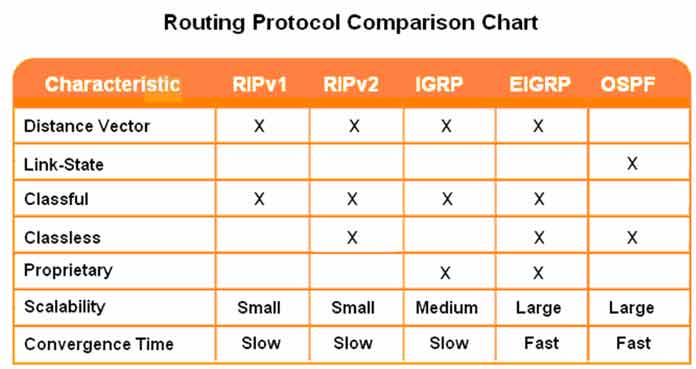
Classic vs Advanced: RIP v1 and IGRP are classic Distance Vector protocols. RIP v2 and EIGRP are advanced Distance Vector protocols with better features.
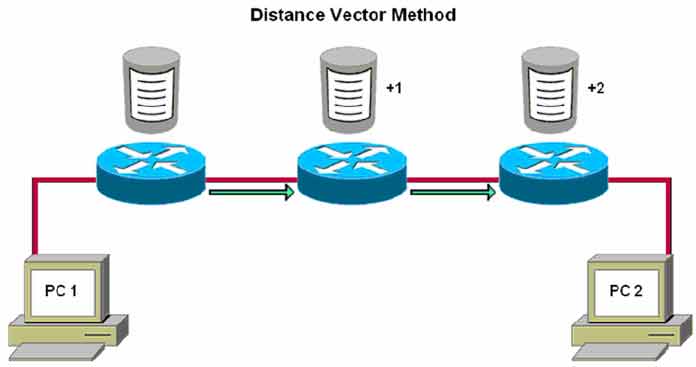
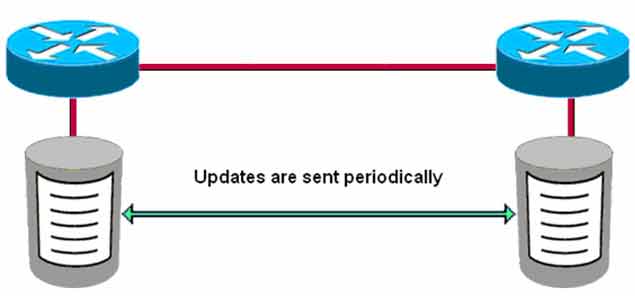
Updates are sent at regular intervals — even when nothing has changed. This wastes bandwidth but keeps neighbors synchronized.
Link State
Link State Protocols
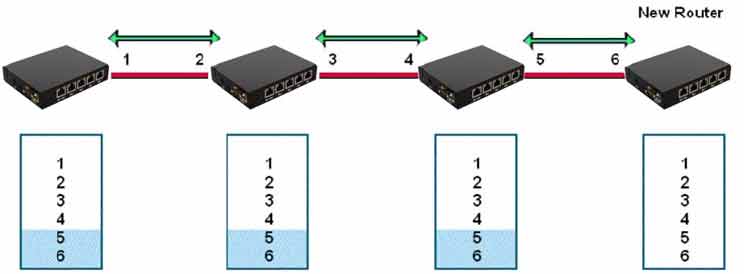
Link State protocols are more advanced than Distance Vector protocols. Instead of sending the full routing table at regular intervals, they send incremental updates — only when changes occur.
Link State protocols don’t use broadcasts — they use multicast messages. They’re much smarter than Distance Vector protocols.
Link State protocols send hello packets to neighbors to discover them and the networks they connect to. When a neighbor receives the hello packet, the routers form an adjacency relationship. Each router updates its routing table when it receives update messages from neighbors.
If a router stops sending hello packets, its neighbor considers it a dead router — one that has a problem. Whenever the network changes, a router sends the change immediately without waiting for the regular update timer — this is called a triggered update.
Link State protocols are typically used in medium and large networks.
Update Methods Compared
The table below compares several routing protocols side by side.
| Feature | Distance Vector | Link State |
|---|---|---|
| Update Content | Full routing table | Only changes (incremental) |
| Update Timing | Periodic (fixed interval) | Triggered (on change) |
| Transmission Method | Broadcast (or multicast for v2) | Multicast |
| Neighbor Discovery | Not required | Hello packets |
| Adjacency Formation | No formal process | Yes — adjacency required |
| Failure Detection | Timeout on update interval | Missed hello packets |
| Bandwidth Usage | High (full tables repeatedly) | Low (only changes) |
| CPU Usage | Lower | Higher (SPF calculations) |
| Convergence Speed | Slow | Fast |
| Scalability | Small to medium networks | Medium to large networks |
Routing Protocol Comparison
| Protocol | Type | Standard | Metric | AD |
|---|---|---|---|---|
| RIP v1 | Distance Vector | Open | Hop count | 120 |
| RIP v2 | Distance Vector | Open | Hop count | 120 |
| IGRP | Distance Vector | Cisco Proprietary | Composite | 100 |
| EIGRP | Advanced Distance Vector | Cisco Proprietary (now open) | Composite | 90 |
| OSPF | Link State | Open | Cost | 110 |
| IS-IS | Link State | Open | Cost | 115 |
| BGP | Path Vector | Open | Path attributes | 20 (eBGP) |
Key Differences at a Glance
| Aspect | Distance Vector | Link State |
|---|---|---|
| Topology Knowledge | Knows only neighbor’s view | Knows full network topology |
| Routing Decision | Based on neighbor’s report | Based on SPF calculation |
| Routing Loops | Prone to loops (uses split horizon, poison reverse) | Loop-free (uses SPF tree) |
| Memory Usage | Lower | Higher (topology database) |
| Typical Examples | RIP, IGRP | OSPF, IS-IS |
Which Protocol Should You Use?
- Small network (under 15 hops): RIP v2 — simple and open.
- Cisco-only network: EIGRP — fast convergence with Cisco features.
- Large enterprise network: OSPF — open standard, highly scalable.
- Service provider backbone: IS-IS — used in many ISP networks.
- Between autonomous systems: BGP — the internet’s routing protocol.
Related Labs
