
Pass Microsoft AI-102 in Just 3 Days – Stress-Free, No Study Needed!
Have questions? Contact us directly on WhatsApp for quick support!
Free Microsoft AI-102 Dumps & Practice Questions
Get ready for the Microsoft Azure AI Engineer Associate (AI-102) exam with
our 100% free practice dumps and exam-style questions.
No sign-up, no payment, no email required.
What Is the Microsoft AI-102 Exam?
The AI-102: Designing and Implementing a Microsoft Azure AI Solution exam
tests your ability to design, build, and deploy AI solutions on Azure. It covers
Azure AI services such as vision, language, speech, decision, and conversational bots.
Our free AI-102 dumps and practice questions help you review key topics, learn the
question style, and build confidence before you schedule the real exam.
Why Use Our Free AI-102 Dumps?
Our AI-102 resources are written to support your learning.
You get fresh, exam-style questions that focus on the skills measured
by Microsoft, including:
- Designing Azure AI solutions and architectures
- Working with Azure AI Studio and related tools
- Integrating Cognitive Services, Language, and Vision
- Building and managing bots with Azure Bot Service
- Securing, monitoring, and optimizing AI solutions
Our content is reviewed by experienced Azure engineers and trainers for clarity and accuracy.
There are no hidden fees, trial locks, or forced registrations.
Important: These questions are original practice items and are
intended only for study and revision.
How to Study with Our AI-102 Free Dumps
- Step 1: Open a set of AI-102 practice questions by topic (vision, language, bots, etc.).
- Step 2: Try to answer each question without looking at the explanation.
- Step 3: Read the detailed answers and compare them with Microsoft Learn docs.
- Step 4: Mark questions you missed and review those areas again in Azure or a lab.
- Step 5: Repeat the questions later to check if you have really learned the concepts.
Using these dumps as a study guide helps you focus your time, discover weak areas,
and improve your understanding before you book the official AI-102 exam.
Sample AI-102 Practice Questions – Free Access
Here are a few example questions to show the style of our AI-102 practice dumps:
- Question 1: You need to build a solution that extracts text and layout information from invoices.
Which Azure AI service should you use, and how would you deploy it for production workloads? - Question 2: You are designing a chatbot that uses Azure OpenAI and Azure Bot Service.
Which components handle user authentication, message routing, and integration with external APIs? - Question 3: You must detect and redact sensitive information such as credit card numbers in user messages.
Which service or feature do you configure, and how do you integrate it into your pipeline? - Question 4: Your vision model is misclassifying certain images.
What steps can you take to improve model accuracy and reduce bias? - Question 5: You need to monitor latency, failures, and drift in your AI APIs.
Which Azure monitoring tools and metrics should you track?
All practice questions are free to use and are designed to reflect real-world
Azure AI scenarios.
Who Should Use These AI-102 Free Dumps?
These practice dumps and questions are ideal for:
- Azure AI engineers and developers
- Cloud solution architects working with AI workloads
- Data scientists and ML engineers moving solutions to Azure
- IT professionals planning to earn the Azure AI Engineer Associate badge
Whether this is your first attempt or you are retaking AI-102,
using targeted practice questions helps you study smarter and avoid surprises on exam day.
Best Practices for Passing the AI-102 Exam
- Combine our free dumps with official Microsoft Learn paths.
- Spend time in the Azure portal and AI Studio, not just reading.
- Build small demo projects using Cognitive Services and bots.
- Review security, compliance, and responsible AI guidelines.
- Take timed practice sessions to simulate real exam pressure.
Google and Microsoft both value real learning. Use these resources to deepen
your skills and build solutions that work in production.
Start Practicing for AI-102 Today
You can access all our free AI-102 dumps and exam-style questions right now.
Study at your own pace, practice with realistic scenarios, and boost your confidence before
scheduling the Microsoft AI-102 exam.
Click through the question sets, review the explanations, and keep practicing until you feel
ready to sit for the Azure AI Engineer Associate certification.
DRAG DROP –
You have 100 chatbots that each has its own Language Understanding model.
Frequently, you must add the same phrases to each model.
You need to programmatically update the Language Understanding models to include the new phrases.
How should you complete the code? To answer, drag the appropriate values to the correct targets. Each value may be used once, more than once, or not at all.
You may need to drag the split bar between panes or scroll to view content.
NOTE: Each correct selection is worth one point.
Select and Place:
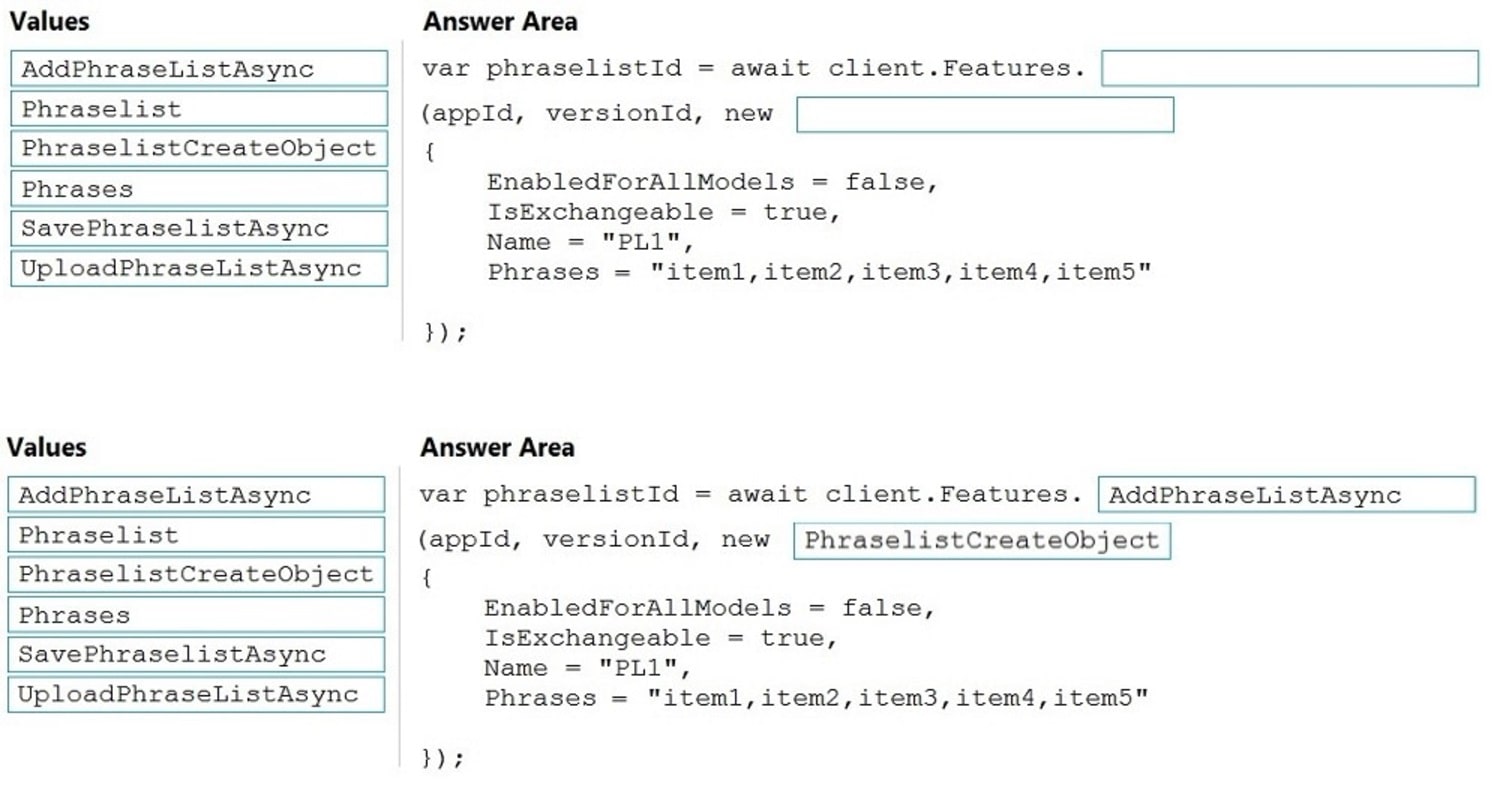
Box 1: AddPhraseListAsync –
Example: Add phraselist feature –
var phraselistId = await client.Features.AddPhraseListAsync(appId, versionId, new PhraselistCreateObject
{
EnabledForAllModels = false,
IsExchangeable = true,
Name = “QuantityPhraselist”,
Phrases = “few,more,extra”
});
Box 2: PhraselistCreateObject –
Reference:
https://docs.microsoft.com/en-us/azure/cognitive-services/luis/client-libraries-rest-api
DRAG DROP –
You plan to use a Language Understanding application named app1 that is deployed to a container.
App1 was developed by using a Language Understanding authoring resource named lu1.
App1 has the versions shown in the following table.
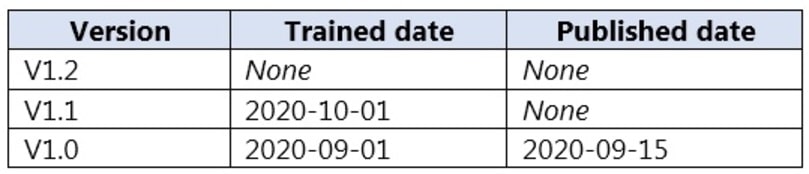
You need to create a container that uses the latest deployable version of app1.
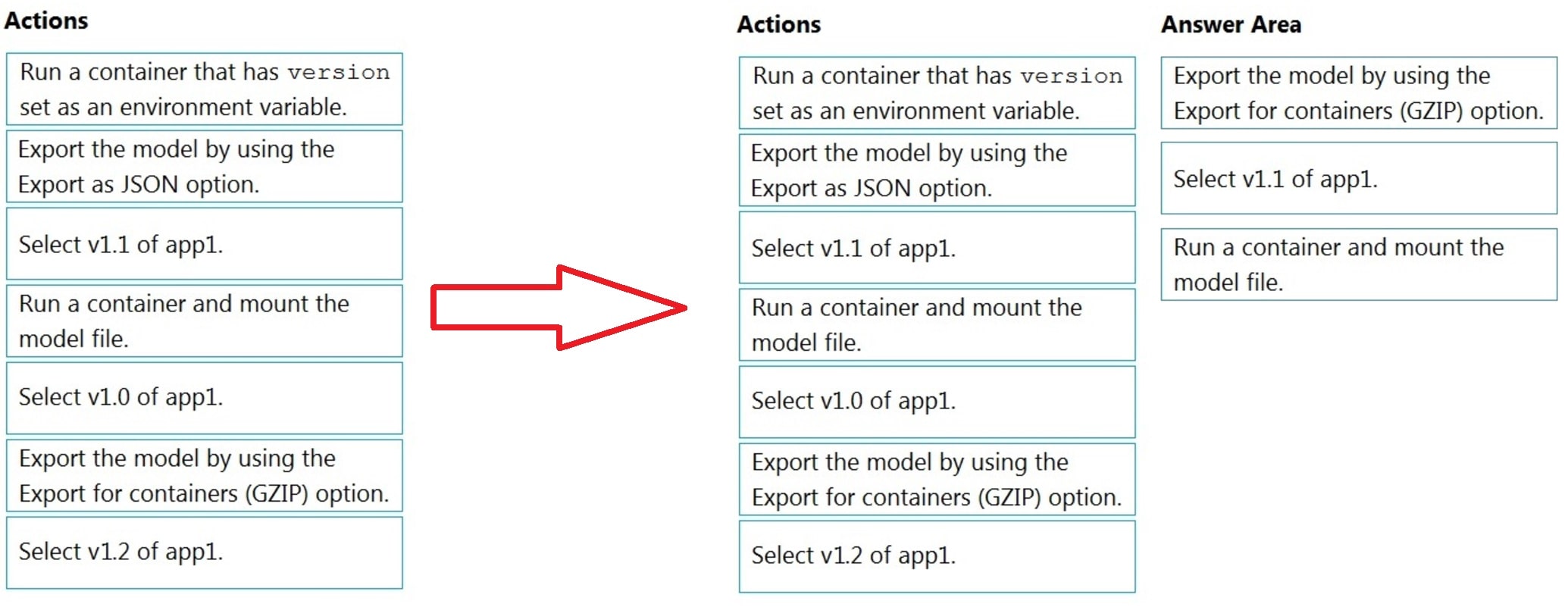
Which three actions should you perform in sequence? To answer, move the appropriate actions from the list of actions to the answer area and arrange them in the correct order.
Select and Place:
You need to build a chatbot that meets the following requirements:
– Supports chit-chat, knowledge base, and multilingual models
– Performs sentiment analysis on user messages
– Selects the best language model automatically
What should you integrate into the chatbot?
- A. QnA Maker, Language Understanding, and Dispatch
- B. Translator, Speech, and Dispatch
- C. Language Understanding, Text Analytics, and QnA Maker
- D. Text Analytics, Translator, and Dispatch
Your company wants to reduce how long it takes for employees to log receipts in expense reports. All the receipts are in English.
You need to extract top-level information from the receipts, such as the vendor and the transaction total. The solution must minimize development effort.
Which Azure service should you use?
- A. Custom Vision
- B. Personalizer
- C. Form Recognizer
- D. Computer Vision
HOTSPOT –
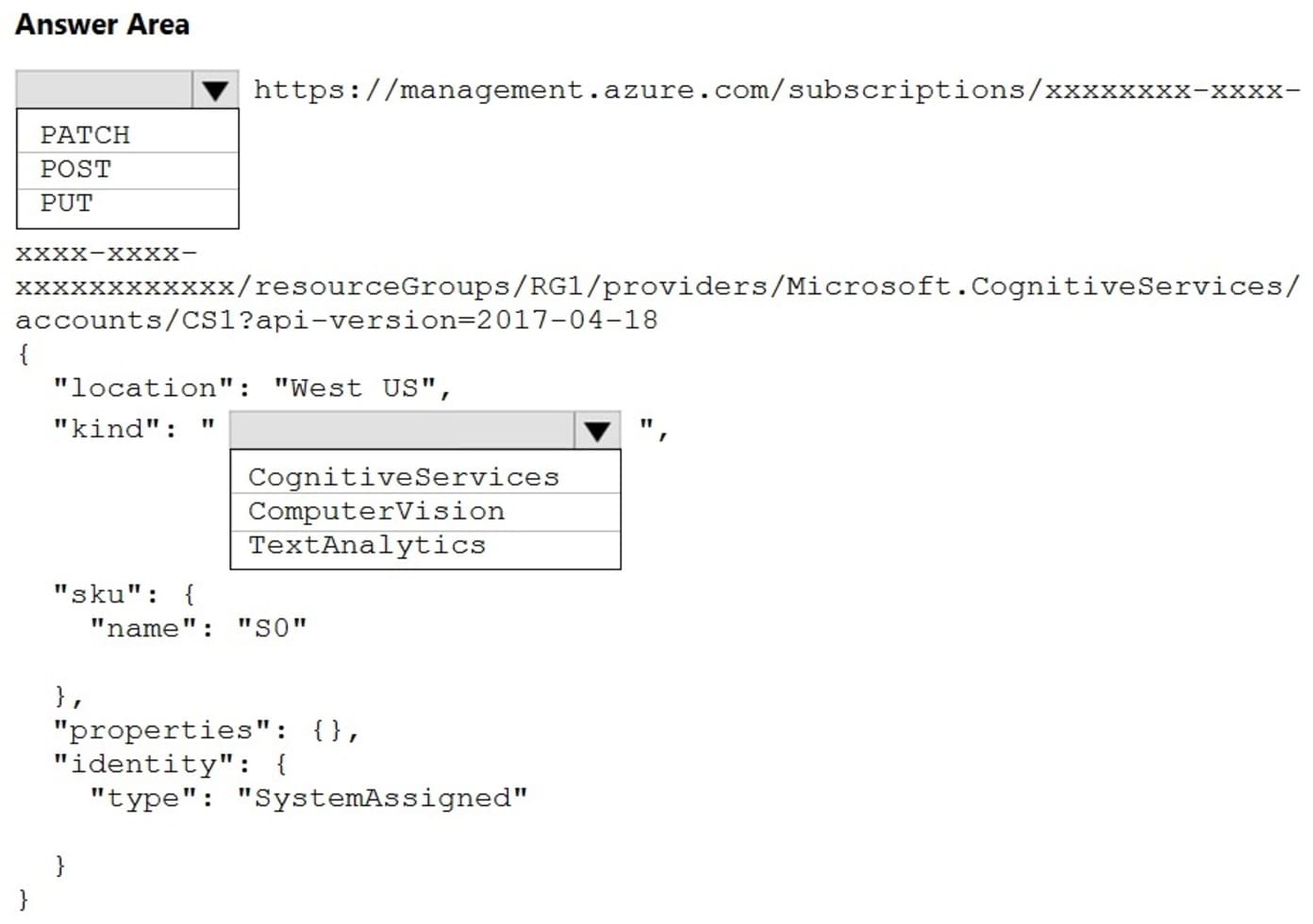
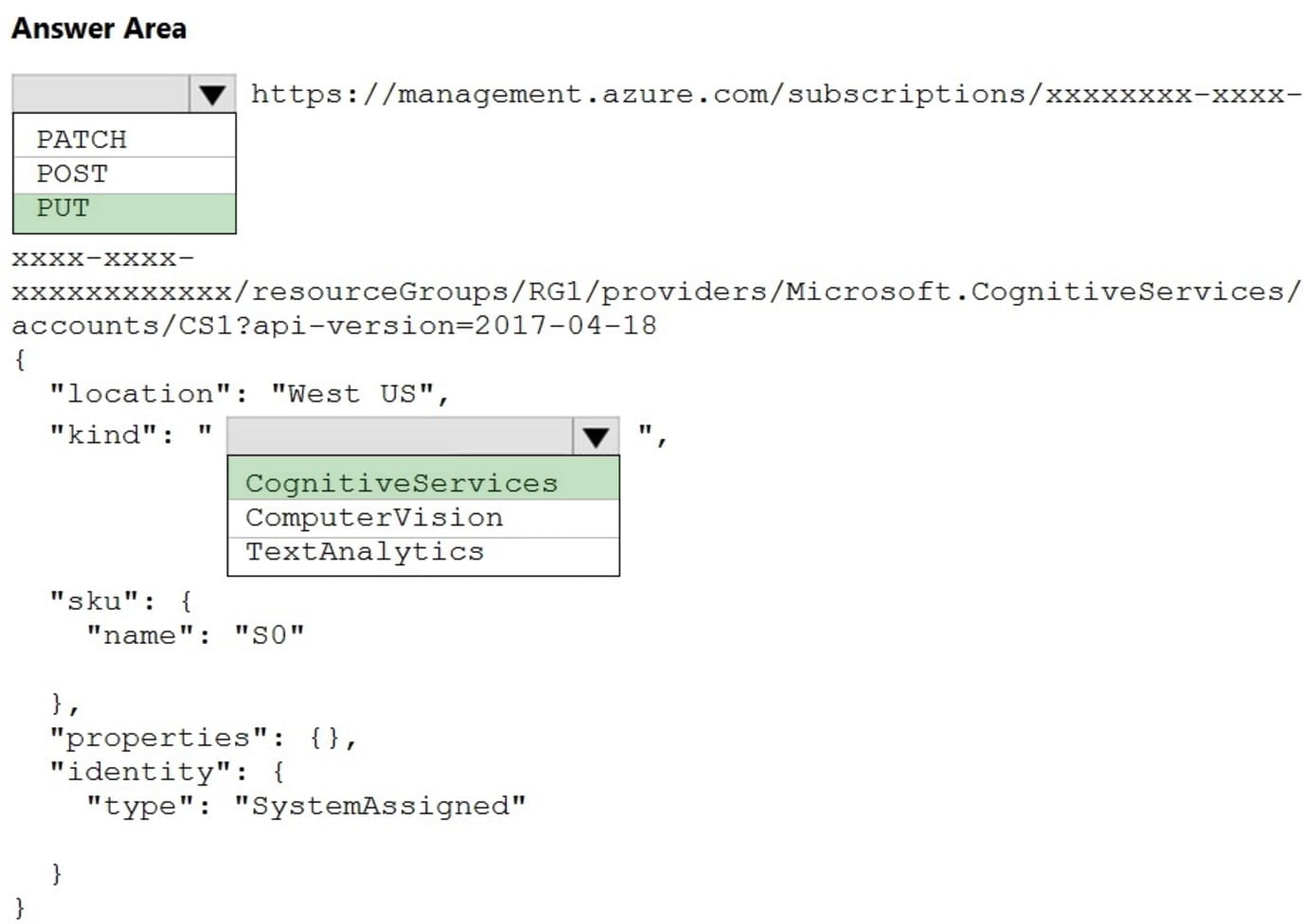
You need to create a new resource that will be used to perform sentiment analysis and optical character recognition (OCR). The solution must meet the following requirements:
– Use a single key and endpoint to access multiple services.
– Consolidate billing for future services that you might use.
– Support the use of Computer Vision in the future.
How should you complete the HTTP request to create the new resource? To answer, select the appropriate options in the answer area.
NOTE: Each correct selection is worth one point.
Hot Area:
You are developing a new sales system that will process the video and text from a public-facing website.
You plan to monitor the sales system to ensure that it provides equitable results regardless of the user’s location or background.
Which two responsible AI principles provide guidance to meet the monitoring requirements? Each correct answer presents part of the solution.
NOTE: Each correct selection is worth one point.
- A. transparency
- B. fairness
- C. inclusiveness
- D. reliability and safety
- E. privacy and security
DRAG DROP –
You plan to use containerized versions of the Anomaly Detector API on local devices for testing and in on-premises datacenters.
You need to ensure that the containerized deployments meet the following requirements:
– Prevent billing and API information from being stored in the command-line histories of the devices that run the container.
– Control access to the container images by using Azure role-based access control (Azure RBAC).
Which four actions should you perform in sequence? To answer, move the appropriate actions from the list of actions to the answer area and arrange them in the correct order.
NOTE: More than one order of answer choices is correct. You will receive credit for any of the correct orders you select.
Select and Place:
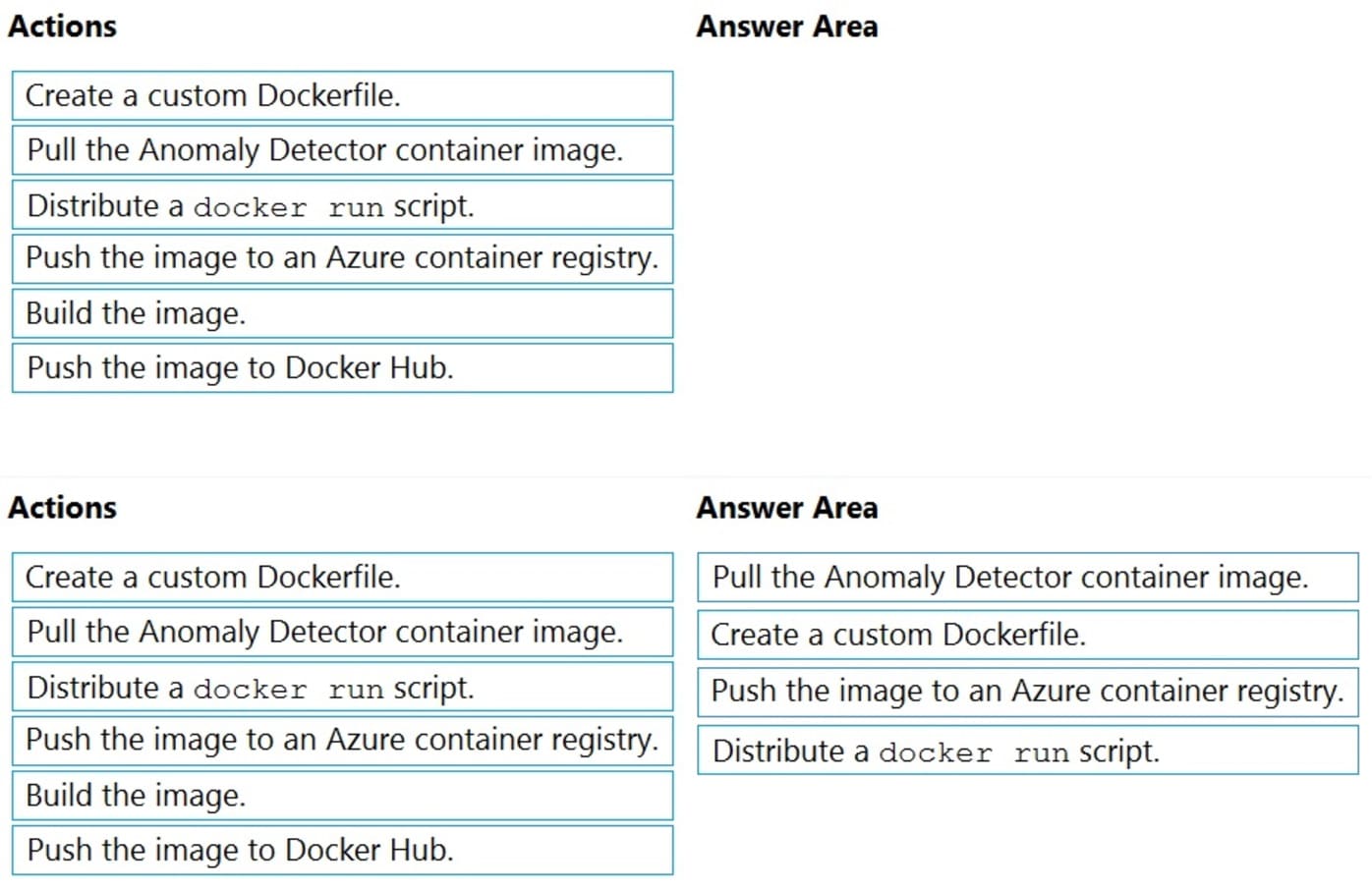
Step 1: Pull the Anomaly Detector container image.
Step 2: Create a custom Docker file
Step 3: Push the image to an Azure container registry.
To push an image to an Azure Container registry, you must first have an image.
Step 4: Distribute the docker run script
Use the docker run command to run the containers.
Reference:
https://docs.microsoft.com/en-us/azure/container-registry/container-registry-intro
HOTSPOT –
You plan to deploy a containerized version of an Azure Cognitive Services service that will be used for text analysis.
You configure https://contoso.cognitiveservices.azure.com as the endpoint URI for the service, and you pull the latest version of the Text Analytics
Sentiment Analysis container.
You need to run the container on an Azure virtual machine by using Docker.
How should you complete the command? To answer, select the appropriate options in the answer area.
NOTE: Each correct selection is worth one point.
Hot Area:
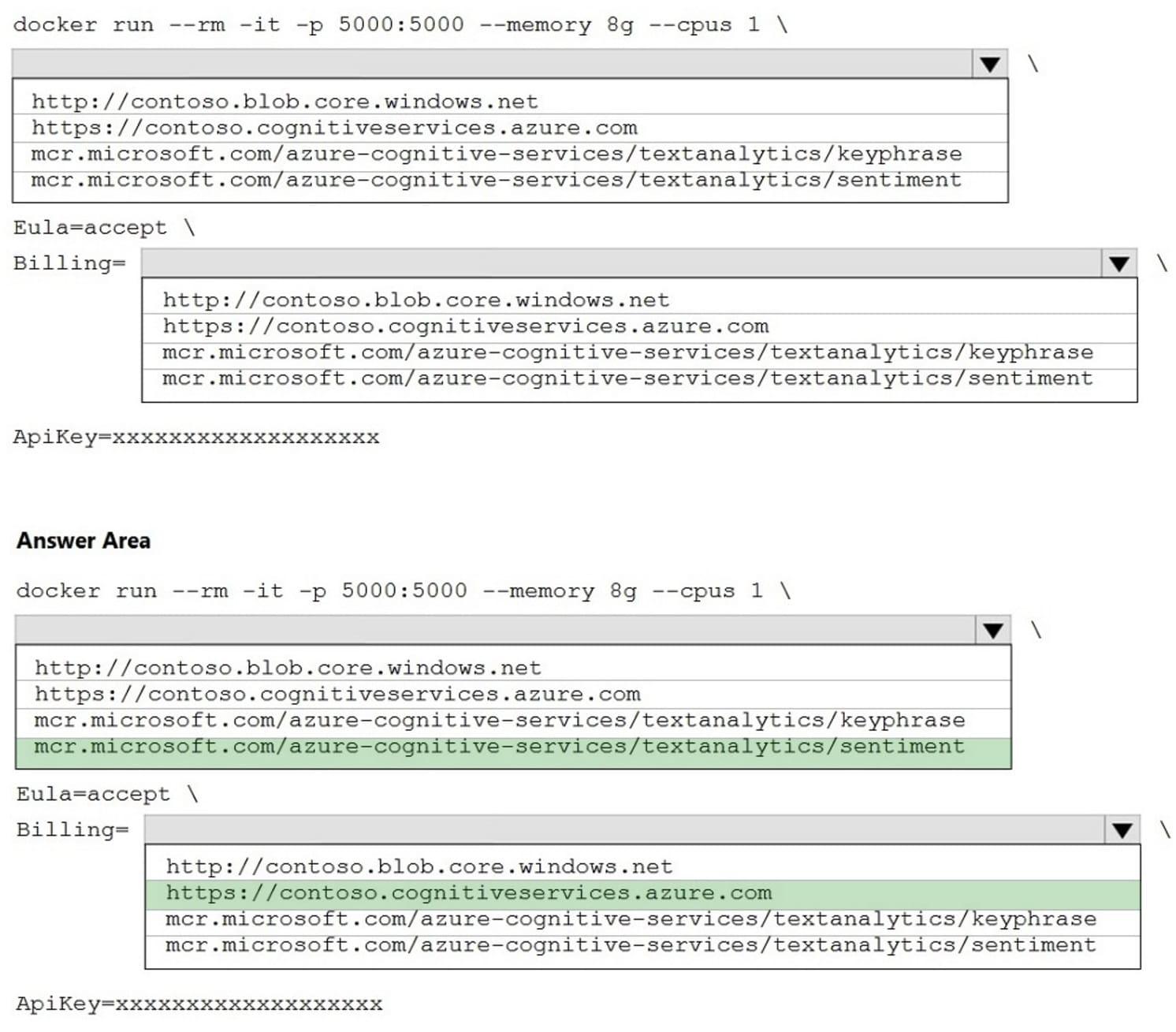
Box 1: mcr.microsoft.com/azure-cognitive-services/textanalytics/sentiment
To run the Sentiment Analysis v3 container, execute the following docker run command. docker run –rm -it -p 5000:5000 –memory 8g –cpus 1 \ mcr.microsoft.com/azure-cognitive-services/textanalytics/sentiment \
Eula=accept \
Billing={ENDPOINT_URI} \
ApiKey={API_KEY} is the endpoint for accessing the Text Analytics API. https://<your-custom-subdomain>.cognitiveservices.azure.com
Box 2: https://contoso.cognitiveservices.azure.com
{ENDPOINT_URI} is the endpoint for accessing the Text Analytics API: https://<your-custom-subdomain>.cognitiveservices.a The endpoint for accessing the Text
Analytics API. zure.com –
Reference:
https://docs.microsoft.com/en-us/azure/cognitive-services/text-analytics/how-tos/text-analytics-how-to-install-containers?tabs=sentiment
You have the following C# method for creating Azure Cognitive Services resources programmatically.
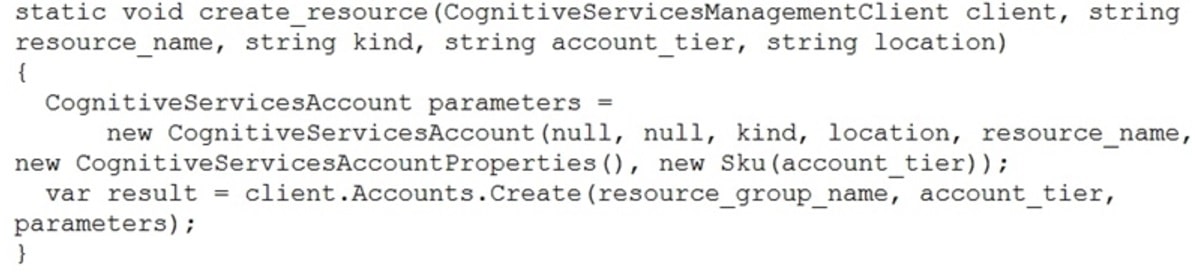
You need to call the method to create a free Azure resource in the West US Azure region. The resource will be used to generate captions of images automatically.
Which code should you use?
- A. create_resource(client, “res1”, “ComputerVision”, “F0”, “westus”)
- B. create_resource(client, “res1”, “CustomVision.Prediction”, “F0”, “westus”)
- C. create_resource(client, “res1”, “ComputerVision”, “S0”, “westus”)
- D. create_resource(client, “res1”, “CustomVision.Prediction”, “S0”, “westus”)
You successfully run the following HTTP request.
POST https://management.azure.com/subscriptions/18c51a87-3a69-47a8-aedc-a54745f708a1/resourceGroups/RG1/providers/
Microsoft.CognitiveServices/accounts/contoso1/regenerateKey?api-version=2017-04-18
Body{“keyName”: “Key2”}
What is the result of the request?
- A. A key for Azure Cognitive Services was generated in Azure Key Vault.
- B. A new query key was generated.
- C. The primary subscription key and the secondary subscription key were rotated.
- D. The secondary subscription key was reset.