
Pass Microsoft AZ-104 in Just 3 Days – Stress-Free, No Study Needed!
Have questions? Contact us directly on WhatsApp for quick support!
You need to meet the user requirement for Admin1.
What should you do?
- A. From the Azure Active Directory blade, modify the Groups
- B. From the Azure Active Directory blade, modify the Properties
- C. From the Subscriptions blade, select the subscription, and then modify the Access control (IAM) settings
- D. From the Subscriptions blade, select the subscription, and then modify the Properties
You need to ensure that you can grant Group4 Azure RBAC read only permissions to all the Azure file shares.
What should you do?
- A. On storage2, enable identity-based access for the file shares.
- B. Recreate storage2 and set Hierarchical namespace to Enabled.
- C. On storage1 and storage4, change the Account kind type to StorageV2 (general purpose v2).
- D. Create a shared access signature (SAS) for storage1, storage2, and storage4.
You need to move the blueprint files to Azure.
What should you do?
- A. Generate an access key. Map a drive, and then copy the files by using File Explorer.
- B. Use Azure Storage Explorer to copy the files.
- C. Use the Azure Import/Export service.
- D. Generate a shared access signature (SAS). Map a drive, and then copy the files by using File Explorer.
HOTSPOT –
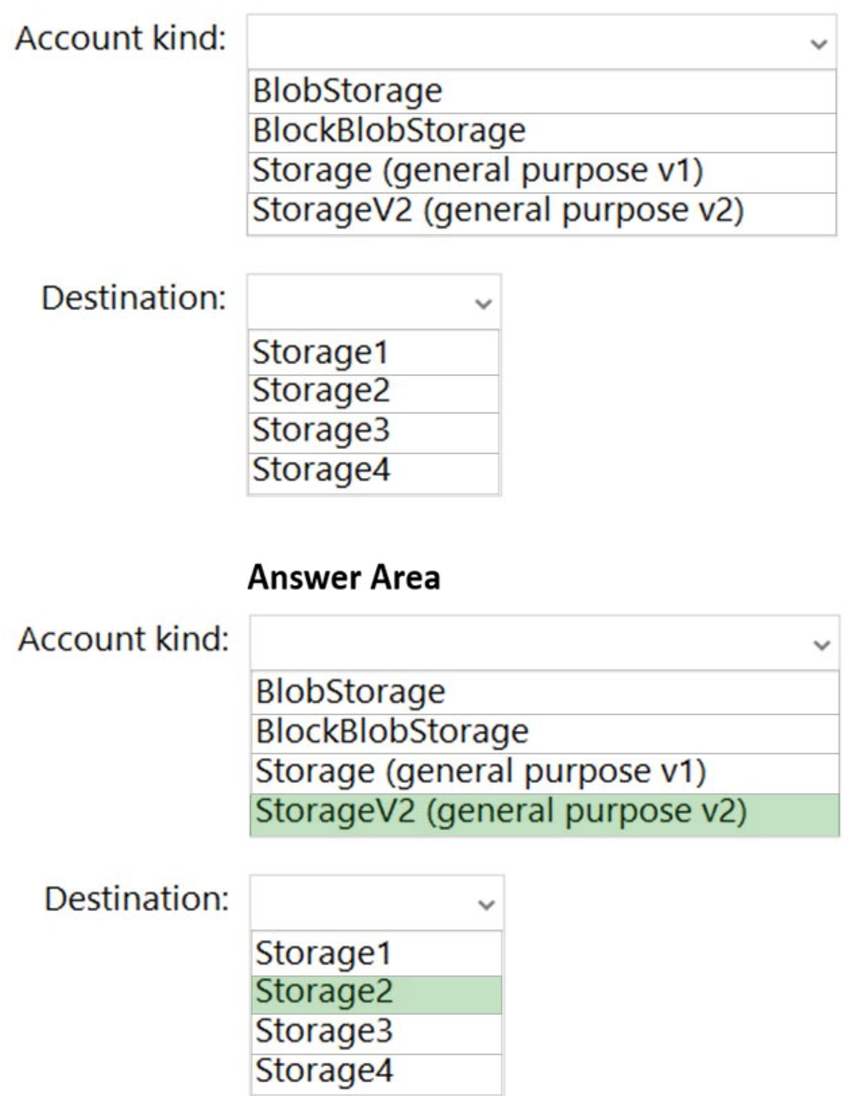
You need to create storage5. The solution must support the planned changes.
Which type of storage account should you use, and which account should you configure as the destination storage account? To answer, select the appropriate options in the answer area.
NOTE: Each correct selection is worth one point.
Hot Area:
Reference:
https://docs.microsoft.com/en-us/azure/storage/blobs/object-replication-configure?tabs=portal
HOTSPOT –
You need to meet the connection requirements for the New York office.
What should you do? To answer, select the appropriate options in the answer area.
NOTE: Each correct selection is worth one point.
Hot Area:
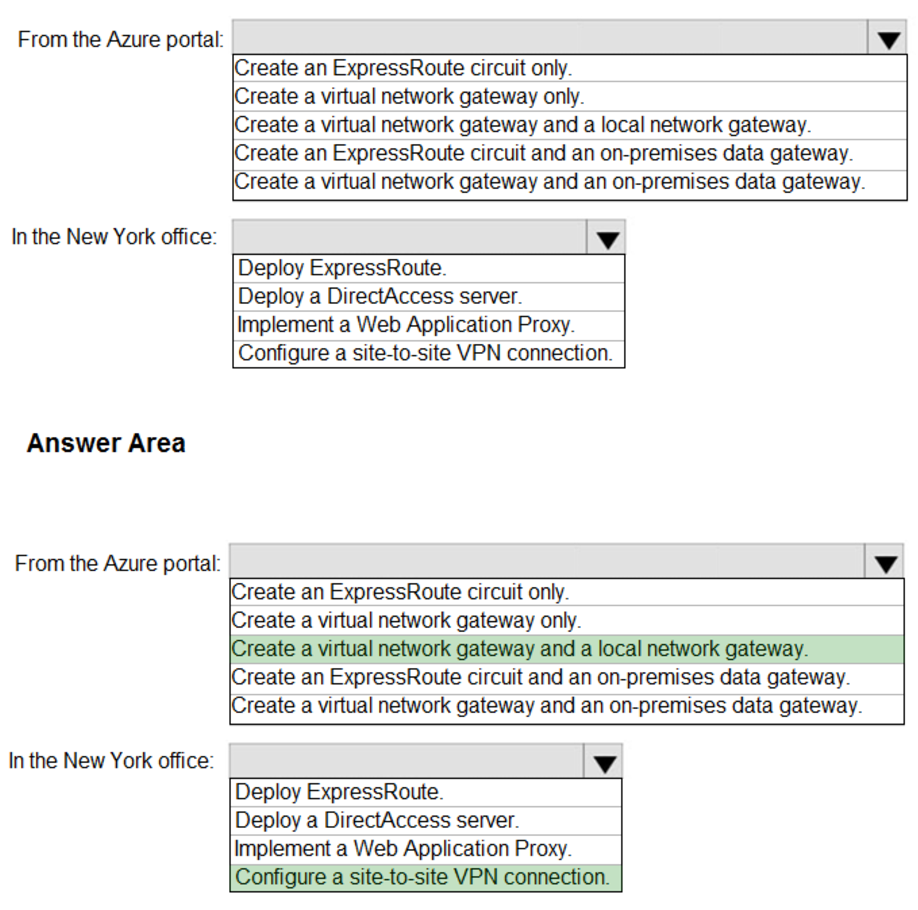
Box 1: Create a virtual network gateway and a local network gateway.
Azure VPN gateway. The VPN gateway service enables you to connect the VNet to the on-premises network through a VPN appliance. For more information, see
Connect an on-premises network to a Microsoft Azure virtual network. The VPN gateway includes the following elements:
– Virtual network gateway. A resource that provides a virtual VPN appliance for the VNet. It is responsible for routing traffic from the on-premises network to the
VNet.
– Local network gateway. An abstraction of the on-premises VPN appliance. Network traffic from the cloud application to the on-premises network is routed through this gateway.
– Connection. The connection has properties that specify the connection type (IPSec) and the key shared with the on-premises VPN appliance to encrypt traffic.
– Gateway subnet. The virtual network gateway is held in its own subnet, which is subject to various requirements, described in the Recommendations section below.
Box 2: Configure a site-to-site VPN connection
On premises create a site-to-site connection for the virtual network gateway and the local network gateway.
Reference:
https://docs.microsoft.com/en-us/azure/architecture/reference-architectures/hybrid-networking/vpn
You are planning the move of App1 to Azure.
You create a network security group (NSG).
You need to recommend a solution to provide users with access to App1.
What should you recommend?
- A. Create an incoming security rule for port 443 from the Internet. Associate the NSG to the subnet that contains the web servers.
- B. Create an outgoing security rule for port 443 from the Internet. Associate the NSG to the subnet that contains the web servers.
- C. Create an incoming security rule for port 443 from the Internet. Associate the NSG to all the subnets.
- D. Create an outgoing security rule for port 443 from the Internet. Associate the NSG to all the subnets
You need to recommend a solution to automate the configuration for the finance department users. The solution must meet the technical requirements.
What should you include in the recommendation?
- A. Azure AD B2C
- B. dynamic groups and conditional access policies
- C. Azure AD Identity Protection
- D. an Azure logic app and the Microsoft Identity Management (MIM) client
HOTSPOT –
You need to identify the storage requirements for Contoso.
For each of the following statements, select Yes if the statement is true. Otherwise, select No.
NOTE: Each correct selection is worth one point.
Hot Area:
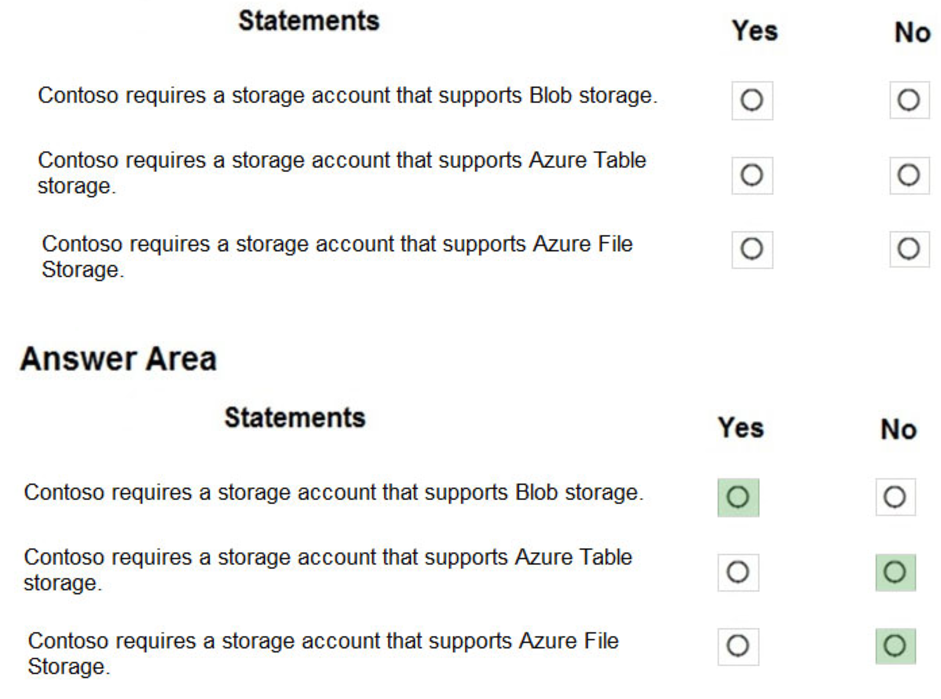
Box 1: Yes –
Contoso is moving the existing product blueprint files to Azure Blob storage.
Use unmanaged standard storage for the hard disks of the virtual machines. We use Page Blobs for these.
Box 2: No –
Box 3: No
You need to identify which storage account to use for the flow logging of IP traffic from VM5. The solution must meet the retention requirements.
Which storage account should you identify?
- A. storage1
- B. storage2
- C. storage3
- D. storage4
You need to add VM1 and VM2 to the backend pool of LB1.
What should you do first?
- A. Connect VM2 to VNET1/Subnet1.
- B. Redeploy VM1 and VM2 to the same availability zone.
- C. Redeploy VM1 and VM2 to the same availability set.
- D. Create a new NSG and associate the NSG to VNET1/Subnet1.