

Pass Microsoft AZ-104 in Just 3 Days – Stress-Free, No Study Needed!
Have questions? Contact us directly on WhatsApp for quick support!
HOTSPOT –
You have an Azure Active Directory (Azure AD) tenant named contoso.com that contains the users shown in the following table:
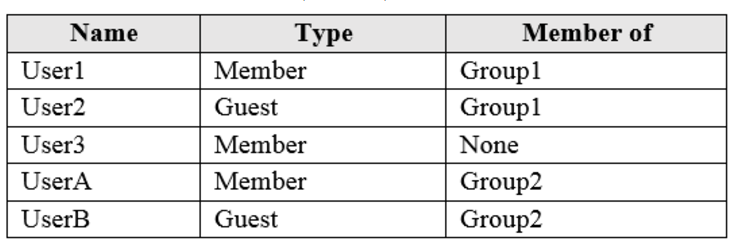
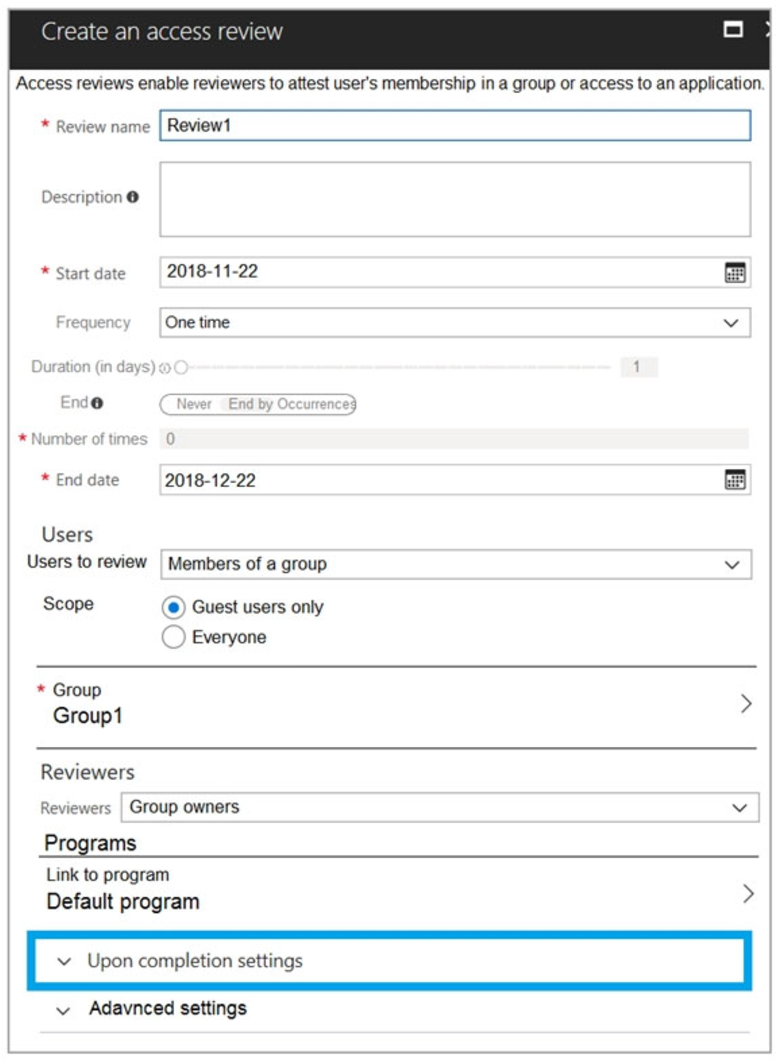
User3 is the owner of Group1.
Group2 is a member of Group1.
You configure an access review named Review1 as shown in the following exhibit:
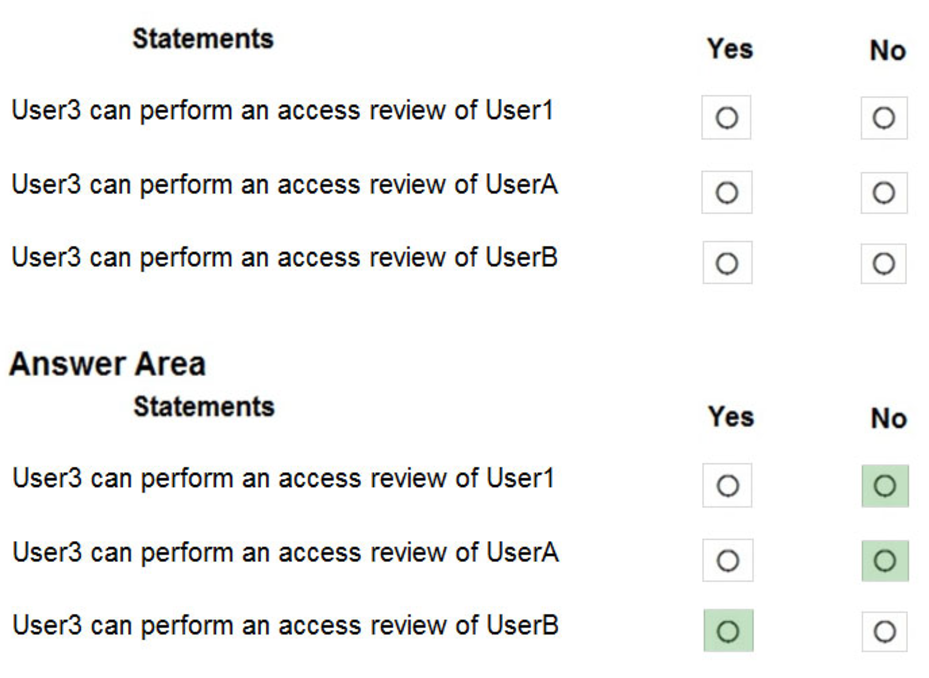
For each of the following statements, select Yes if the statement is true. Otherwise, select No.
NOTE: Each correct selection is worth one point.
Hot Area:
Reference:
https://docs.microsoft.com/en-us/azure/active-directory/governance/create-access-review
HOTSPOT –
You have an Azure Storage account named storage1.
You have an Azure App Service app named App1 and an app named App2 that runs in an Azure container instance. Each app uses a managed identity.
You need to ensure that App1 and App2 can read blobs from storage1. The solution must meet the following requirements:
– Minimize the number of secrets used.
– Ensure that App2 can only read from storage1 for the next 30 days.
What should you configure in storage1 for each app? To answer, select the appropriate options in the answer area.
NOTE: Each correct selection is worth one point.
Hot Area:
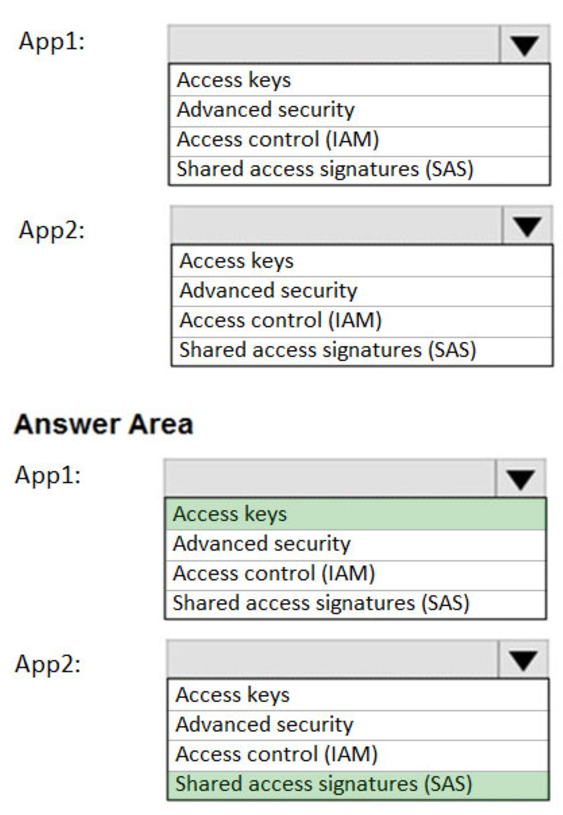
App1: Access keys –
App2: Shared access signature (SAS)
A shared access signature (SAS) provides secure delegated access to resources in your storage account without compromising the security of your data. With a
SAS, you have granular control over how a client can access your data. You can control what resources the client may access, what permissions they have on those resources, and how long the SAS is valid, among other parameters.
Reference:
https://docs.microsoft.com/en-us/azure/storage/common/storage-sas-overview
Note: This question is part of a series of questions that present the same scenario. Each question in the series contains a unique solution that might meet the stated goals. Some question sets might have more than one correct solution, while others might not have a correct solution.
After you answer a question in this section, you will NOT be able to return to it. As a result, these questions will not appear in the review screen.
You have an Azure virtual machine named VM1 that runs Windows Server 2016.
You need to create an alert in Azure when more than two error events are logged to the System event log on VM1 within an hour.
Solution: You create an Azure storage account and configure shared access signatures (SASs). You install the Microsoft Monitoring Agent on VM1. You create an alert in Azure Monitor and specify the storage account as the source.
Does that meet the goal?
- A. Yes
- B. No
You have an Azure subscription that contains the resources shown in the following table.
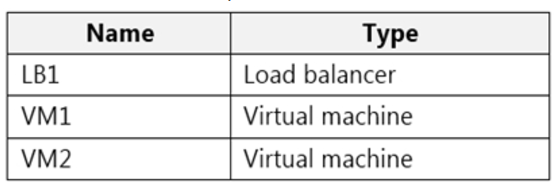
LB1 is configured as shown in the following table.
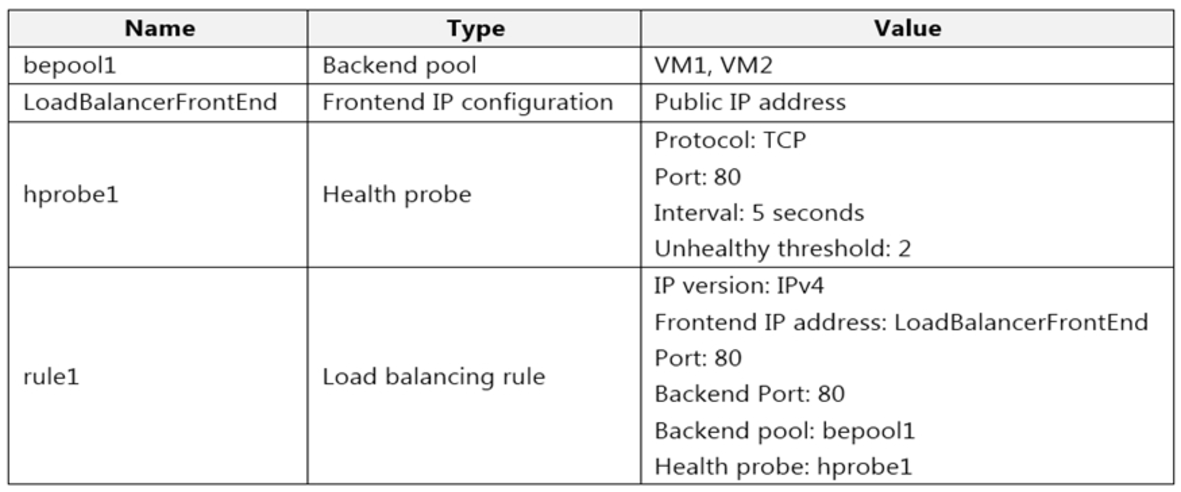
You plan to create new inbound NAT rules that meet the following requirements:
– Provide Remote Desktop access to VM1 from the internet by using port 3389.
– Provide Remote Desktop access to VM2 from the internet by using port 3389.
What should you create on LB1 before you can create the new inbound NAT rules?
- A. a frontend IP address
- B. a load balancing rule
- C. a health probe
- D. a backend pool
HOTSPOT –
You have an Azure subscription that contains an Azure Storage account named storage1 and the users shown in the following table.
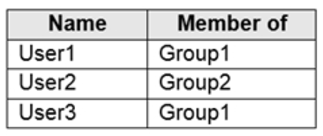
You plan to monitor storage1 and to configure email notifications for the signals shown in the following table.

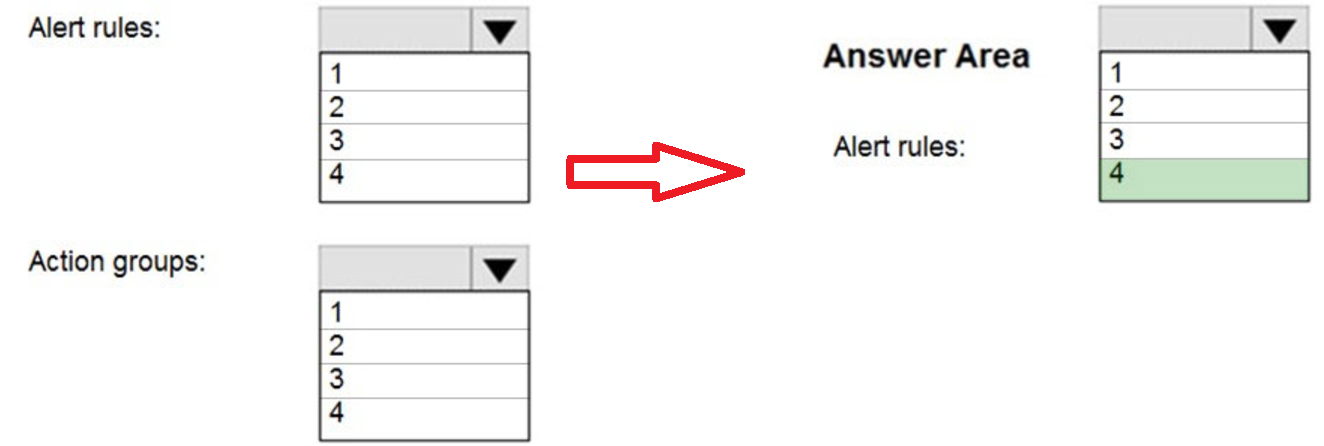
You need to identify the minimum number of alert rules and action groups required for the planned monitoring.
How many alert rules and action groups should you identify? To answer, select the appropriate options in the answer area.
NOTE: Each correct selection is worth one point.
Hot Area:
HOTSPOT –
You need to create an Azure Storage account that meets the following requirements:
– Minimizes costs
– Supports hot, cool, and archive blob tiers
– Provides fault tolerance if a disaster affects the Azure region where the account resides
How should you complete the command? To answer, select the appropriate options in the answer area.
NOTE: Each correct selection is worth one point.
Hot Area:
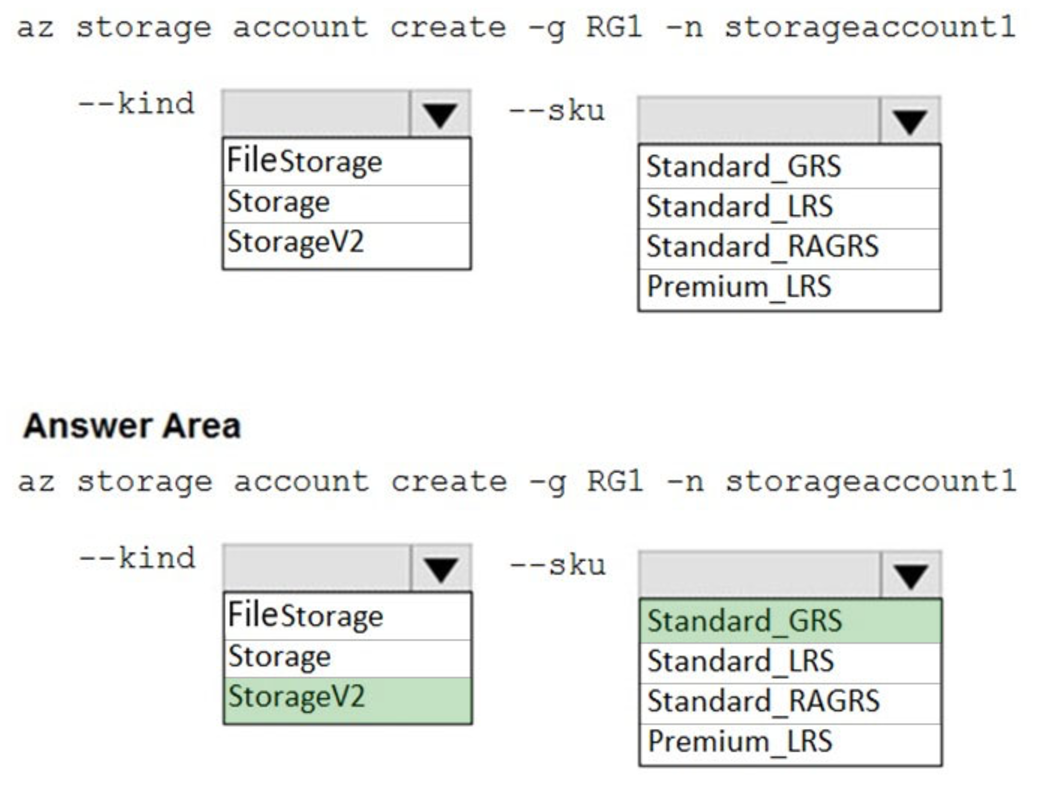
Box 1: StorageV2 –
You may only tier your object storage data to hot, cool, or archive in Blob storage and General Purpose v2 (GPv2) accounts. General Purpose v1 (GPv1) accounts do not support tiering.
General-purpose v2 accounts deliver the lowest per-gigabyte capacity prices for Azure Storage, as well as industry-competitive transaction prices.
Box 2: Standard_GRS –
Geo-redundant storage (GRS): Cross-regional replication to protect against region-wide unavailability.
Incorrect Answers:
Locally-redundant storage (LRS): A simple, low-cost replication strategy. Data is replicated within a single storage scale unit.
Read-access geo-redundant storage (RA-GRS): Cross-regional replication with read access to the replica. RA-GRS provides read-only access to the data in the secondary location, in addition to geo-replication across two regions, but is more expensive compared to GRS.
Reference:
https://docs.microsoft.com/en-us/azure/storage/common/storage-redundancy-grs https://docs.microsoft.com/en-us/azure/storage/blobs/storage-blob-storage-tiers
HOTSPOT –
You have an Azure subscription named Subscription1. Subscription1 contains the resources in the following table.
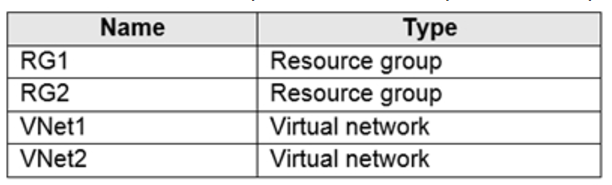
VNet1 is in RG1. VNet2 is in RG2. There is no connectivity between VNet1 and VNet2.
An administrator named Admin1 creates an Azure virtual machine named VM1 in RG1. VM1 uses a disk named Disk1 and connects to VNet1. Admin1 then installs a custom application in VM1.
You need to move the custom application to VNet2. The solution must minimize administrative effort.
Which two actions should you perform? To answer, select the appropriate options in the answer area.
NOTE: Each correct selection is worth one point.
Hot Area:
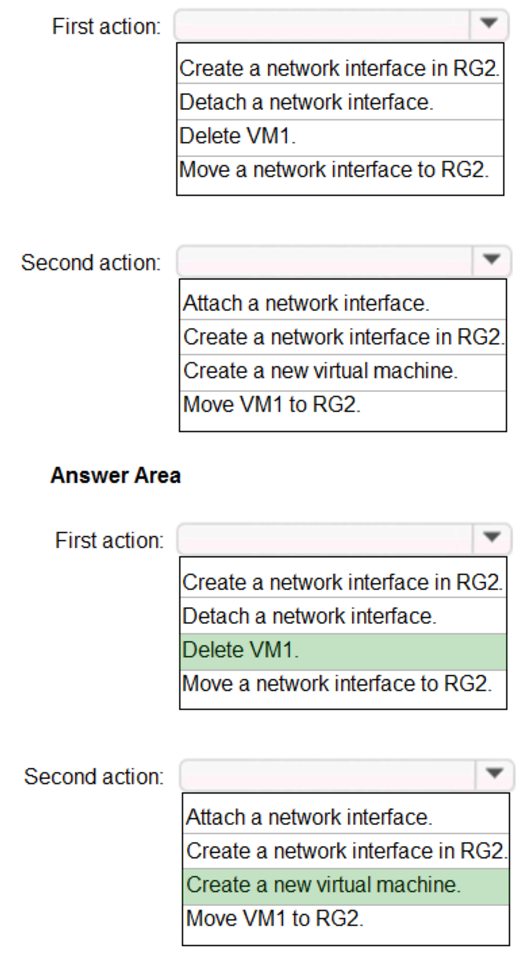
We cannot just move a virtual machine between networks. What we need to do is identify the disk used by the VM, delete the VM itself while retaining the disk, and recreate the VM in the target virtual network and then attach the original disk to it.
Reference:
https://blogs.technet.microsoft.com/canitpro/2014/06/16/step-by-step-move-a-vm-to-a-different-vnet-on-azure/ https://4sysops.com/archives/move-an-azure-vm-to-another-virtual-network-vnet/#migrate-an-azure-vm-between-vnets
HOTSPOT –
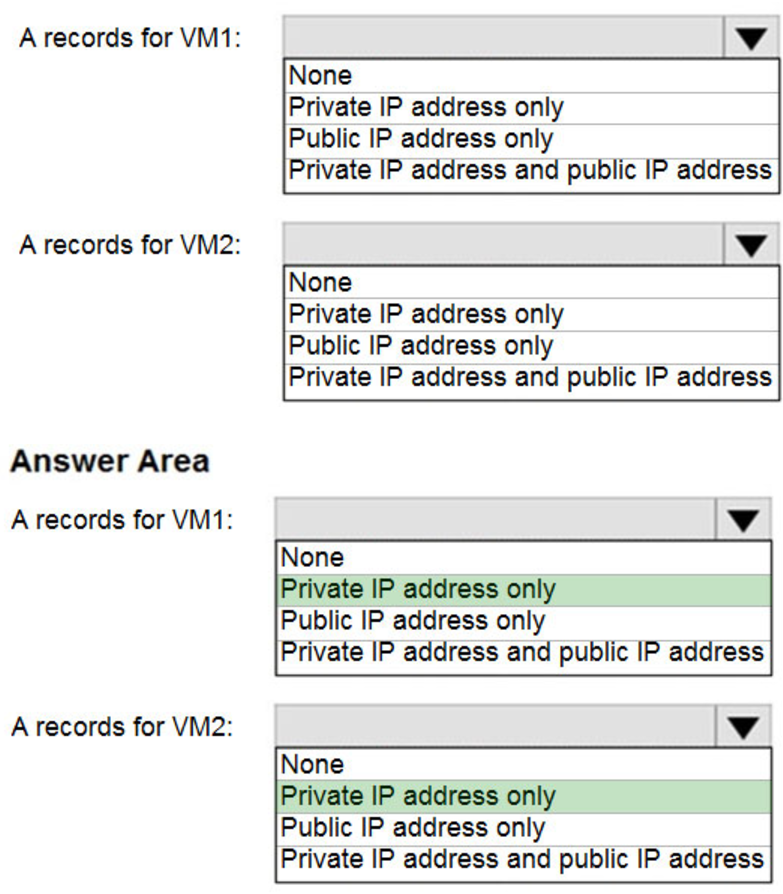
You have Azure virtual machines that run Windows Server 2019 and are configured as shown in the following table.

You create a private Azure DNS zone named adatum.com. You configure the adatum.com zone to allow auto registration from VNET1.
Which A records will be added to the adatum.com zone for each virtual machine? To answer, select the appropriate options in the answer area.
NOTE: Each correct selection is worth one point.
Hot Area:
You have an Azure subscription that contains the identities shown in the following table.
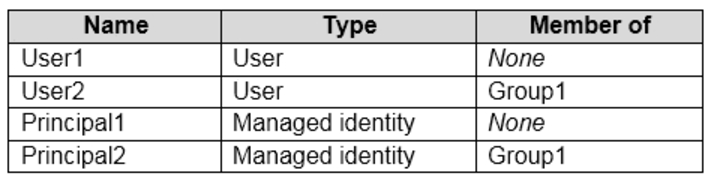
User1, Principal1, and Group1 are assigned the Monitoring Reader role.
An action group named AG1 has the Email Azure Resource Manager Role notification type and is configured to email the Monitoring Reader role.
You create an alert rule named Alert1 that uses AG1.
You need to identity who will receive an email notification when Alert1 is triggered.
Who should you identify?
- A. User1 and Principal1 only
- B. User1, User2, Principal1, and Principal2
- C. User1 only
- D. User1 and User2 only
You download an Azure Resource Manager template based on an existing virtual machine. The template will be used to deploy 100 virtual machines.
You need to modify the template to reference an administrative password. You must prevent the password from being stored in plain text.
What should you create to store the password?
- A. an Azure Key Vault and an access policy
- B. an Azure Storage account and an access policy
- C. a Recovery Services vault and a backup policy
- D. Azure Active Directory (AD) Identity Protection and an Azure policy