

Pass Microsoft AZ-104 in Just 3 Days – Stress-Free, No Study Needed!
Have questions? Contact us directly on WhatsApp for quick support!
DRAG DROP –
You have an on-premises file server named Server1 that runs Windows Server 2016.
You have an Azure subscription that contains an Azure file share.
You deploy an Azure File Sync Storage Sync Service, and you create a sync group.
You need to synchronize files from Server1 to Azure.
Which three actions should you perform in sequence? To answer, move the appropriate actions from the list of actions to the answer area and arrange them in the correct order.
Select and Place:
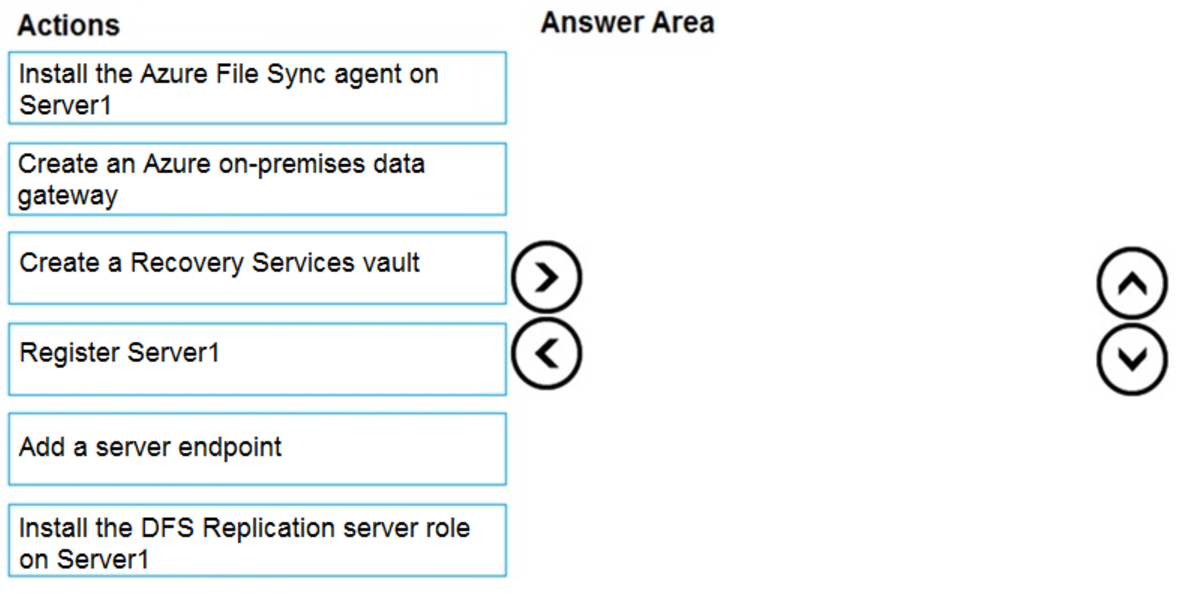
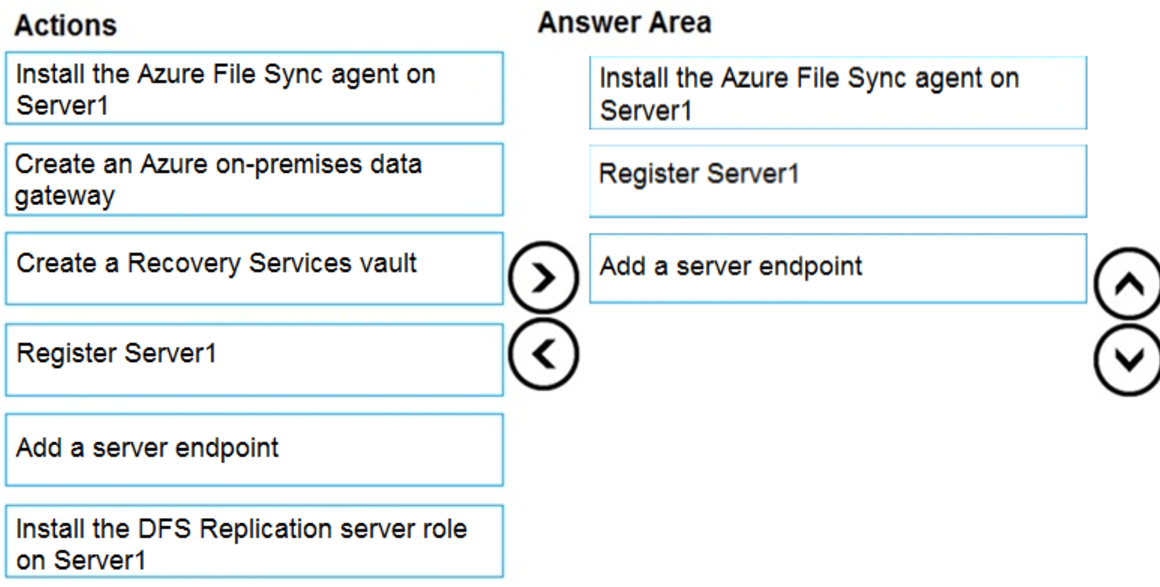
Step 1: Install the Azure File Sync agent on Server1
The Azure File Sync agent is a downloadable package that enables Windows Server to be synced with an Azure file share
Step 2: Register Server1.
Register Windows Server with Storage Sync Service
Registering your Windows Server with a Storage Sync Service establishes a trust relationship between your server (or cluster) and the Storage Sync Service.
Step 3: Add a server endpoint –
Create a sync group and a cloud endpoint.
A sync group defines the sync topology for a set of files. Endpoints within a sync group are kept in sync with each other. A sync group must contain one cloud endpoint, which represents an Azure file share and one or more server endpoints. A server endpoint represents a path on registered server.
Reference:
https://docs.microsoft.com/en-us/azure/storage/files/storage-sync-files-deployment-guide
Note: This question is part of a series of questions that present the same scenario. Each question in the series contains a unique solution that might meet the stated goals. Some question sets might have more than one correct solution, while others might not have a correct solution.
After you answer a question in this section, you will NOT be able to return to it. As a result, these questions will not appear in the review screen.
You have an Azure virtual machine named VM1. VM1 was deployed by using a custom Azure Resource Manager template named ARM1.json.
You receive a notification that VM1 will be affected by maintenance.
You need to move VM1 to a different host immediately.
Solution: From the Redeploy blade, you click Redeploy.
Does this meet the goal?
- A. Yes
- B. No
Note: This question is part of a series of questions that present the same scenario. Each question in the series contains a unique solution that might meet the stated goals. Some question sets might have more than one correct solution, while others might not have a correct solution.
After you answer a question in this section, you will NOT be able to return to it. As a result, these questions will not appear in the review screen.
You have an Azure subscription that contains the following resources:
– A virtual network that has a subnet named Subnet1
– Two network security groups (NSGs) named NSG-VM1 and NSG-Subnet1
– A virtual machine named VM1 that has the required Windows Server configurations to allow Remote Desktop connections
NSG-Subnet1 has the default inbound security rules only.
NSG-VM1 has the default inbound security rules and the following custom inbound security rule:
– Priority: 100
– Source: Any
– Source port range: *
– Destination: *
– Destination port range: 3389
– Protocol: UDP
– Action: Allow
VM1 has a public IP address and is connected to Subnet1. NSG-VM1 is associated to the network interface of VM1. NSG-Subnet1 is associated to Subnet1.
You need to be able to establish Remote Desktop connections from the internet to VM1.
Solution: You add an inbound security rule to NSG-Subnet1 that allows connections from the Any source to the *destination for port range 3389 and uses the TCP protocol. You remove NSG-VM1 from the network interface of VM1.
Does this meet the goal?
- A. Yes
- B. No
HOTSPOT –
You purchase a new Azure subscription named Subscription1.
You create a virtual machine named VM1 in Subscription1. VM1 is not protected by Azure Backup.
You need to protect VM1 by using Azure Backup. Backups must be created at 01:00 and stored for 30 days.
What should you do? To answer, select the appropriate options in the answer area.
NOTE: Each correct selection is worth one point.
Hot Area:
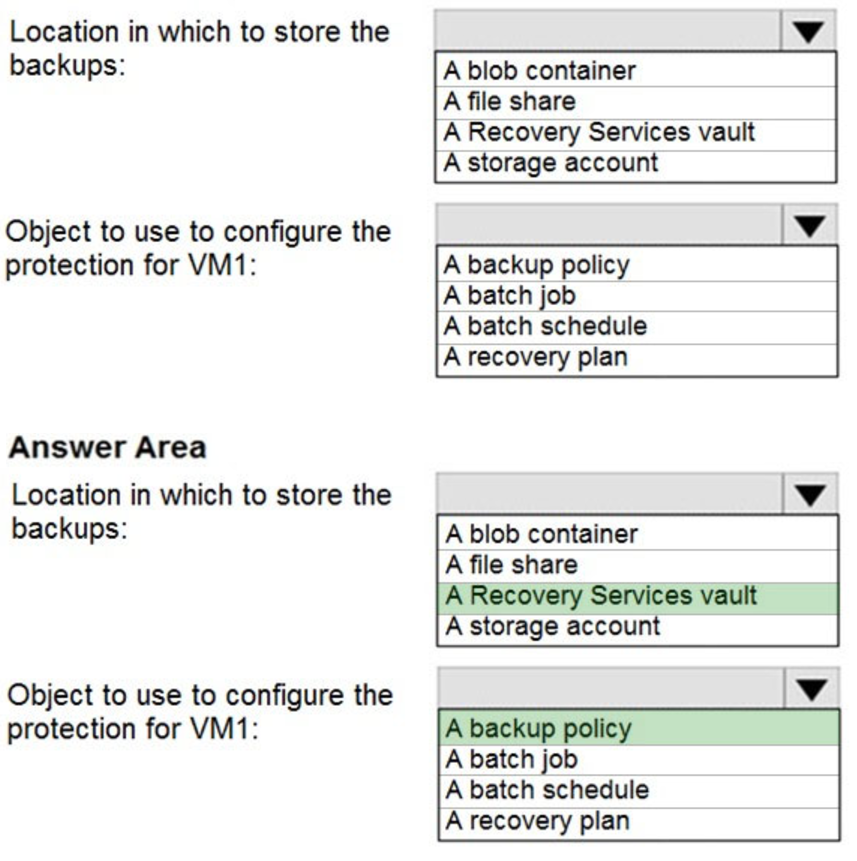
Box 1: A Recovery Services vault
You can set up a Recovery Services vault and configure backup for multiple Azure VMs.
Box 2: A backup policy –
In Choose backup policy, do one of the following:
– Leave the default policy. This backs up the VM once a day at the time specified, and retains backups in the vault for 30 days.
– Select an existing backup policy if you have one.
– Create a new policy, and define the policy settings.
Reference:
https://docs.microsoft.com/en-us/azure/backup/backup-azure-vms-first-look-arm
Note: This question is part of a series of questions that present the same scenario. Each question in the series contains a unique solution that might meet the stated goals. Some question sets might have more than one correct solution, while others might not have a correct solution.
After you answer a question in this section, you will NOT be able to return to it. As a result, these questions will not appear in the review screen.
You have an Azure virtual machine named VM1. VM1 was deployed by using a custom Azure Resource Manager template named ARM1.json.
You receive a notification that VM1 will be affected by maintenance.
You need to move VM1 to a different host immediately.
Solution: From the Update management blade, you click Enable.
Does this meet the goal?
- A. Yes
- B. No
You have an Azure subscription that contains 10 virtual machines and the resources shown in the following table.

You need to ensure that Bastion1 can support 100 concurrent SSH users. The solution must minimize administrative effort.
What should you do first?
- A. Resize the subnet of Bastion1
- B. Configure host scaling.
- C. Create a network security group (NSG)
- D. Upgrade Bastion1 to the Standard SKU
You have an Azure virtual machine named VM1.
Azure collects events from VM1.
You are creating an alert rule in Azure Monitor to notify an administrator when an error is logged in the System event log of VM1.
Which target resource should you monitor in the alert rule?
- A. virtual machine extension
- B. virtual machine
- C. metric alert
- D. Azure Log Analytics workspace
Your company has an Azure subscription.
You need to deploy a number of Azure virtual machines (VMs) using Azure Resource Manager (ARM) templates. You have been informed that the VMs will be included in a single availability set.
You are required to make sure that the ARM template you configure allows for as many VMs as possible to remain accessible in the event of fabric failure or maintenance.
Which of the following is the value that you should configure for the platformUpdateDomainCount property?
- A. 10
- B. 20
- C. 30
- D. 40
You plan to use the Azure Import/Export service to copy files to a storage account.
Which two files should you create before you prepare the drives for the import job? Each correct answer presents part of the solution.
NOTE: Each correct selection is worth one point.
- A. an XML manifest file
- B. a dataset CSV file
- C. a JSON configuration file
- D. a PowerShell PS1 file
- E. a driveset CSV file
You have an Azure subscription that contains a web app named webapp1.
You need to add a custom domain named www.contoso.com to webapp1.
What should you do first?
- A. Create a DNS record
- B. Add a connection string
- C. Upload a certificate.
- D. Stop webapp1.