
Pass Microsoft AZ-104 in Just 3 Days – Stress-Free, No Study Needed!
Have questions? Contact us directly on WhatsApp for quick support!
Note: This question is part of a series of questions that present the same scenario. Each question in the series contains a unique solution that might meet the stated goals. Some question sets might have more than one correct solution, while others might not have a correct solution.
After you answer a question in this section, you will NOT be able to return to it. As a result, these questions will not appear in the review screen.
You have an Azure subscription that contains the following resources:
– A virtual network that has a subnet named Subnet1
– Two network security groups (NSGs) named NSG-VM1 and NSG-Subnet1
– A virtual machine named VM1 that has the required Windows Server configurations to allow Remote Desktop connections
NSG-Subnet1 has the default inbound security rules only.
NSG-VM1 has the default inbound security rules and the following custom inbound security rule:
– Priority: 100
– Source: Any
– Source port range: *
– Destination: *
– Destination port range: 3389
– Protocol: UDP
– Action: Allow
VM1 has a public IP address and is connected to Subnet1. NSG-VM1 is associated to the network interface of VM1. NSG-Subnet1 is associated to Subnet1.
You need to be able to establish Remote Desktop connections from the internet to VM1.
Solution: You add an inbound security rule to NSG-Subnet1 and NSG-VM1 that allows connections from the internet source to the VirtualNetwork destination for port range 3389 and uses the TCP protocol.
Does this meet the goal?
- A. Yes
- B. No
You have an Azure subscription that contains 100 virtual machines.
You regularly create and delete virtual machines.
You need to identify unattached disks that can be deleted.
What should you do?
- A. From Azure Cost Management, view Cost Analysis
- B. From Azure Advisor, modify the Advisor configuration
- C. From Microsoft Azure Storage Explorer, view the Account Management properties
- D. From Azure Cost Management, view Advisor Recommendations
You have a Recovery Service vault that you use to test backups. The test backups contain two protected virtual machines.
You need to delete the Recovery Services vault.
What should you do first?
- A. From the Recovery Service vault, delete the backup data.
- B. Modify the disaster recovery properties of each virtual machine.
- C. Modify the locks of each virtual machine.
- D. From the Recovery Service vault, stop the backup of each backup item.
Note: This question is part of a series of questions that present the same scenario. Each question in the series contains a unique solution that might meet the stated goals. Some question sets might have more than one correct solution, while others might not have a correct solution.
After you answer a question in this section, you will NOT be able to return to it. As a result, these questions will not appear in the review screen.
You have an Azure subscription that contains the resources shown in the following table.
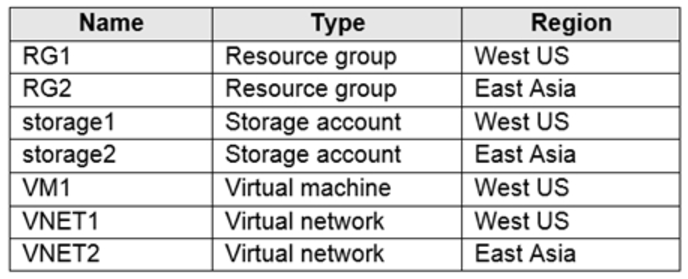
VM1 connects to VNET1.
You need to connect VM1 to VNET2.
Solution: You move VM1 to RG2, and then you add a new network interface to VM1.
Does this meet the goal?
- A. Yes
- B. No
HOTSPOT –
You have a virtual network named VNet1 that has the configuration shown in the following exhibit.
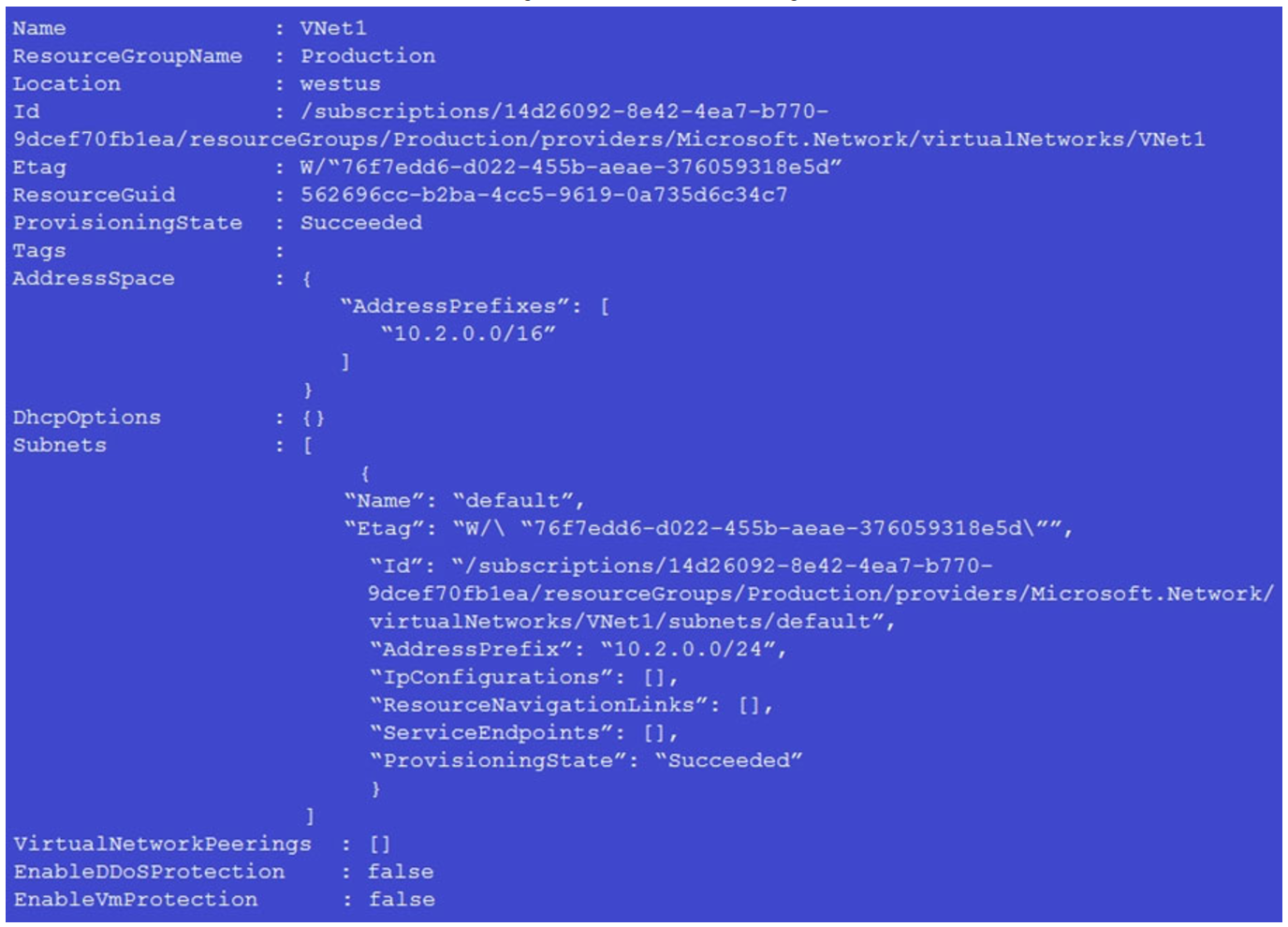
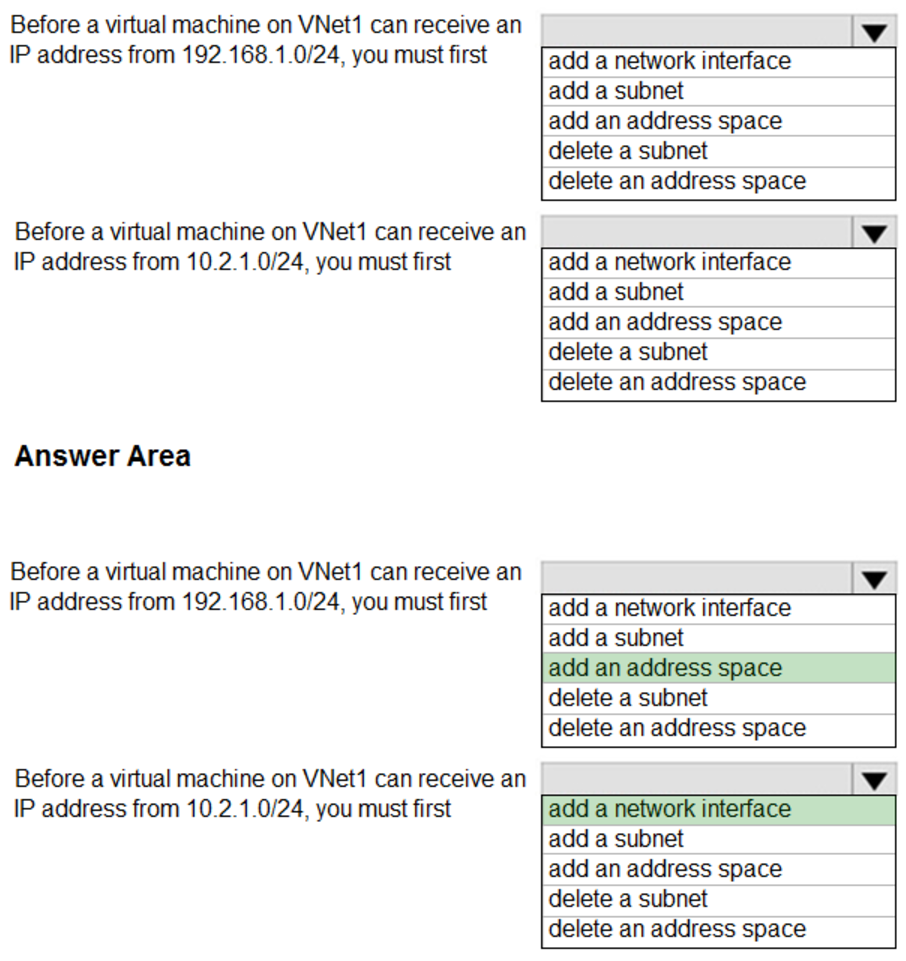
Use the drop-down menus to select the answer choice that completes each statement based on the information presented in the graphic.
NOTE: Each correct selection is worth one point.
Hot Area:
You have an Azure web app named webapp1.
Users report that they often experience HTTP 500 errors when they connect to webapp1.
You need to provide the developers of webapp1 with real-time access to the connection errors. The solution must provide all the connection error details.
What should you do first?
- A. From webapp1, enable Web server logging
- B. From Azure Monitor, create a workbook
- C. From Azure Monitor, create a Service Health alert
- D. From webapp1, turn on Application Logging
HOTSPOT –
You have an Azure subscription named Subscription1 that contains the resources shown in the following table.
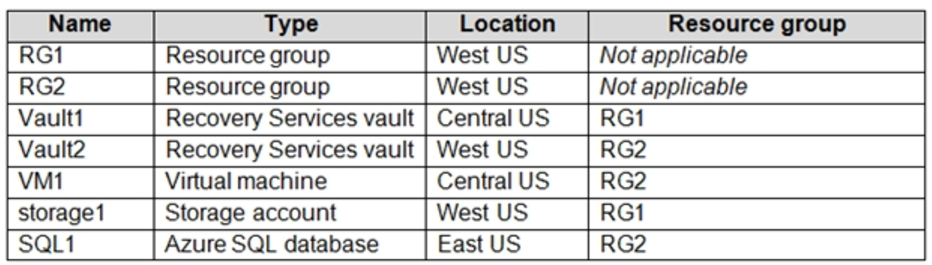
In storage1, you create a blob container named blob1 and a file share named share1.
Which resources can be backed up to Vault1 and Vault2? To answer, select the appropriate options in the answer area.
NOTE: Each correct selection is worth one point.
Hot Area:
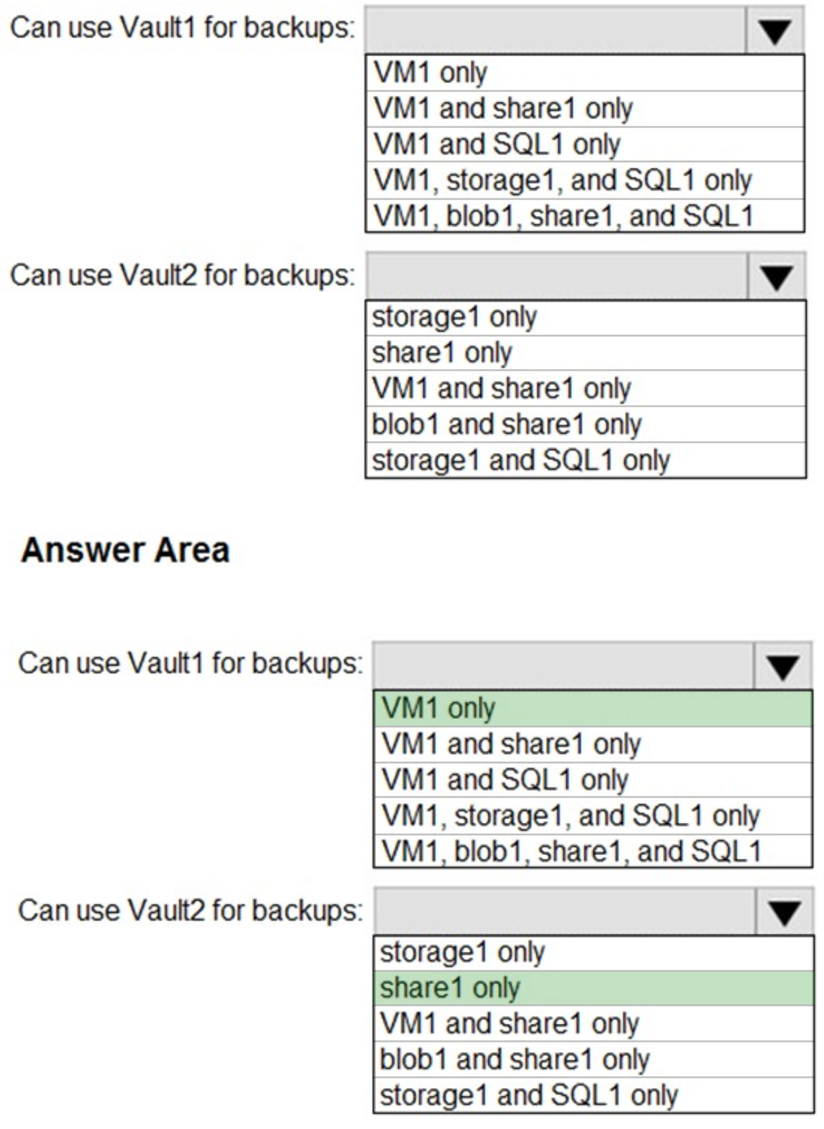
Box 1: VM1 only –
VM1 is in the same region as Vault1.
File1 is not in the same region as Vautl1.
SQL is not in the same region as Vault1.
Blobs cannot be backup up to service vaults.
Note: To create a vault to protect virtual machines, the vault must be in the same region as the virtual machines.
Box 2: Share1 only.
Storage1 is in the same region (West USA) as Vault2. Share1 is in Storage1.
Note: After you select Backup, the Backup pane opens and prompts you to select a storage account from a list of discovered supported storage accounts. They’re either associated with this vault or present in the same region as the vault, but not yet associated to any Recovery Services vault.
Reference:
https://docs.microsoft.com/bs-cyrl-ba/azure/backup/backup-create-rs-vault https://docs.microsoft.com/en-us/azure/backup/backup-afs
Note: This question is part of a series of questions that present the same scenario. Each question in the series contains a unique solution that might meet the stated goals. Some question sets might have more than one correct solution, while others might not have a correct solution.
After you answer a question in this section, you will NOT be able to return to it. As a result, these questions will not appear in the review screen.
You have an Azure subscription that contains the resources shown in the following table.
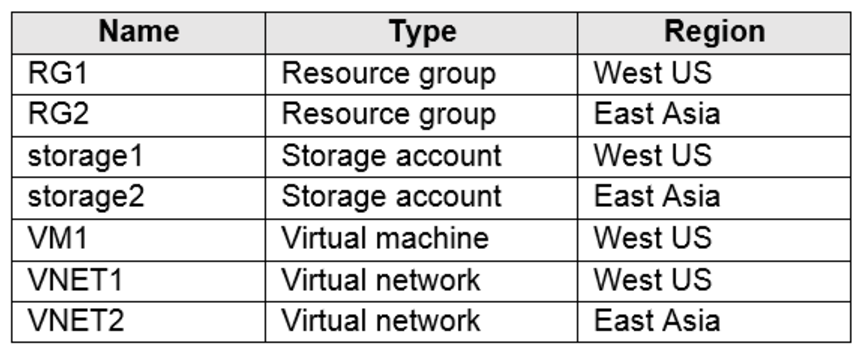
VM1 connects to VNET1.
You need to connect VM1 to VNET2.
Solution: You delete VM1. You recreate VM1, and then you create a new network interface for VM1 and connect it to VNET2.
Does this meet the goal?
- A. Yes
- B. No
You have an Azure subscription that contains a virtual network named VNET1. VNET1 contains the subnets shown in the following table.
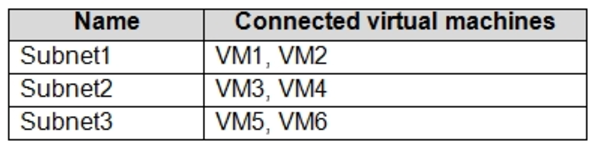
Each virtual machine uses a static IP address.
You need to create network security groups (NSGs) to meet following requirements:
– Allow web requests from the internet to VM3, VM4, VM5, and VM6.
– Allow all connections between VM1 and VM2.
– Allow Remote Desktop connections to VM1.
– Prevent all other network traffic to VNET1.
What is the minimum number of NSGs you should create?
- A. 1
- B. 3
- C. 4
- D. 12
You have an Azure web app named App1.
You need to monitor the availability of App1 by using a multi-step web test.
What should you use in Azure Monitor?
- A. Azure Service Health
- B. Azure Application Insights
- C. the Diagnostic settings
- D. metrics