
Pass Microsoft AZ-104 in Just 3 Days – Stress-Free, No Study Needed!
Have questions? Contact us directly on WhatsApp for quick support!
You have a general-purpose v1 Azure Storage account named storage1 that uses locally-redundant storage (LRS).
You need to ensure that the data in the storage account is protected if a zone fails. The solution must minimize costs and administrative effort.
What should you do first?
- A. Create a new storage account.
- B. Configure object replication rules.
- C. Upgrade the account to general-purpose v2.
- D. Modify the Replication setting of storage1.
Note: This question is part of a series of questions that present the same scenario. Each question in the series contains a unique solution that might meet the stated goals. Some question sets might have more than one correct solution, while others might not have a correct solution.
After you answer a question in this section, you will NOT be able to return to it. As a result, these questions will not appear in the review screen.
You have an Azure subscription that contains the resources shown in the following table.
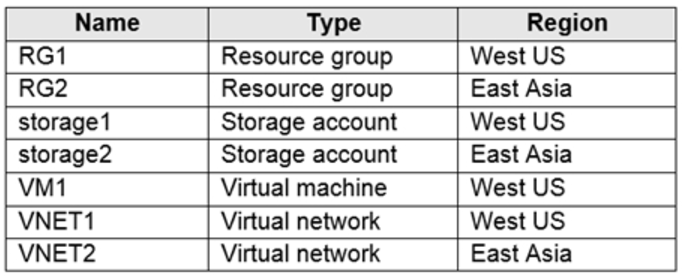
VM1 connects to VNET1.
You need to connect VM1 to VNET2.
Solution: You create a new network interface, and then you add the network interface to VM1.
Does this meet the goal?
- A. Yes
- B. No
Note: This question is part of a series of questions that present the same scenario. Each question in the series contains a unique solution that might meet the stated goals. Some question sets might have more than one correct solution, while others might not have a correct solution.
After you answer a question in this section, you will NOT be able to return to it. As a result, these questions will not appear in the review screen.
You have an Azure subscription that contains 10 virtual networks. The virtual networks are hosted in separate resource groups.
Another administrator plans to create several network security groups (NSGs) in the subscription.
You need to ensure that when an NSG is created, it automatically blocks TCP port 8080 between the virtual networks.
Solution: You create a resource lock, and then you assign the lock to the subscription.
Does this meet the goal?
- A. Yes
- B. No
You have an Azure subscription that contains the storage accounts shown in the following table.
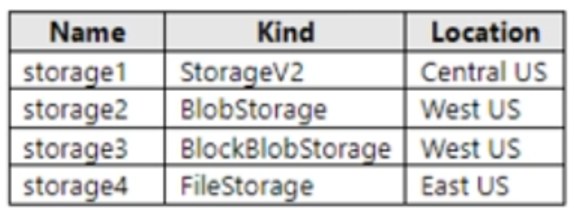
You deploy a web app named App1 to the West US Azure region.
You need to back up App1. The solution must minimize costs.
Which storage account should you use as the target for the backup?
- A. storage1
- B. storage2
- C. storage3
- D. storage4
You have an Azure subscription that contains the storage accounts shown in the following table.
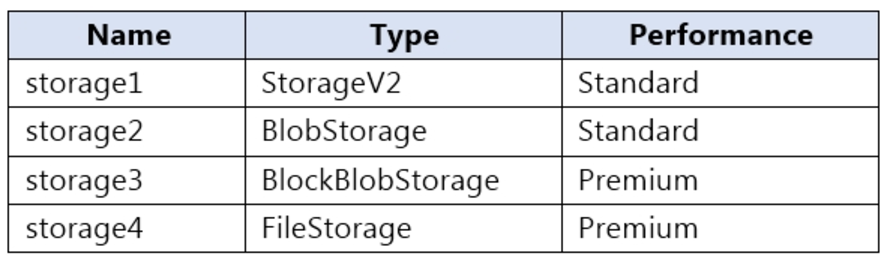
You plan to manage the data stored in the accounts by using lifecycle management rules.
To which storage accounts can you apply lifecycle management rules?
- A. storage1 only
- B. storage1 and storage2 only
- C. storage3 and storage4 only
- D. storage1, storage2, and storage3 only
- E. storage1, storage2, storage3, and storage4
You have an Azure Active Directory (Azure AD) tenant named adatum.com that contains the users shown in the following table.
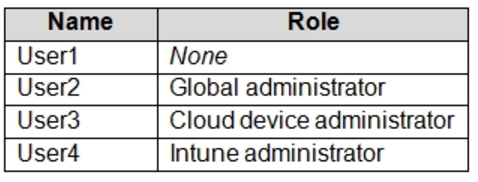
Adatum.com has the following configurations:
– Users may join devices to Azure AD is set to User1.
– Additional local administrators on Azure AD joined devices is set to None.
You deploy Windows 10 to a computer named Computer1. User1 joins Computer1 to adatum.com.
You need to identify the local Administrator group membership on Computer1.
Which users are members of the local Administrators group?
- A. User1 only
- B. User2 only
- C. User1 and User2 only
- D. User1, User2, and User3 only
- E. User1, User2, User3, and User4
You have an Azure subscription that is linked to an Azure AD tenant. The tenant contains two users named User1 and User2.
The subscription contains the resources shown in the following table.

The subscription contains the alert rules shown in the following table.

The users perform the following action:
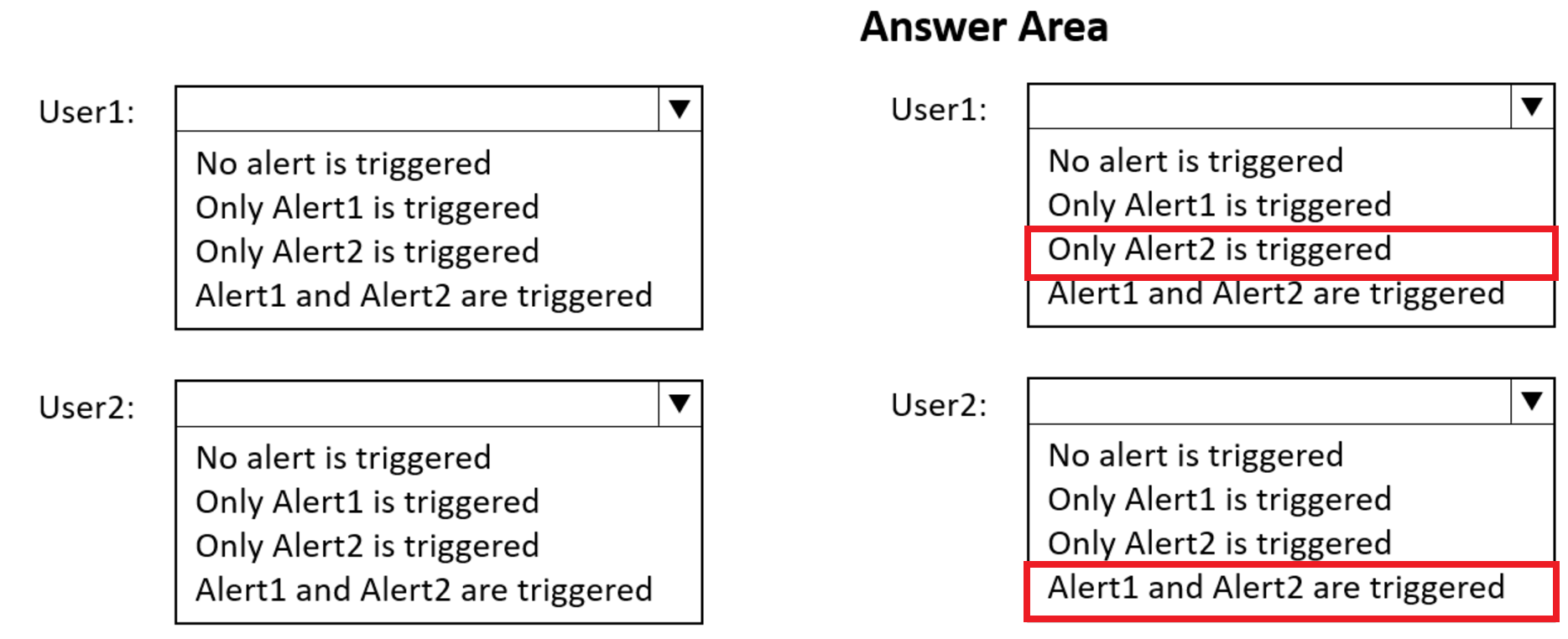
• User1 creates a new virtual disk and attaches the disk to VM1
• User2 creates a new resource tag and assigns the tag to RG1 and VM1
Which alert rules are triggered by each user? To answer, select the appropriate options in the answer area.
NOTE: Each correct selection is worth one point.
You create an Azure Storage account named contosostorage.
You plan to create a file share named data.
Users need to map a drive to the data file share from home computers that run Windows 10.
Which outbound port should you open between the home computers and the data file share?
- A. 80
- B. 443
- C. 445
- D. 3389
HOTSPOT –
You have Azure subscriptions named Subscription1 and Subscription2.
Subscription1 has following resource groups:
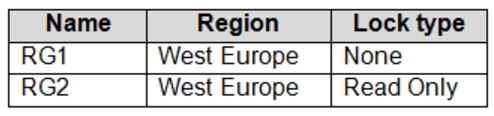
RG1 includes a web app named App1 in the West Europe location.
Subscription2 contains the following resource groups:
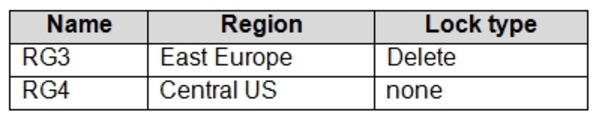
For each of the following statements, select Yes if the statement is true. Otherwise, select No.
NOTE: Each correct selection is worth one point.
Hot Area:
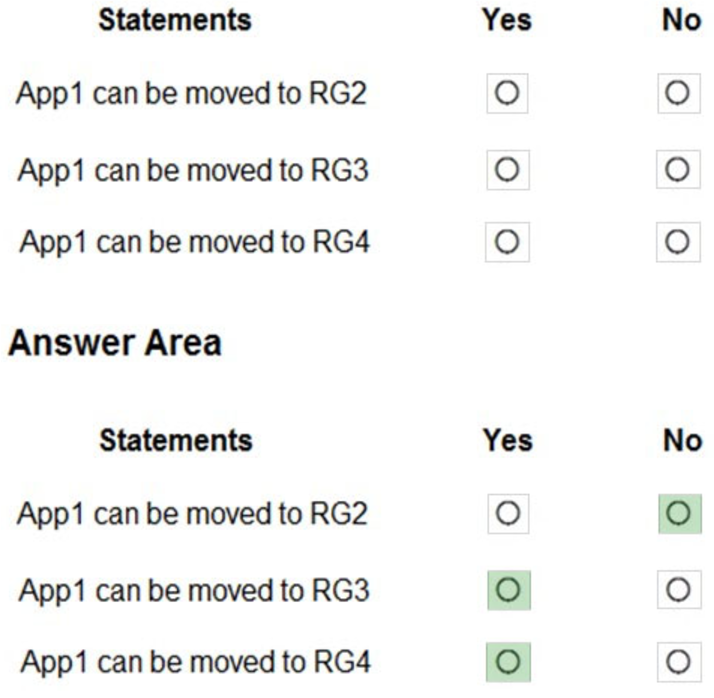
Box 1: No –
RG2 is read only. ReadOnly means authorized users can read a resource, but they cannot delete or update the resource.
Box 2: Yes –
Box 3: Yes –
Note:
App Service resources are region-specific and cannot be moved directly across regions. You can move the App Service resource by creating a copy of your existing App Service resource in the target region, then move your content over to the new app. You can then delete the source app and App Service plan.
To make copying your app easier, you can clone an individual App Service app into an App Service plan in another region.
Reference:
https://docs.microsoft.com/en-us/azure/app-service/manage-move-across-regions https://docs.microsoft.com/en-us/azure/azure-resource-manager/management/move-limitations/app-service-move-limitations
You have the Azure virtual machines shown in the following table.
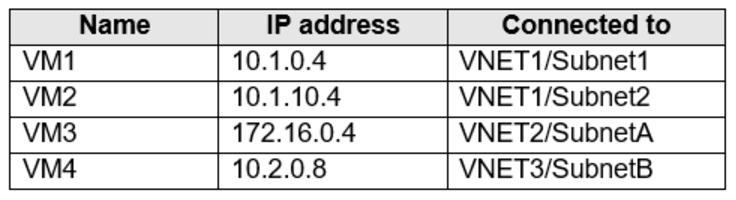
A DNS service is installed on VM1.
You configure the DNS servers settings for each virtual network as shown in the following exhibit.
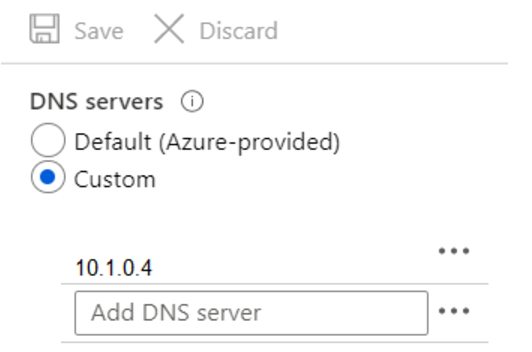
You need to ensure that all the virtual machines can resolve DNS names by using the DNS service on VM1.
What should you do?
- A. Configure a conditional forwarder on VM1
- B. Add service endpoints on VNET1
- C. Add service endpoints on VNET2 and VNET3
- D. Configure peering between VNET1, VNET2, and VNET3