
Pass Microsoft AZ-104 in Just 3 Days – Stress-Free, No Study Needed!
Have questions? Contact us directly on WhatsApp for quick support!
You have an Azure subscription that contains the resources shown in the following table.
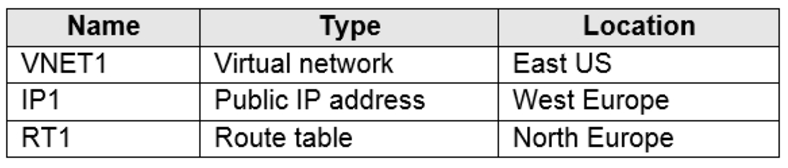
You need to create a network interface named NIC1.
In which location can you create NIC1?
- A. East US and North Europe only
- B. East US only
- C. East US, West Europe, and North Europe
- D. East US and West Europe only
You have an Azure subscription that contains a virtual network named VNet1.
VNet1 uses two ExpressRoute circuits that connect to two separate on-premises datacenters.
You need to create a dashboard to display detailed metrics and a visual representation of the network topology.
What should you use?
- A. Azure Monitor Network Insights
- B. a Data Collection Rule (DCR)
- C. Azure Virtual Network Watcher
- D. Log Analytics
HOTSPOT –
You have the Azure resources shown on the following exhibit.
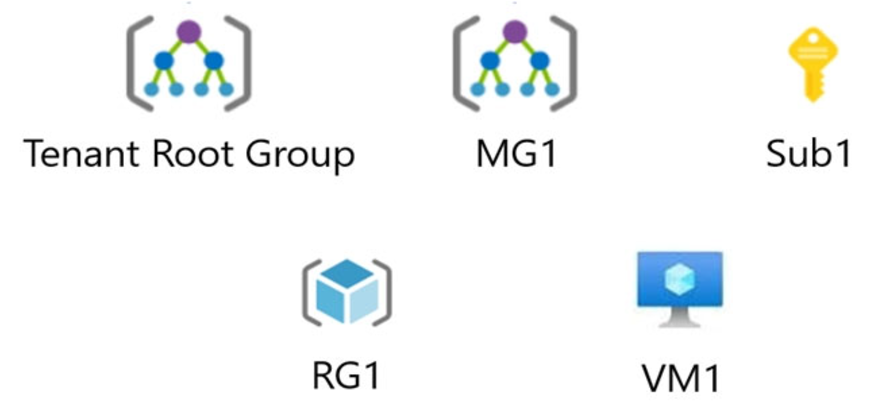
You plan to track resource usage and prevent the deletion of resources.
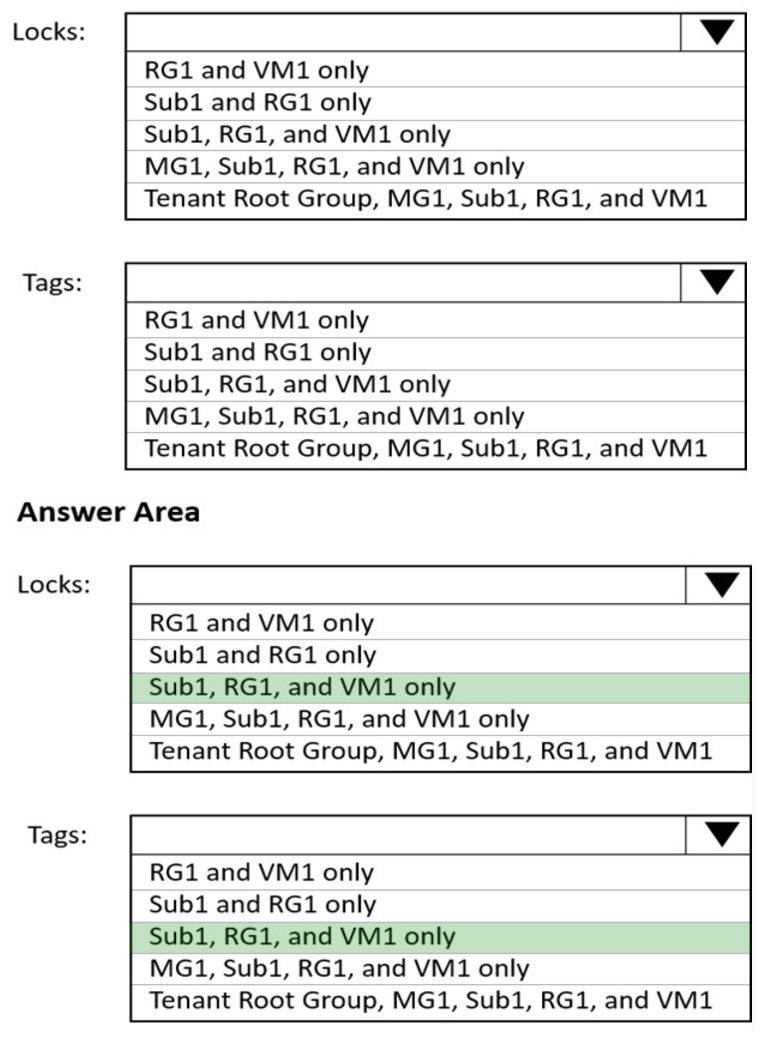
To which resources can you apply locks and tags? To answer, select the appropriate options in the answer area.
NOTE: Each correct selection is worth one point.
Hot Area:
You have an Azure subscription.
In the Azure portal, you plan to create a storage account named storage1 that will have the following settings:
– Performance: Standard
– Replication: Zone-redundant storage (ZRS)
– Access tier (default): Cool
– Hierarchical namespace: Disabled
You need to ensure that you can set Account kind for storage1 to BlockBlobStorage.
Which setting should you modify first?
- A. Performance
- B. Replication
- C. Access tier (default)
- D. Hierarchical namespace
Note: This question is part of a series of questions that present the same scenario. Each question in the series contains a unique solution that might meet the stated goals. Some question sets might have more than one correct solution, while others might not have a correct solution.
After you answer a question in this section, you will NOT be able to return to it. As a result, these questions will not appear in the review screen.
You have an Azure subscription named Subscription1. Subscription1 contains a resource group named RG1. RG1 contains resources that were deployed by using templates.
You need to view the date and time when the resources were created in RG1.
Solution: From the RG1 blade, you click Deployments.
Does this meet the goal?
- A. Yes
- B. No
You have Azure virtual machines that run Windows Server 2019 and are configured as shown in the following table.
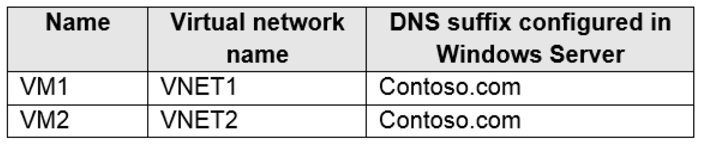
You create a public Azure DNS zone named adatum.com and a private Azure DNS zone named contoso.com.
For controso.com, you create a virtual network link named link1 as shown in the exhibit. (Click the Exhibit tab.)
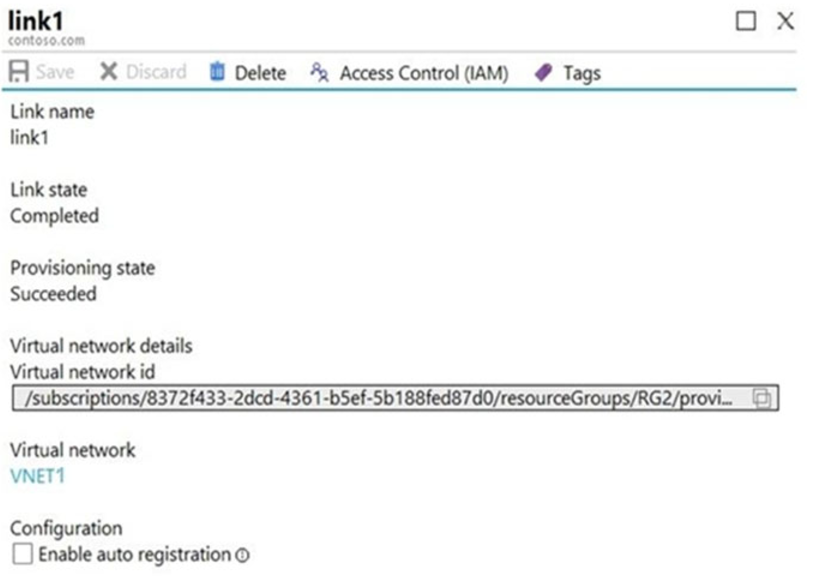
You discover that VM1 can resolve names in contoso.com but cannot resolve names in adatum.com. VM1 can resolve other hosts on the Internet.
You need to ensure that VM1 can resolve host names in adatum.com.
What should you do?
- A. Update the DNS suffix on VM1 to be adatum.com
- B. Configure the name servers for adatum.com at the domain registrar
- C. Create an SRV record in the contoso.com zone
- D. Modify the Access control (IAM) settings for link1
You deploy Azure virtual machines to three Azure regions
Each region contains a virtual network. Each virtual network contains multiple subnets peered in a full mesh topology.
Each subnet contains a network security group (NSG) that has defined rules.
A user reports that he cannot use port 33000 to connect from a virtual machine in one region to a virtual machine in another region.
Which two options can you use to diagnose the issue? Each correct answer presents a complete solution.
NOTE: Each correct selection is worth one point.
- A. Azure Virtual Network Manager
- B. IP flow verify
- C. Azure Monitor Network Insights
- D. Connection troubleshoot
- E. elective security rules
DRAG DROP –
You have an Azure subscription that contains the storage accounts shown in the following table.
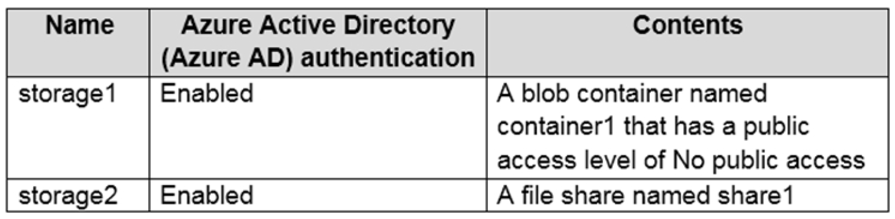
You plan to use AzCopy to copy a blob from container1 directly to share1.
You need to identify which authentication method to use when you use AzCopy.
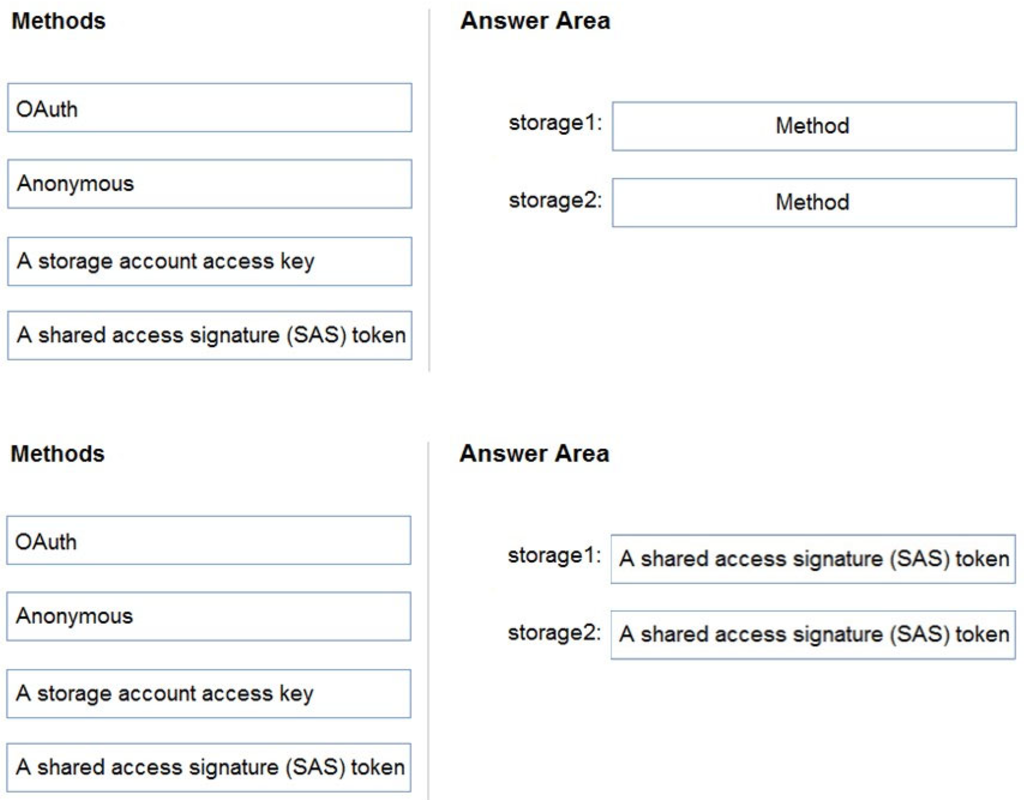
What should you identify for each account? To answer, drag the appropriate authentication methods to the correct accounts. Each method may be used once, more than once, or not at all. You may need to drag the split bar between panes or scroll to view content.
NOTE: Each correct selection is worth one point.
Select and Place:
You have an Azure subscription named Subscription1.
You deploy a Linux virtual machine named VM1 to Subscription1.
You need to monitor the metrics and the logs of VM1.
What should you use?
- A. Azure HDInsight
- B. Linux Diagnostic Extension (LAD) 3.0
- C. the Azure Performance Diagnostics extension
- D. Azure Analysis Services
HOTSPOT –
You plan to use Azure Network Watcher to perform the following tasks:
– Task1: Identify a security rule that prevents a network packet from reaching an Azure virtual machine.
– Task2: Validate outbound connectivity from an Azure virtual machine to an external host.
Which feature should you use for each task? To answer, select the appropriate options in the answer area.
NOTE: Each correct selection is worth one point.
Hot Area:
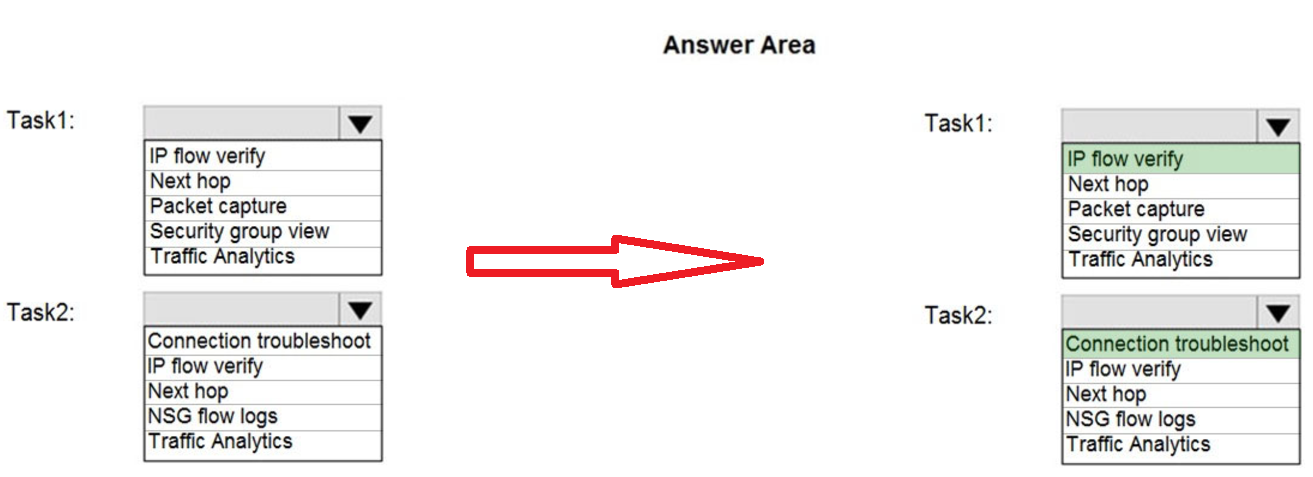
Box 1: IP flow verify –
At some point, a VM may become unable to communicate with other resources, because of a security rule. The IP flow verify capability enables you to specify a source and destination IPv4 address, port, protocol (TCP or UDP), and traffic direction (inbound or outbound). IP flow verify then tests the communication and informs you if the connection succeeds or fails. If the connection fails, IP flow verify tells you which.
Box 2: Connection troubleshoot –
Diagnose outbound connections from a VM: The connection troubleshoot capability enables you to test a connection between a VM and another VM, an FQDN, a
URI, or an IPv4 address. The test returns similar information returned when using the connection monitor capability, but tests the connection at a point in time, rather than monitoring it over time, as connection monitor does. Learn more about how to troubleshoot connections using connection-troubleshoot.
Reference:
https://docs.microsoft.com/en-us/azure/network-watcher/network-watcher-monitoring-overview