

Pass Microsoft AZ-104 in Just 3 Days – Stress-Free, No Study Needed!
Have questions? Contact us directly on WhatsApp for quick support!
You have an Azure subscription that contains multiple virtual machines in the West US Azure region.
You need to use Traffic Analytics in Azure Network Watcher to monitor virtual machine traffic.
Which two resources should you create? Each correct answer presents part of the solution.
NOTE: Each correct selection is worth one point.
- A. a Log Analytics workspace
- B. an Azure Monitor workbook
- C. a storage account
- D. a Microsoft Sentinel workspace
- E. a Data Collection Rule (DCR) in Azure Monitor
You have an Azure subscription. The subscription contains a storage account named storage1 that has the lifecycle management rules shown in the following table.
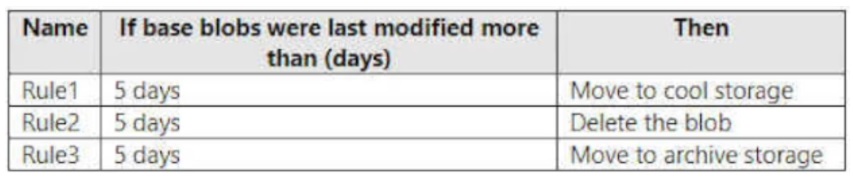
On June 1, you store a blob named File1 in the Hot access tier of storage1.
What is the state of File1 on June 7?
- A. stored in the Cool access tier
- B. stored in the Archive access tier
- C. stored in the Hot access tier
- D. deleted
You have an Azure subscription.
You plan to deploy an Azure Kubernetes Service (AKS) cluster to support an app named App1. On-premises clients connect to App1 by using the IP address of the pod.
For the AKS cluster, you need to choose a network type that will support App1.
What should you choose?
- A. kubenet
- B. Azure Container Networking Interface (CNI)
- C. Hybrid Connection endpoints
- D. Azure Private Link
HOTSPOT
–
Case study
–
This is a case study. Case studies are not timed separately. You can use as much exam time as you would like to complete each case. However, there may be additional case studies and sections on this exam. You must manage your time to ensure that you are able to complete all questions included on this exam in the time provided.
To answer the questions included in a case study, you will need to reference information that is provided in the case study. Case studies might contain exhibits and other resources that provide more information about the scenario that is described in the case study. Each question is independent of the other questions in this case study.
At the end of this case study, a review screen will appear. This screen allows you to review your answers and to make changes before you move to the next section of the exam. After you begin a new section, you cannot return to this section.
To start the case study
–
To display the first question in this case study, click the Next button. Use the buttons in the left pane to explore the content of the case study before you answer the questions. Clicking these buttons displays information such as business requirements, existing environment, and problem statements. If the case study has an All Information tab, note that the information displayed is identical to the information displayed on the subsequent tabs. When you are ready to answer a question, click the Question button to return to the question.
Overview
–
ADatum Corporation is consulting firm that has a main office in Montreal and branch offices in Seattle and New York.
Existing Environment
–
Azure Environment
–
ADatum has an Azure subscription that contains three resource groups named RG1, RG2, and RG3.
The subscription contains the storage accounts shown in the following table.

The subscription contains the virtual machines shown in the following table.

The subscription has an Azure container registry that contains the images shown in the following table.

The subscription contains the resources shown in the following table.

Azure Key Vault
–
The subscription contains an Azure key vault named Vault1.
Vault1 contains the certificates shown in the following table.
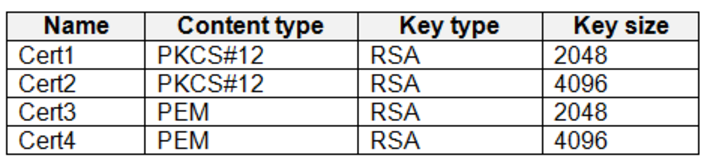
Vault1 contains the keys shown in the following table.

Microsoft Entra Environment
–
ADatum has a Microsoft Entra tenant named adatum.com that is linked to the Azure subscription and contains the users shown in the following table.

The tenant contains the groups shown in the following table.
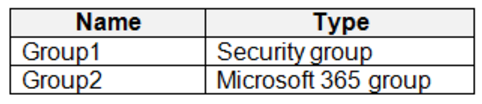
The adatum.com tenant has a custom security attribute named Attribute1.
Planned Changes
–
ADatum plans to implement the following changes:
• Configure a data collection rule (DCR) named DCR1 to collect only system events that have an event ID of 4648 from VM2 and VM4.
• In storage1, create a new container named cont2 that has the following access policies:
o Three stored access policies named Stored1, Stored2, and Stored3
o A legal hold for immutable blob storage
• Whenever possible, use directories to organize storage account content.
• Grant User1 the permissions required to link Zone1 to VNet1.
• Assign Attribute1 to supported adatum.com resources.
• In storage2, create an encryption scope named Scope1.
• Deploy new containers by using Image1 or Image2.
Technical Requirements
–
ADatum must meet the following technical requirements:
• Use TLS for WebApp1.
• Follow the principle of least privilege.
• Grant permissions at the required scope only.
• Ensure that Scope1 is used to encrypt storage services.
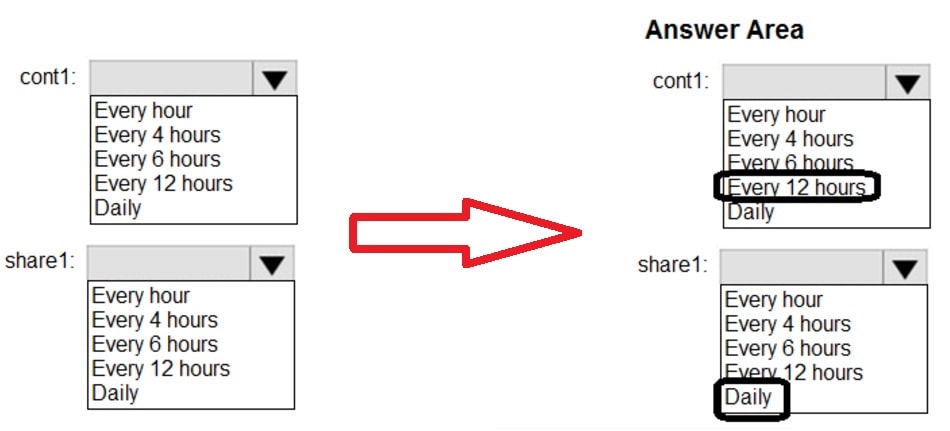
• Use Azure Backup to back up cont1 and share1 as frequently as possible.
• Whenever possible, use Azure Disk Encryption and a key encryption key (KEK) to encrypt the virtual machines.
You need to configure Azure Backup to meet the technical requirements for cont1 and share1.
To what should you set the backup frequency for each resource? To answer, select the appropriate options in the answer area.
NOTE: Each correct selection is worth one point.
HOTSPOT
–
You have an Azure subscription that contains the storage accounts shown in the following table.

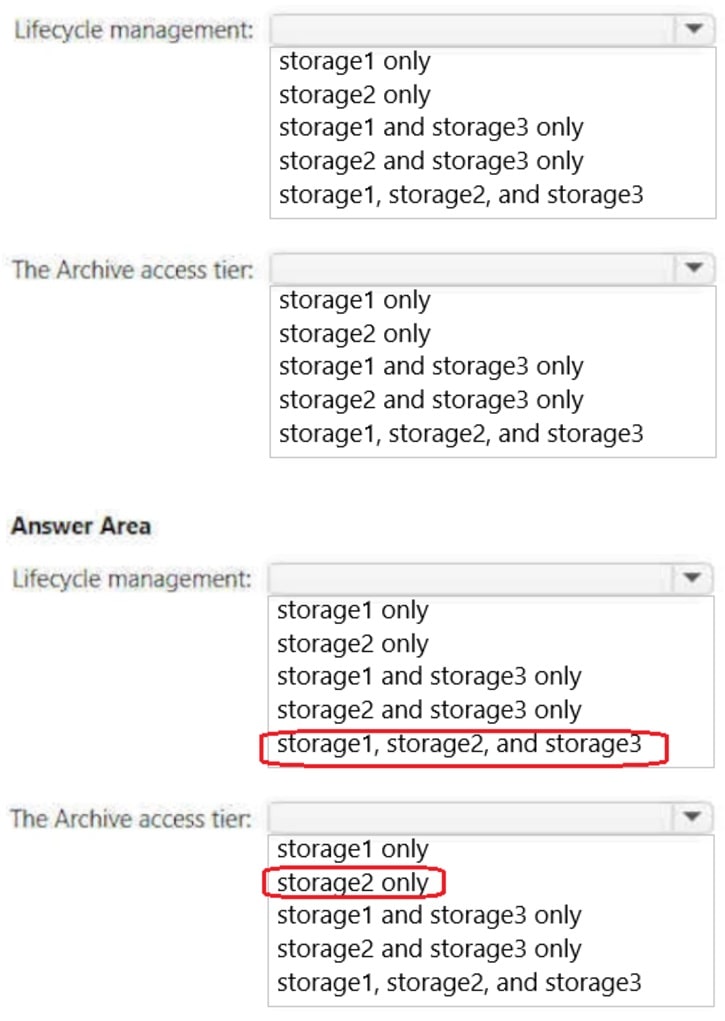
You need to identify which storage accounts support lifecycle management, and which storage accounts support moving data to the Archive access tier.
Which storage accounts should you use? To answer, select the appropriate options in the answer area.
NOTE: Each correct selection is worth one point.
Note: This question is part of a series of questions that present the same scenario. Each question in the series contains a unique solution that might meet the stated goals. Some question sets might have more than one correct solution, while others might not have a correct solution.
After you answer a question in this section, you will NOT be able to return to it. As a result, these questions will not appear in the review screen.
You have an Azure virtual machine named VM1. VM1 was deployed by using a custom Azure Resource Manager template named ARM1.json.
You receive a notification that VM1 will be affected by maintenance.
You need to move VM1 to a different host immediately.
Solution: From the Overview blade, you move the virtual machine to a different resource group.
Does this meet the goal?
- A. Yes
- B. No
Note: This question is part of a series of questions that present the same scenario. Each question in the series contains a unique solution that might meet the stated goals. Some question sets might have more than one correct solution, while others might not have a correct solution.
After you answer a question in this section, you will NOT be able to return to it. As a result, these questions will not appear in the review screen.
You have an Azure subscription that contains the virtual machines shown in the following table.

You deploy a load balancer that has the following configurations:
– Name: LB1
– Type: Internal
– SKU: Standard
– Virtual network: VNET1
You need to ensure that you can add VM1 and VM2 to the backend pool of LB1.
Solution: You disassociate the public IP address from the network interface of VM2.
Does this meet the goal?
- A. Yes
- B. No
You have an Azure subscription named Subscription1.
You have 5 TB of data that you need to transfer to Subscription1.
You plan to use an Azure Import/Export job.
What can you use as the destination of the imported data?
- A. an Azure Cosmos DB database
- B. Azure Data Lake Store
- C. Azure Blob storage
- D. Azure Data Factory
HOTSPOT –
You have an Azure subscription.
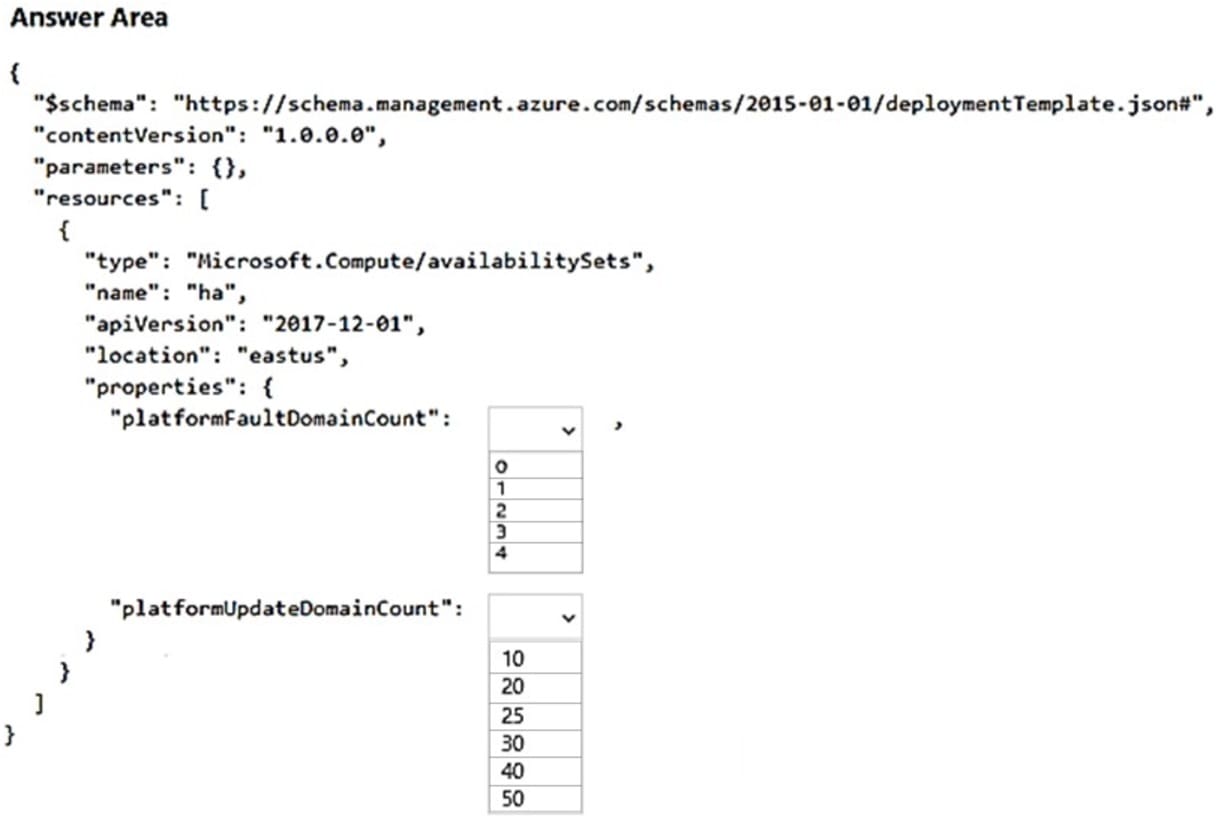
You plan to use Azure Resource Manager templates to deploy 50 Azure virtual machines that will be part of the same availability set.
You need to ensure that as many virtual machines as possible are available if the fabric fails or during servicing.
How should you configure the template? To answer, select the appropriate options in the answer area.
NOTE: Each correct selection is worth one point.
Hot Area:
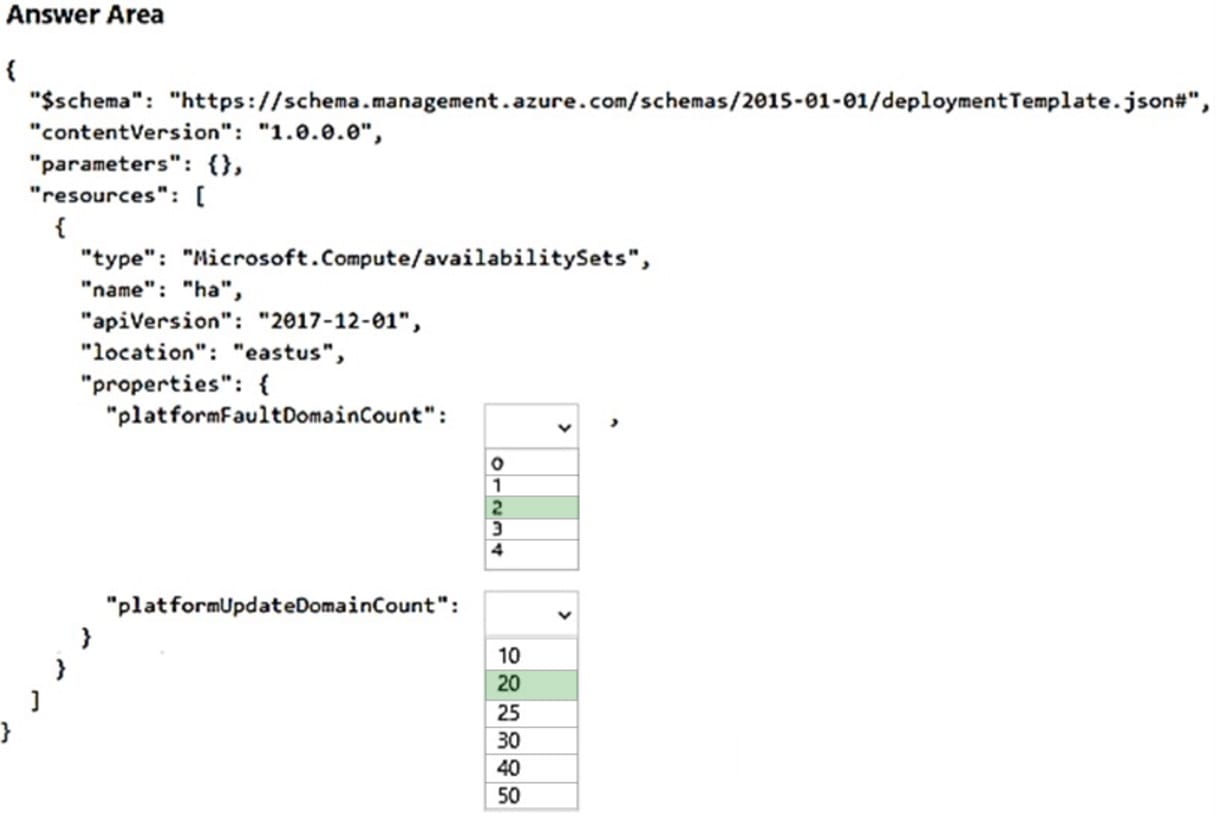
Box 1: 2 –
Use two fault domains.
2 or 3 is max, depending on which region you are in.
Box 2: 20 –
Use 20 for platformUpdateDomainCount
Increasing the update domain (platformUpdateDomainCount) helps with capacity and availability planning when the platform reboots nodes. A higher number for the pool (20 is max) means that fewer of their nodes in any given availability set would be rebooted at once.
Reference:
https://www.itprotoday.com/microsoft-azure/check-if-azure-region-supports-2-or-3-fault-domains-managed-disks https://github.com/Azure/acs-engine/issues/1030
Note: This question is part of a series of questions that present the same scenario. Each question in the series contains a unique solution that might meet the stated goals. Some question sets might have more than one correct solution, while others might not have a correct solution.
After you answer a question in this section, you will NOT be able to return to it. As a result, these questions will not appear in the review screen.
You have an Azure subscription that contains 10 virtual networks. The virtual networks are hosted in separate resource groups.
Another administrator plans to create several network security groups (NSGs) in the subscription.
You need to ensure that when an NSG is created, it automatically blocks TCP port 8080 between the virtual networks.
Solution: You configure a custom policy definition, and then you assign the policy to the subscription.
Does this meet the goal?
- A. Yes
- B. No