Pass Microsoft AZ-104 in Just 3 Days – Stress-Free, No Study Needed!
Have questions? Contact us directly on WhatsApp for quick support!
HOTSPOT
–
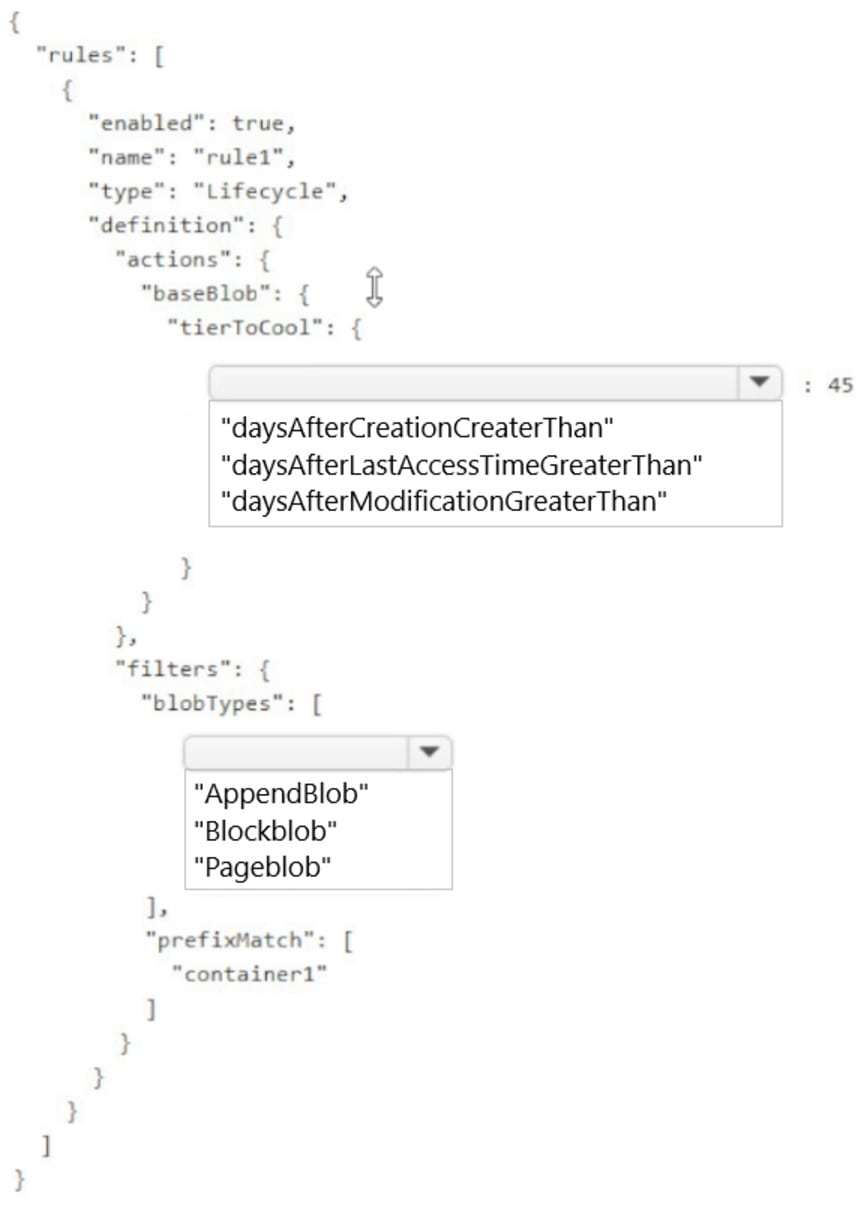
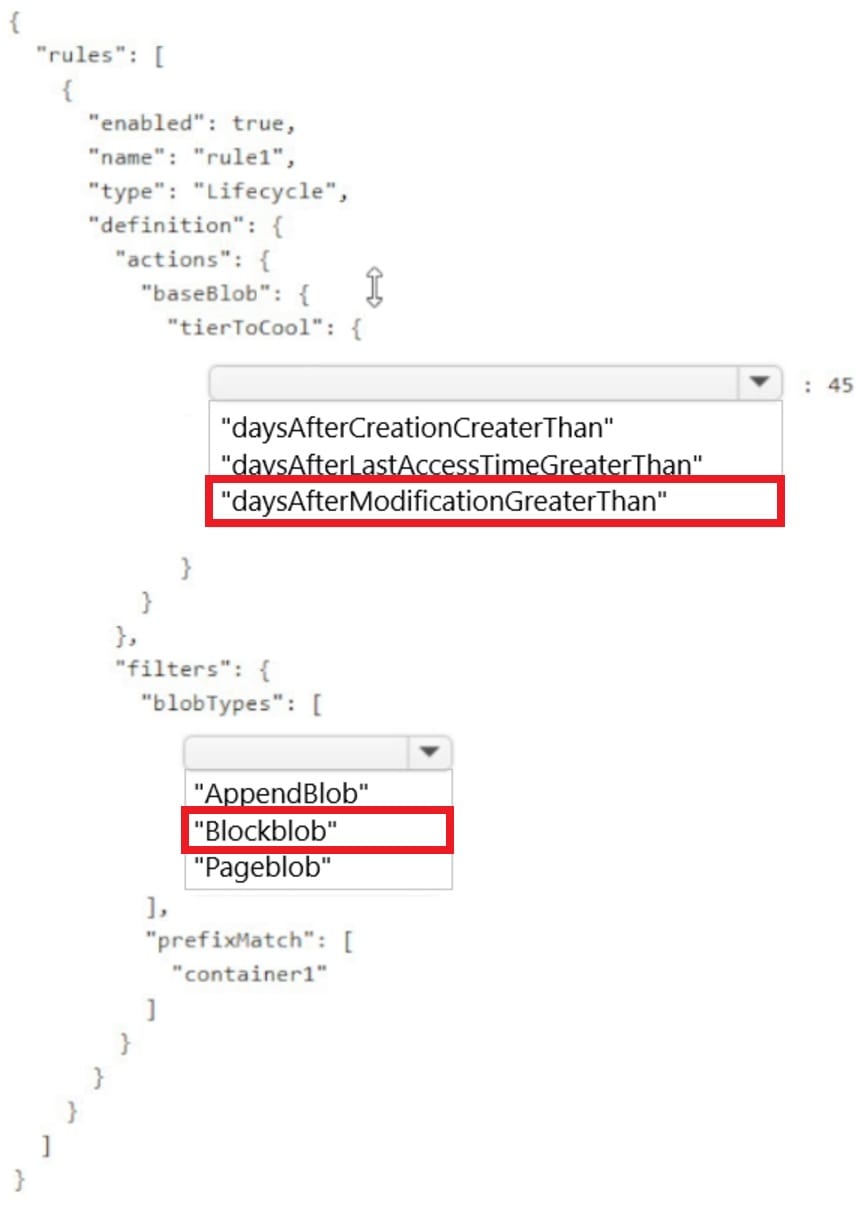
You have an Azure subscription that contains a storage account named storage1. The storage1 account contains a container named container1.
You create a blob lifecycle rule named rule1.
You need to configure rule1 to automatically move blobs that were NOT updated for 45 days from contained to the Cool access tier.
How should you complete the rule? To answer, select the appropriate options in the answer area.
NOTE: Each correct selection is worth one point.
Answer:
Note: This question is part of a series of questions that present the same scenario. Each question in the series contains a unique solution that might meet the stated goals. Some question sets might have more than one correct solution, while others might not have a correct solution.
After you answer a question in this section, you will NOT be able to return to it. As a result, these questions will not appear in the review screen.
You have an Azure virtual machine named VM1 that runs Windows Server 2016.
You need to create an alert in Azure when more than two error events are logged to the System event log on VM1 within an hour.
Solution: You create an Azure Log Analytics workspace and configure the Agent configuration settings. You install the Microsoft Monitoring Agent on VM1. You create an alert in Azure Monitor and specify the Log Analytics workspace as the source.
Does this meet the goal?
- A. Yes
- B. No
You have two Azure virtual networks named VNet1 and VNet2. VNet1 contains an Azure virtual machine named VM1. VNet2 contains an Azure virtual machine named VM2.
VM1 hosts a frontend application that connects to VM2 to retrieve data.
Users report that the frontend application is slower than usual.
You need to view the average round-trip time (RTT) of the packets from VM1 to VM2.
Which Azure Network Watcher feature should you use?
- A. IP flow verify
- B. Connection troubleshoot
- C. Connection monitor
- D. NSG flow logs
You have an Azure subscription named Subscription1.
You have 5 TB of data that you need to transfer to Subscription1.
You plan to use an Azure Import/Export job.
What can you use as the destination of the imported data?
- A. an Azure Cosmos DB database
- B. Azure Blob Storage
- C. Azure SQL Database
- D. the Azure File Sync Storage Sync Service
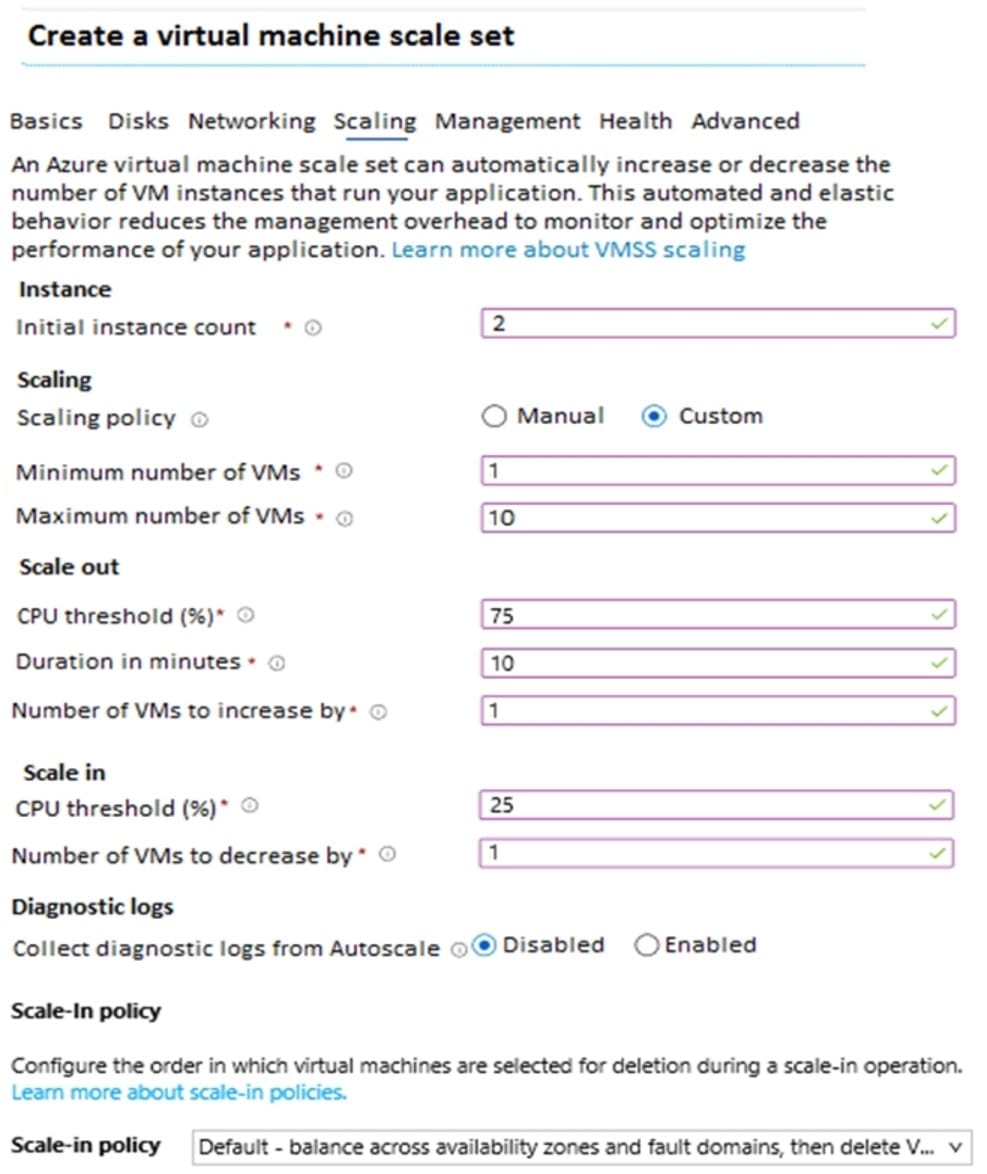
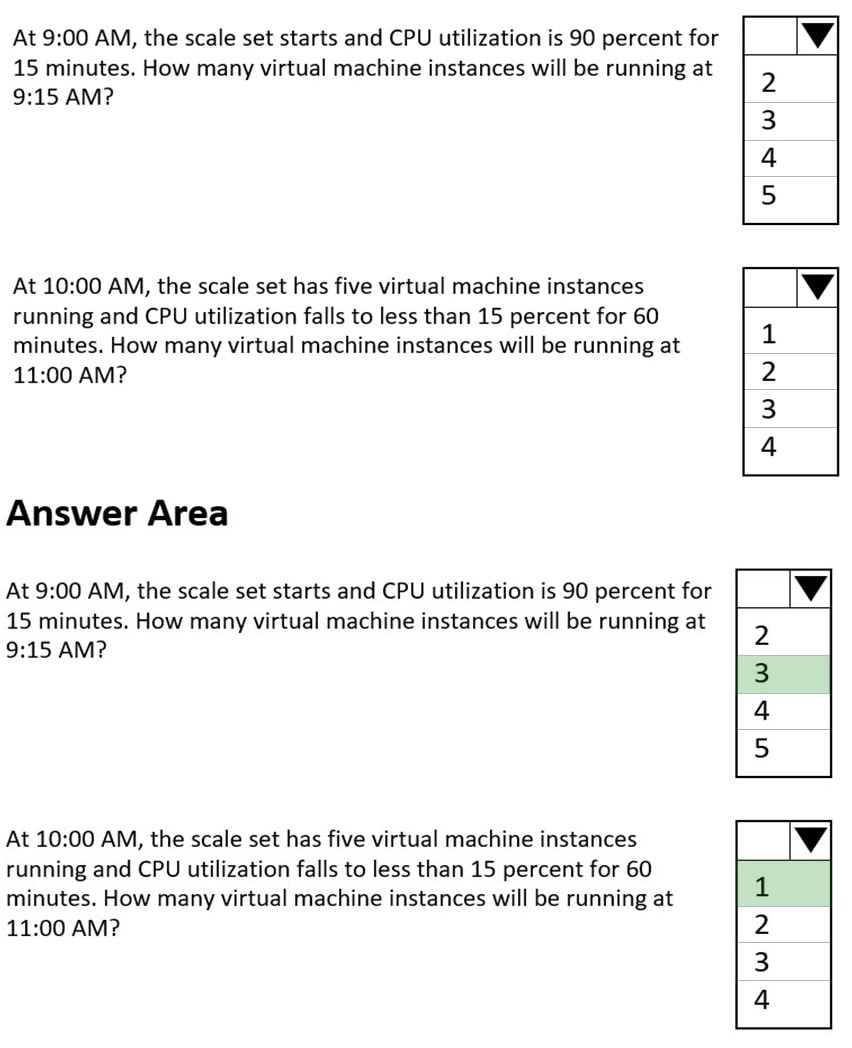
HOTSPOT –
You have an Azure subscription.
You deploy a virtual machine scale set that is configured as shown in the following exhibit.
HOTSPOT –
You have an Azure subscription that contains the public load balancers shown in the following table.
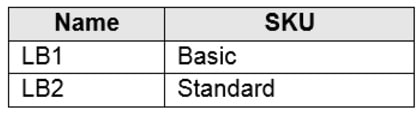
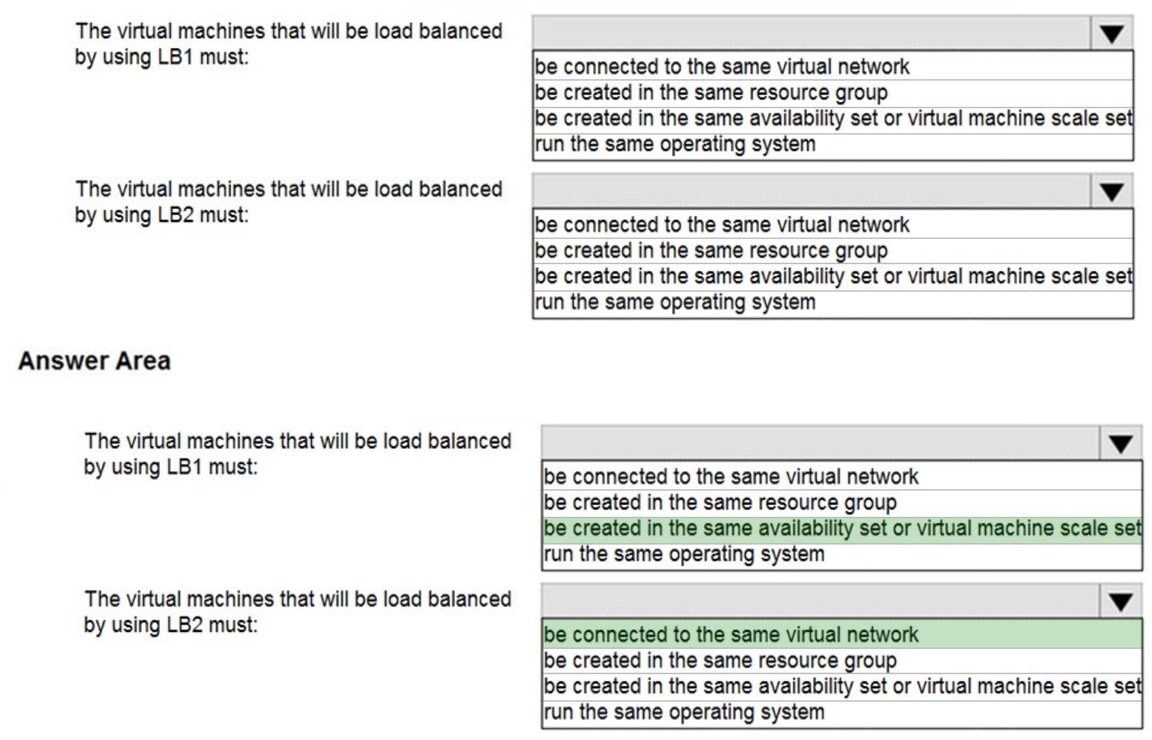
You plan to create six virtual machines and to load balance requests to the virtual machines. Each load balancer will load balance three virtual machines.
You need to create the virtual machines for the planned solution.
How should you create the virtual machines? To answer, select the appropriate options in the answer area.
NOTE: Each correct selection is worth one point.
Hot Area:
You plan to create an Azure Storage account named storage1 that will contain a file share named share1.
You need to ensure that share1 can support SMB Multichannel. The solution must minimize costs.
How should you configure storage?
- A. Premium performance with locally-redundant storage (LRS)
- B. Standard performance with zone-redundant storage (ZRS)
- C. Premium performance with geo-redundant storage (GRS)
- D. Standard performance with locally-redundant storage (LRS)
You have web apps in the West US, Central US and East US Azure regions.
You have the App Service plans shown in the following table.
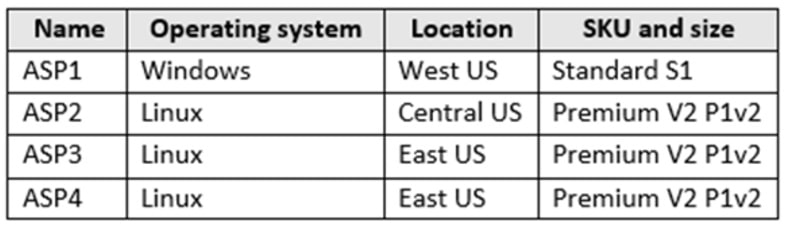
You plan to create an additional App Service plan named ASP5 that will use the Linux operating system.
You need to identify in which of the currently used locations you can deploy ASP5.
What should you recommend?
- A. West US, Central US, or East US
- B. Central US only
- C. East US only
- D. West US only
HOTSPOT –
You have an on-premises data center and an Azure subscription. The data center contains two VPN devices. The subscription contains an Azure virtual network named VNet1. VNet1 contains a gateway subnet.
You need to create a site-to-site VPN. The solution must ensure that if a single instance of an Azure VPN gateway fails, or a single on-premises VPN device fails, the failure will not cause an interruption that is longer than two minutes.
What is the minimum number of public IP addresses, virtual network gateways, and local network gateways required in Azure? To answer, select the appropriate options in the answer area.
NOTE: Each correct selection is worth one point.
Hot Area:
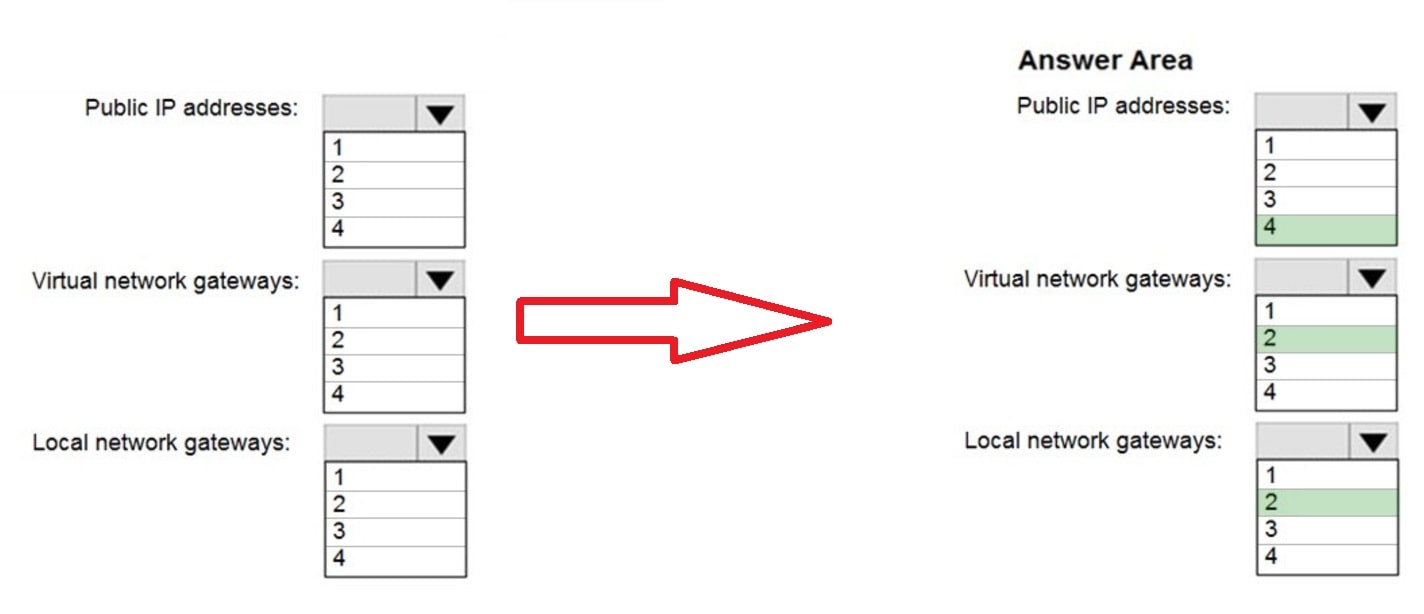
Box 1: 4 –
Two public IP addresses in the on-premises data center, and two public IP addresses in the VNET.
The most reliable option is to combine the active-active gateways on both your network and Azure
Box 2: 2 –
Every Azure VPN gateway consists of two instances in an active-standby configuration. For any planned maintenance or unplanned disruption that happens to the active instance, the standby instance would take over (failover) automatically, and resume the S2S VPN or VNet-to-VNet connections.
Box 3: 2 –
Dual-redundancy: active-active VPN gateways for both Azure and on-premises networks
Reference:
https://docs.microsoft.com/en-us/azure/vpn-gateway/vpn-gateway-highlyavailable
DRAG DROP
–
You have an Azure subscription named Sub1 that contains two users named User1 and User2.
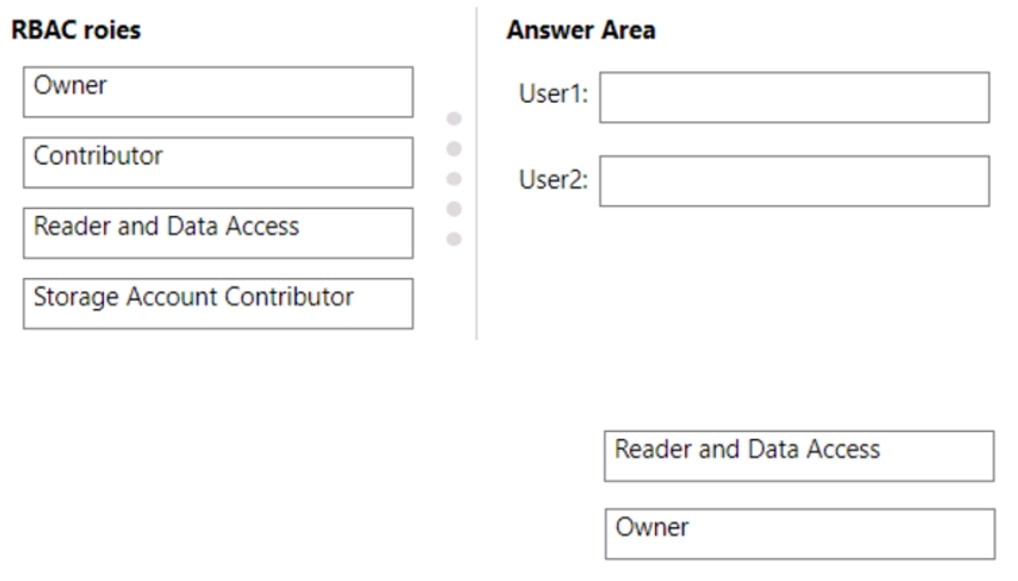
You need to assign role-based access control (RBAC) roles to User1 and User2. The users must be able to perform the following tasks in Sub1:
• User1 must view the data in any storage account.
• User2 must assign users the Contributor role for storage accounts.
The solution must use the principle of least privilege.
Which RBAC role should you assign to each user? To answer, drag the appropriate roles to the correct users. Each role may be used once, more than once, or not at all. You may need to drag the split bar between panes or scroll to view content.
NOTE: Each correct selection is worth one point.