
We HELP you PASS (CCNP 350-401) Implementing Cisco Enterprise Network Core Technologies (ENCOR) certification, without exam and training!
***Pay after you Pass***
What is the role of the vSmart controller in a Cisco SD-WAN environment?
- A. It performs authentication and authorization.
- B. It manages the control plane.
- C. It is the centralized network management system.
- D. It manages the data plane.
When a wired client connects to an edge switch in a Cisco SD-Access fabric, which component decides whether the client has access to the network?
- A. edge node
- B. Identity Services Engine
- C. RADIUS server
- D. control-plane node
Which benefit is offered by a cloud infrastructure deployment but is lacking in an on-premises deployment?
- A. virtualization
- B. supported systems
- C. storage capacity
- D. efficient scalability
Which action is the vSmart controller responsible for in a Cisco SD-WAN deployment?
- A. onboard WAN Edge nodes into the Cisco SD-WAN fabric
- B. gather telemetry data from WAN Edge routers
- C. distribute policies that govern data forwarding performed within the Cisco SD-WAN fabric
- D. handle, maintain, and gather configuration and status for nodes within the Cisco SD-WAN fabric
Where is radio resource management performed in a Cisco SD-Access wireless solution?
- A. DNA Center
- B. control plane node
- C. wireless controller
- D. Cisco CMX
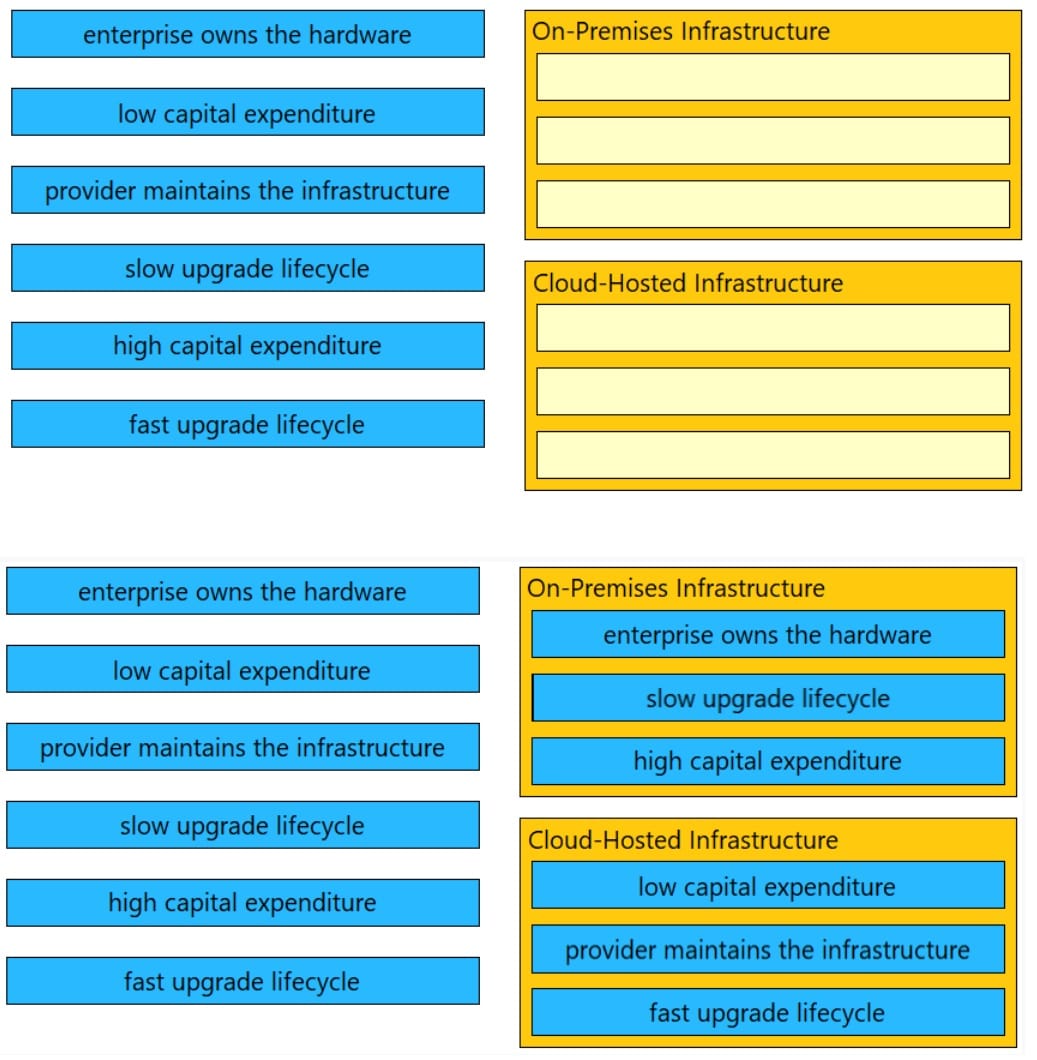
DRAG DROP –
Drag and drop the characteristics from the left onto the infrastructure types on the right.
Select and Place:
How does the RIB differ from the FIB?
- A. The FIB maintains network topologies and routing tables. The RIB is a list of routes to particular network destinations.
- B. The FIB includes many routes to a single destination. The RIB is the best route to a single destination.
- C. The RIB is used to create network topologies and routing tables. The FIB is a list of routes to particular network destinations.
- D. The RIB includes many routes to the same destination prefix. The FIB contains only the best route.
Which technology is used to provide Layer 2 and Layer 3 logical networks in the Cisco SD-Access architecture?
- A. underlay network
- B. VPN routing/forwarding
- C. easy virtual network
- D. overlay network
What is the difference between CEF and process switching?
- A. CEF processes packets that are too complex for process switching to manage.
- B. Process switching is faster than CEF.
- C. CEF uses the FIB and the adjacency table to make forwarding decisions, whereas process switching punts each packet.
- D. CEF is more CPU-intensive than process switching.
What are two considerations when using SSO as a network redundancy feature? (Choose two.)
- A. requires synchronization between supervisors in order to guarantee continuous connectivity
- B. the multicast state is preserved during switchover
- C. must be combined with NSF to support uninterrupted Layer 3 operations
- D. both supervisors must be configured separately
- E. must be combined with NSF to support uninterrupted Layer 2 operations