
We HELP you PASS (CCNP 350-401) Implementing Cisco Enterprise Network Core Technologies (ENCOR) certification, without exam and training!
***Pay after you Pass***
In a Cisco SD-Access solution, what is the role of a fabric edge node?
- A. to connect external Layer 3 networks to the SD-Access fabric
- B. to connect wired endpoints to the SD-Access fabric
- C. to advertise fabric IP address space to external networks
- D. to connect the fusion router to the SD-Access fabric
What are two reasons a company would choose a cloud deployment over an on-prem deployment? (Choose two.)
- A. Cloud costs adjust up or down depending on the amount of resources consumed. On-prem costs for hardware, power, and space are on-going regardless of usage.
- B. Cloud resources scale automatically to an increase in demand. On-prem requires additional capital expenditure.
- C. In a cloud environment, the company is in full control of access to their data. On-prem risks access to data due to service provider outages.
- D. In a cloud environment, the company controls technical issues. On-prem environments rely on the service provider to resolve technical issues.
- E. Cloud deployments require long implementation times due to capital expenditure processes. On-prem deployments can be accomplished quickly using operational expenditure processes.
What is the difference between the MAC address table and TCAM?
- A. TCAM is used to make L2 forwarding decisions. CAM is used to build routing tables.
- B. Router prefix lookups happen in CAM. MAC address table lookups happen in TCAM.
- C. The MAC address table supports partial matches. TCAM requires an exact match.
- D. The MAC address table is contained in CAM. ACL and QoS information is stored in TCAM.
Which controller is the single plane of management for Cisco SD-WAN?
- A. vBond
- B. vSmart
- C. vManage
- D. vEdge
A company plans to implement intent-based networking in its campus infrastructure.
Which design facilitates a migration from a traditional campus design to a programmable fabric design?
- A. two-tier
- B. Layer 2 access
- C. three-tier
- D. routed access
Which statement about a fabric access point is true?
- A. It is in local mode and must be connected directly to the fabric edge switch.
- B. It is in local mode and must be connected directly to the fabric border node.
- C. It is in FlexConnect mode and must be connected directly to the fabric border node.
- D. It is in FlexConnect mode and must be connected directly to the fabric edge switch.
A customer requests a network design that supports these requirements:
– FHRP redundancy
– multivendor router environment
– IPv4 and IPv6 hosts
Which protocol does the design include?
- A. VRRP version 2
- B. VRRP version 3
- C. GLBP
- D. HSRP version 2
While configuring an IOS router for HSRP with a virtual IP of 10.1.1.1, an engineer sees this log message.
Jan 1 12:12:12.111 : %HSRP-4-DIFFVIP1: GigabitEthernet0/0 Grp 1 active routers virtual IP address 10.1.1.1 is different to the locally configured address 10.1.1.25
Which configuration change must the engineer make?
- A. Change the HSRP group configuration on the local router to 1.
- B. Change the HSRP virtual address on the local router to 10.1.1.1.
- C. Change the HSRP virtual address on the remote router to 10.1.1.1.
- D. Change the HSRP group configuration on the remote router to 1.
A network administrator has designed a network with two multilayer switches on the distribution layer, which act as default gateways for the end hosts. Which two technologies allow every end host in a VLAN to use both gateways? (Choose two.)
- A. VRRP
- B. GLBP
- C. VSS
- D. MHSRP
- E. HSRP
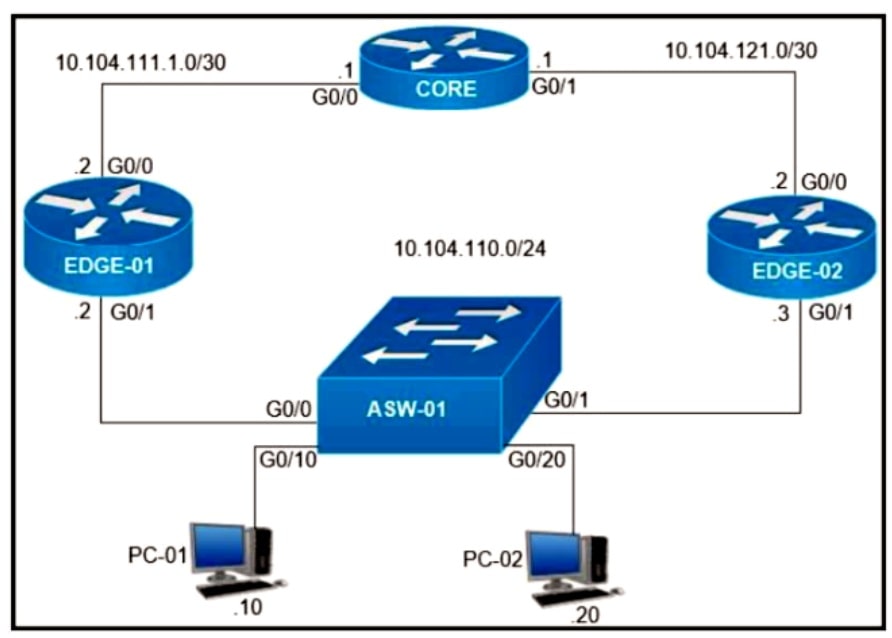
Refer to the exhibit. On which interfaces should VRRP commands be applied to provide first hop redundancy to PC-01 and PC-02?
- A. G0/0 and G0/1 on Core
- B. G0/0 on Edge-01 and G0/0 on Edge-02
- C. G0/1 on Edge-01 and G0/1 on Edge-02
- D. G0/0 and G0/1 on ASW-01