
Pass Microsoft AI-900 in Just 3 Days – Stress-Free!
Get your Microsoft Azure AI Fundamentals (AI-900) certification with 100% pass guarantee. Pay only after passing!
Click here to secure your guaranteed certification now!
Have questions? Contact us directly on WhatsApp for quick support!
HOTSPOT –
For each of the following statements, select Yes if the statement is true. Otherwise, select No.
NOTE: Each correct selection is worth one point.
Hot Area:
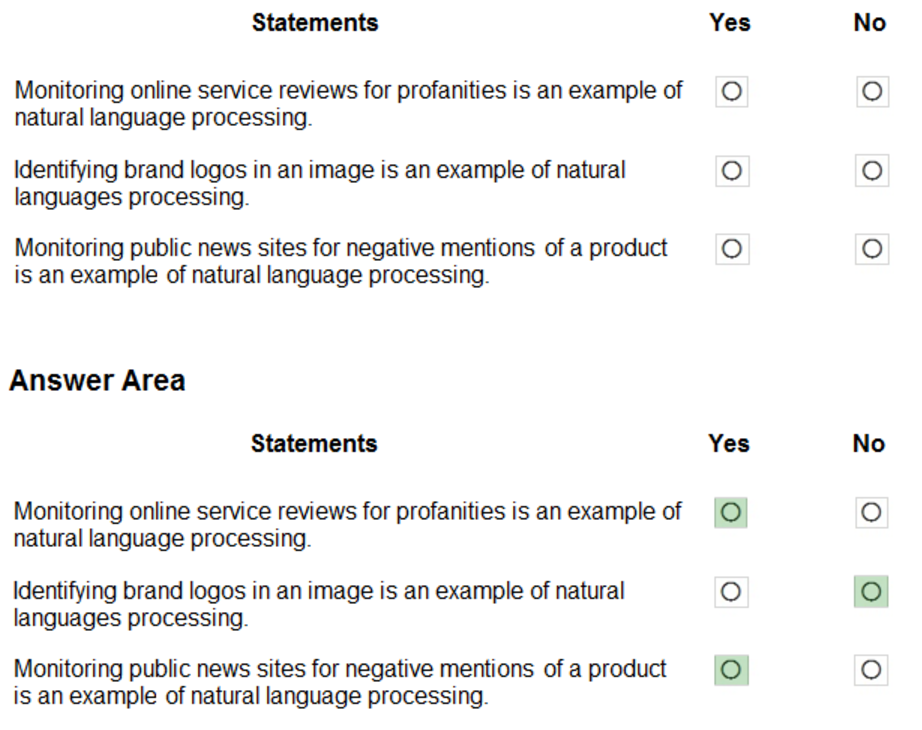
Box 1: Yes –
Content Moderator is part of Microsoft Cognitive Services allowing businesses to use machine assisted moderation of text, images, and videos that augment human review.
The text moderation capability now includes a new machine-learning based text classification feature which uses a trained model to identify possible abusive, derogatory or discriminatory language such as slang, abbreviated words, offensive, and intentionally misspelled words for review.
Box 2: No –
Azure’s Computer Vision service gives you access to advanced algorithms that process images and return information based on the visual features you’re interested in. For example, Computer Vision can determine whether an image contains adult content, find specific brands or objects, or find human faces.
Box 3: Yes –
Natural language processing (NLP) is used for tasks such as sentiment analysis, topic detection, language detection, key phrase extraction, and document categorization.
Sentiment Analysis is the process of determining whether a piece of writing is positive, negative or neutral.
Reference:
https://azure.microsoft.com/es-es/blog/machine-assisted-text-classification-on-content-moderator-public-preview/ https://docs.microsoft.com/en-us/azure/architecture/data-guide/technology-choices/natural-language-processing
You are developing a natural language processing solution in Azure. The solution will analyze customer reviews and determine how positive or negative each review is.
This is an example of which type of natural language processing workload?
- A. language detection
- B. sentiment analysis
- C. key phrase extraction
- D. entity recognition
You use natural language processing to process text from a Microsoft news story.
You receive the output shown in the following exhibit.
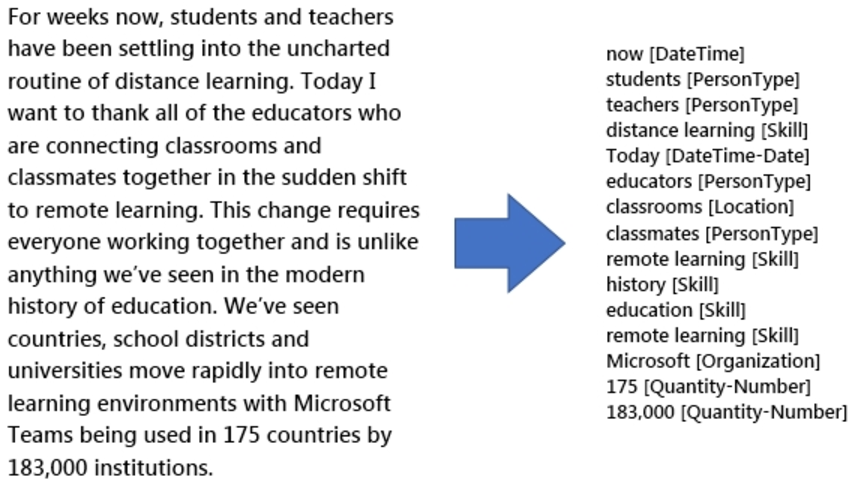
Which type of natural languages processing was performed?
- A. entity recognition
- B. key phrase extraction
- C. sentiment analysis
- D. translation
DRAG DROP –
You plan to apply Text Analytics API features to a technical support ticketing system.
Match the Text Analytics API features to the appropriate natural language processing scenarios.
To answer, drag the appropriate feature from the column on the left to its scenario on the right. Each feature may be used once, more than once, or not at all.
NOTE: Each correct selection is worth one point.
Select and Place:
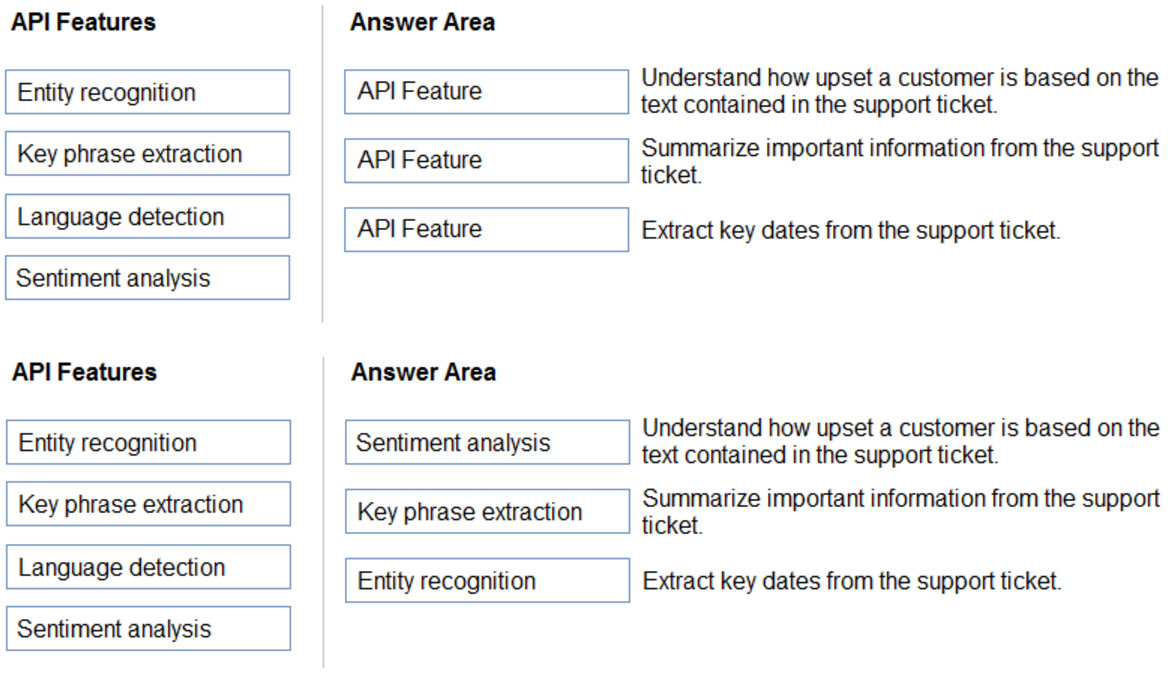
Box1: Sentiment analysis –
Sentiment Analysis is the process of determining whether a piece of writing is positive, negative or neutral.
Box 2: Broad entity extraction –
Broad entity extraction: Identify important concepts in text, including key
Key phrase extraction/ Broad entity extraction: Identify important concepts in text, including key phrases and named entities such as people, places, and organizations.
Box 3: Entity Recognition –
Named Entity Recognition: Identify and categorize entities in your text as people, places, organizations, date/time, quantities, percentages, currencies, and more.
Well-known entities are also recognized and linked to more information on the web.
Reference:
https://docs.microsoft.com/en-us/azure/architecture/data-guide/technology-choices/natural-language-processing https://azure.microsoft.com/en-us/services/cognitive-services/text-analytics
You are authoring a Language Understanding (LUIS) application to support a music festival.
You want users to be able to ask questions about scheduled shows, such as: `Which act is playing on the main stage?`
The question `Which act is playing on the main stage?` is an example of which type of element?
- A. an intent
- B. an utterance
- C. a domain
- D. an entity
You build a QnA Maker bot by using a frequently asked questions (FAQ) page.
You need to add professional greetings and other responses to make the bot more user friendly.
What should you do?
- A. Increase the confidence threshold of responses
- B. Enable active learning
- C. Create multi-turn questions
- D. Add chit-chat
You need to develop a chatbot for a website. The chatbot must answer users’ questions based on the information in the following documents:
– A product troubleshooting guide in a Microsoft Word document
– A frequently asked questions (FAQ) list on a webpage
Which service should you use to process the documents?
- A. Azure Bot Service
- B. Language Understanding
- C. Text Analytics
- D. QnA Maker
You are building a Language Understanding model for an e-commerce business.
You need to ensure that the model detects when utterances are outside the intended scope of the model.
What should you do?
- A. Test the model by using new utterances
- B. Add utterances to the None intent
- C. Create a prebuilt task entity
- D. Create a new model
Which two scenarios are examples of a natural language processing workload? Each correct answer presents a complete solution.
NOTE: Each correct selection is worth one point.
- A. monitoring the temperature of machinery to turn on a fan when the temperature reaches a specific threshold
- B. a smart device in the home that responds to questions such as, “What will the weather be like today?”
- C. a website that uses a knowledge base to interactively respond to users’ questions
- D. assembly line machinery that autonomously inserts headlamps into cars
You have an AI solution that provides users with the ability to control smart devices by using verbal commands.
Which two types of natural language processing (NLP) workloads does the solution use? Each correct answer presents part of the solution.
NOTE: Each correct selection is worth one point.
- A. text-to-speech
- B. key phrase extraction
- C. speech-to-text
- D. language modeling
- E. translation