

Pass Microsoft AI-900 in Just 3 Days – Stress-Free!
Get your Microsoft Azure AI Fundamentals (AI-900) certification with 100% pass guarantee. Pay only after passing!
Click here to secure your guaranteed certification now!
Have questions? Contact us directly on WhatsApp for quick support!
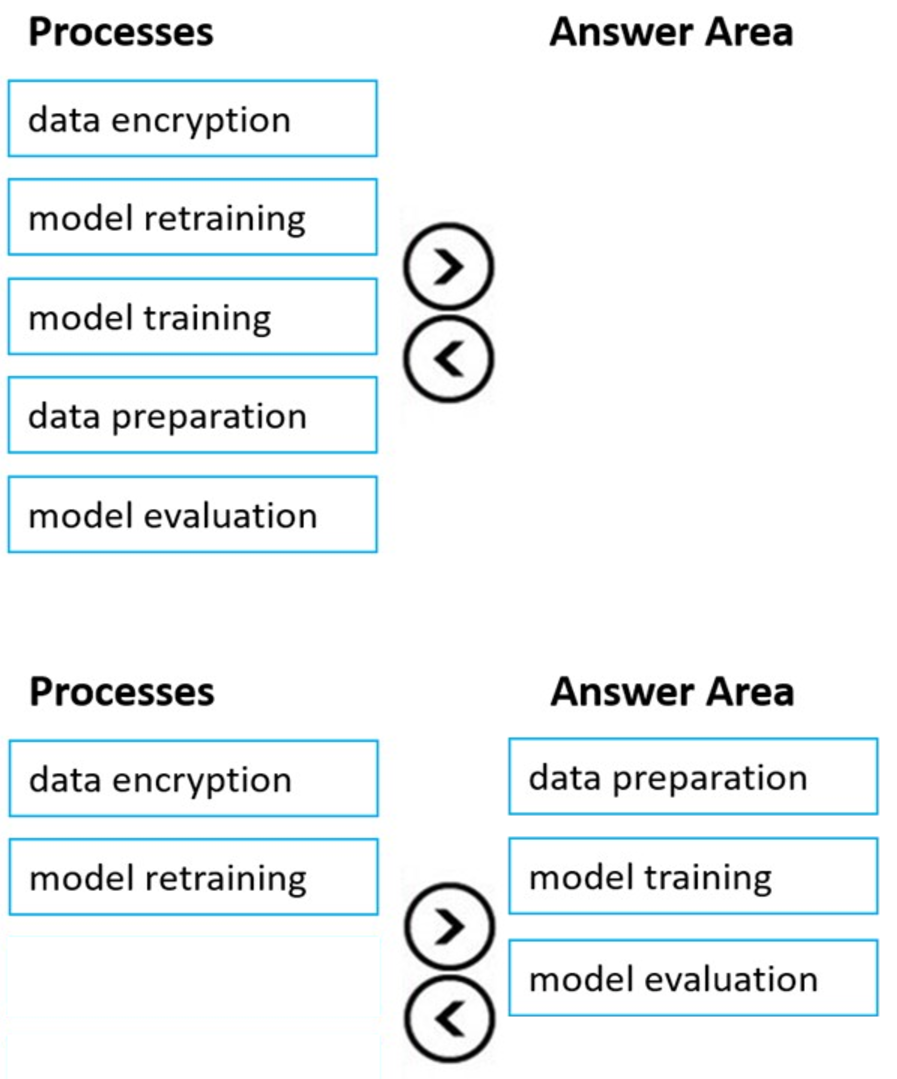
DRAG DROP –
You plan to deploy an Azure Machine Learning model as a service that will be used by client applications.
Which three processes should you perform in sequence before you deploy the model? To answer, move the appropriate processes from the list of processes to the answer area and arrange them in the correct order.
Select and Place:
Reference:
https://docs.microsoft.com/en-us/azure/machine-learning/concept-ml-pipelines
You are building an AI-based app.
You need to ensure that the app uses the principles for responsible AI.
Which two principles should you follow? Each correct answer presents part of the solution.
NOTE: Each correct selection is worth one point.
- A. Implement an Agile software development methodology
- B. Implement a process of AI model validation as part of the software review process
- C. Establish a risk governance committee that includes members of the legal team, members of the risk management team, and a privacy officer
- D. Prevent the disclosure of the use of AI-based algorithms for automated decision making
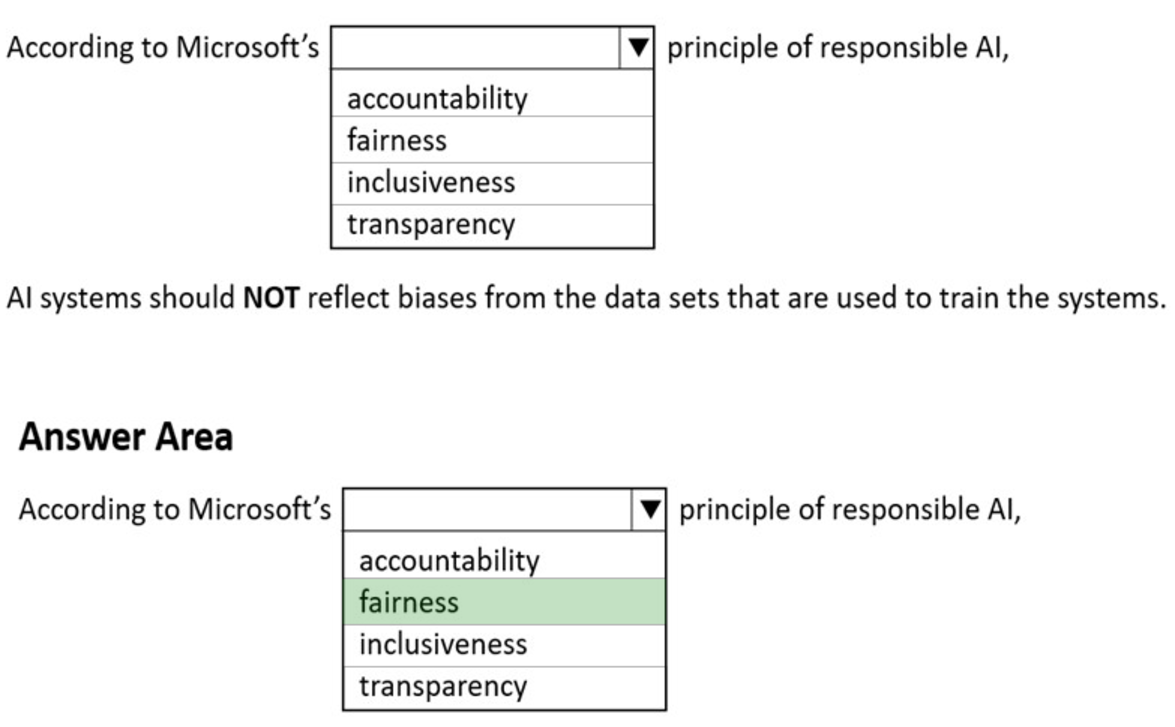
HOTSPOT –
To complete the sentence, select the appropriate option in the answer area.
Hot Area:
Reference:
https://docs.microsoft.com/en-us/azure/cloud-adoption-framework/innovate/best-practices/trusted-ai
HOTSPOT –
Select the answer that correctly completes the sentence.
Hot Area:
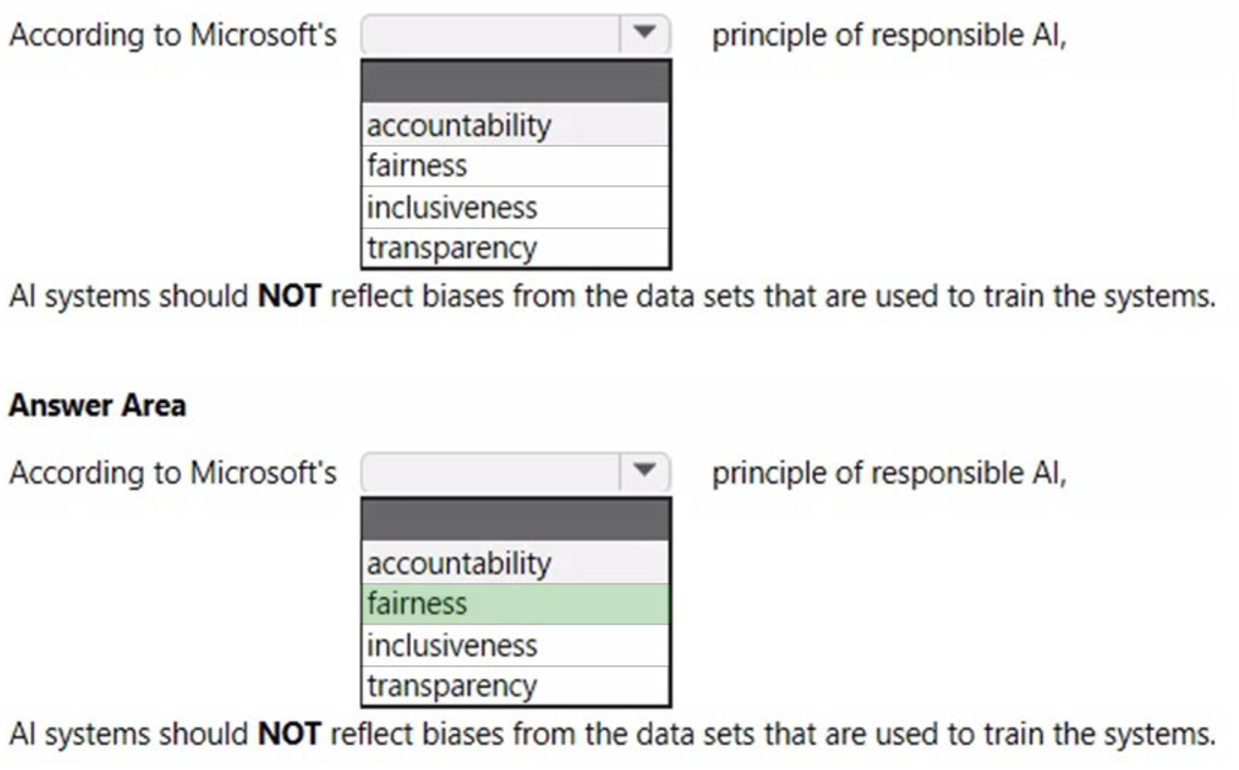
Fairness is a core ethical principle that all humans aim to understand and apply. This principle is even more important when AI systems are being developed. Key checks and balances need to make sure that the system’s decisions don’t discriminate or run a gender, race, sexual orientation, or religion bias toward a group or individual.
Reference:
https://docs.microsoft.com/en-us/azure/cloud-adoption-framework/innovate/best-practices/trusted-ai
DRAG DROP –
Match the types of AI workloads to the appropriate scenarios.
To answer, drag the appropriate workload type from the column on the left to its scenario on the right. Each workload type may be used once, more than once, or not at all.
NOTE: Each correct selection is worth one point.
Select and Place:
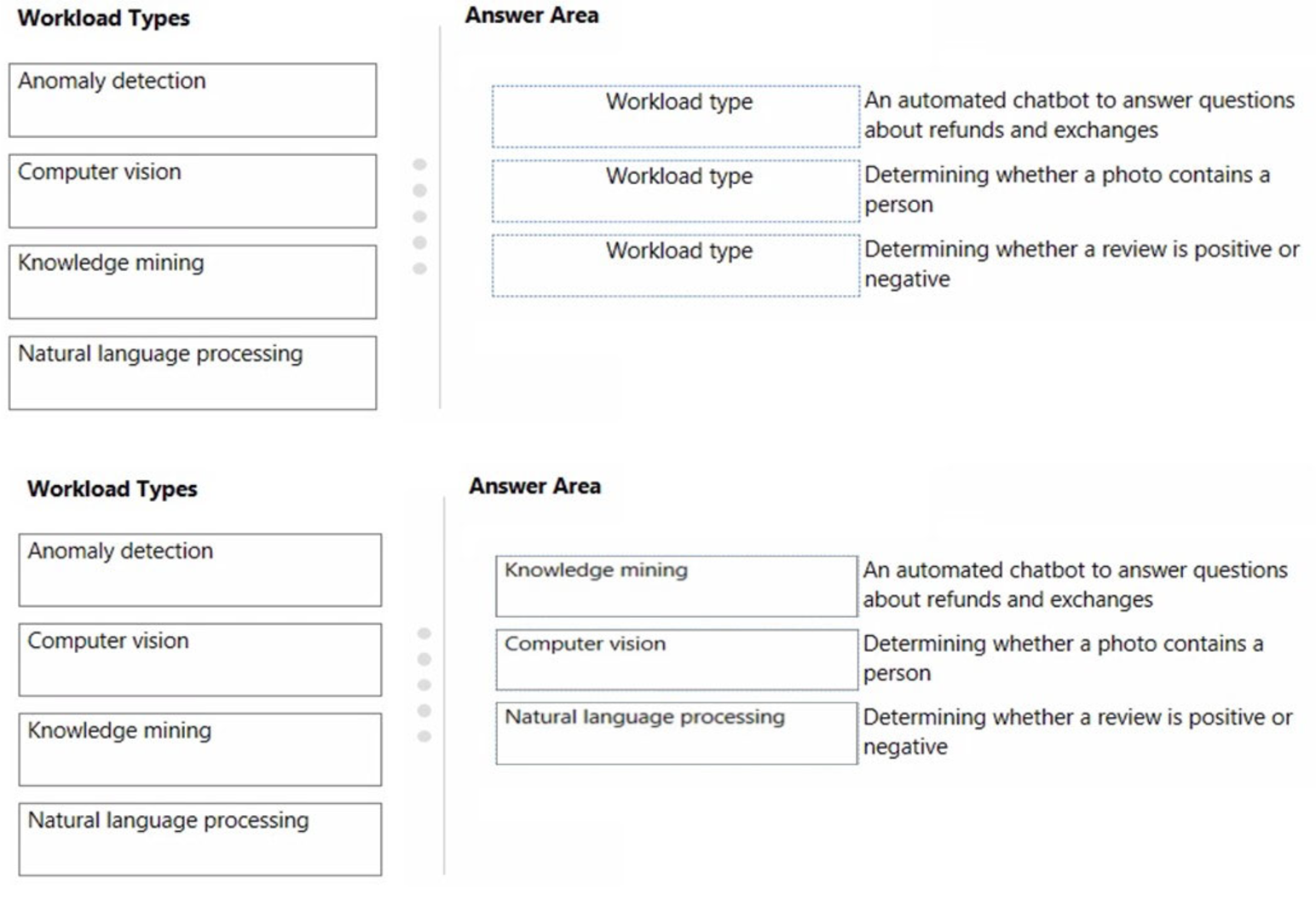
Box 1: Knowledge mining –
You can use Azure Cognitive Search’s knowledge mining results and populate your knowledge base of your chatbot.
Box 2: Computer vision –
Box 3: Natural language processing
Natural language processing (NLP) is used for tasks such as sentiment analysis.
Reference:
https://docs.microsoft.com/en-us/azure/architecture/data-guide/technology-choices/natural-language-processing
DRAG DROP –
Match the machine learning tasks to the appropriate scenarios.
To answer, drag the appropriate task from the column on the left to its scenario on the right. Each task may be used once, more than once, or not at all.
NOTE: Each correct selection is worth one point.
Select and Place:
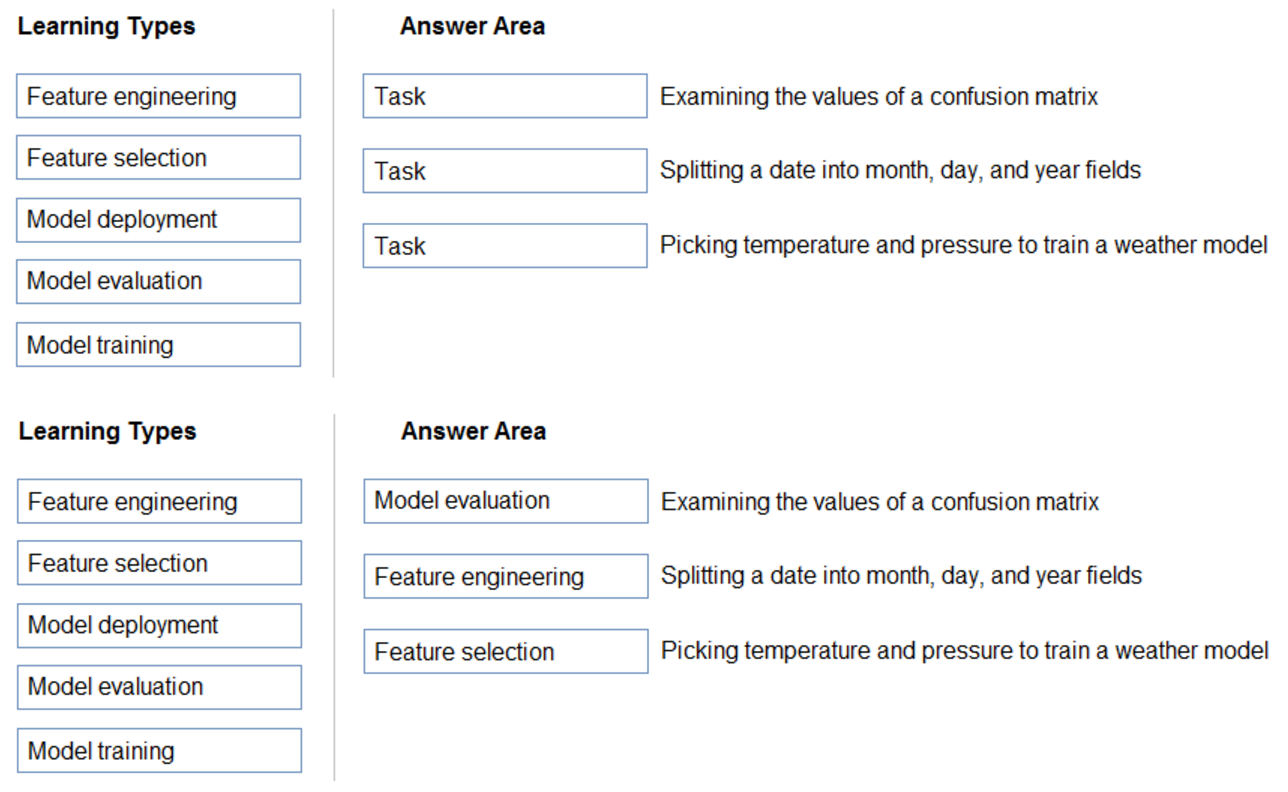
Box 1: Model evaluation –
The Model evaluation module outputs a confusion matrix showing the number of true positives, false negatives, false positives, and true negatives, as well as
ROC, Precision/Recall, and Lift curves.
Box 2: Feature engineering –
Feature engineering is the process of using domain knowledge of the data to create features that help ML algorithms learn better. In Azure Machine Learning, scaling and normalization techniques are applied to facilitate feature engineering. Collectively, these techniques and feature engineering are referred to as featurization.
Note: Often, features are created from raw data through a process of feature engineering. For example, a time stamp in itself might not be useful for modeling until the information is transformed into units of days, months, or categories that are relevant to the problem, such as holiday versus working day.
Box 3: Feature selection –
In machine learning and statistics, feature selection is the process of selecting a subset of relevant, useful features to use in building an analytical model. Feature selection helps narrow the field of data to the most valuable inputs. Narrowing the field of data helps reduce noise and improve training performance.
Reference:
https://docs.microsoft.com/en-us/azure/machine-learning/studio/evaluate-model-performance https://docs.microsoft.com/en-us/azure/machine-learning/concept-automated-ml
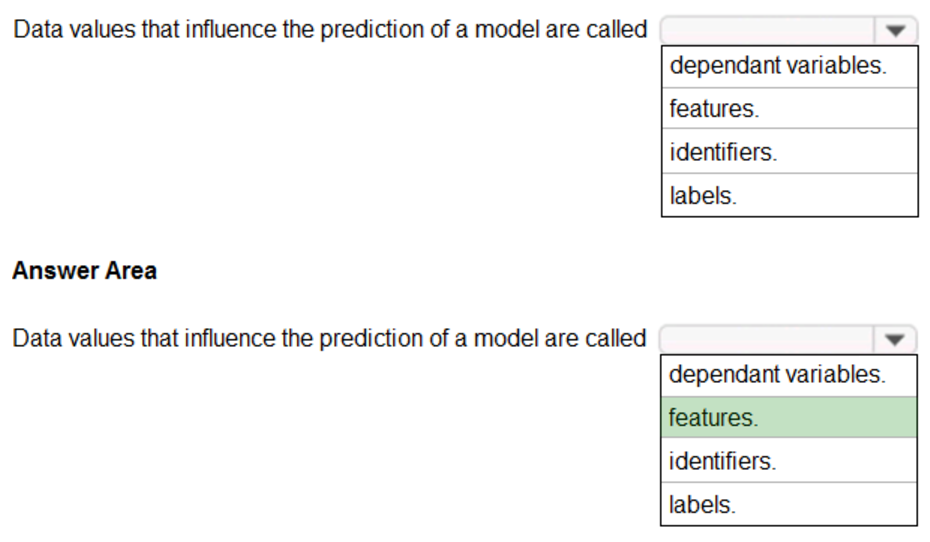
HOTSPOT –
To complete the sentence, select the appropriate option in the answer area.
Hot Area:
Reference:
https://www.baeldung.com/cs/feature-vs-label
https://machinelearningmastery.com/discover-feature-engineering-how-to-engineer-features-and-how-to-get-good-at-it/
You have the Predicted vs. True chart shown in the following exhibit.
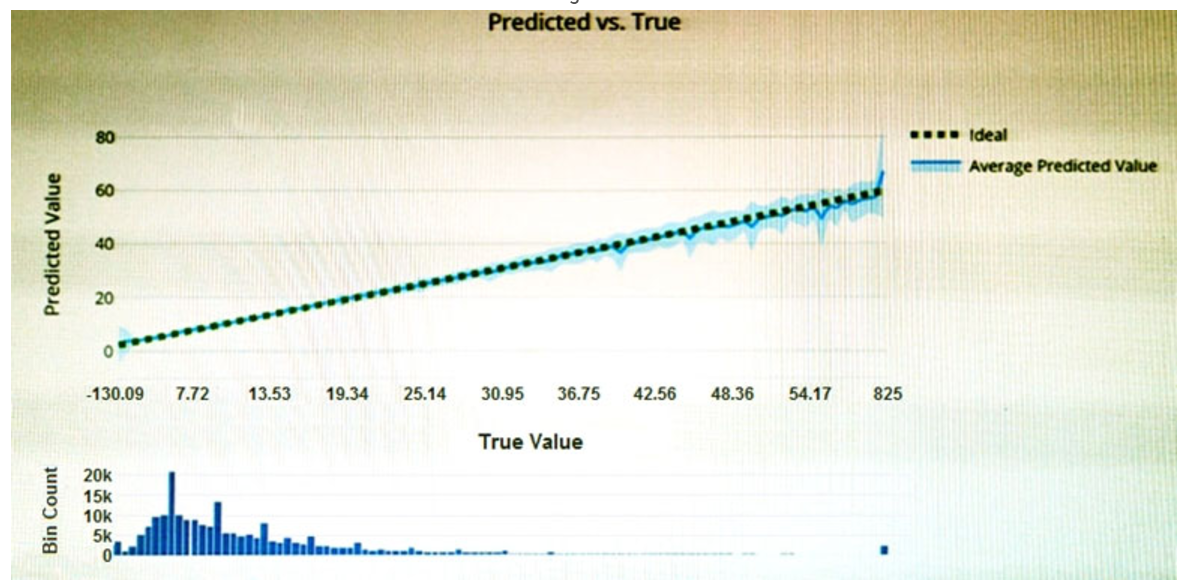
Which type of model is the chart used to evaluate?
- A. classification
- B. regression
- C. clustering
Which type of machine learning should you use to predict the number of gift cards that will be sold next month?
- A. classification
- B. regression
- C. clustering
You have a dataset that contains information about taxi journeys that occurred during a given period.
You need to train a model to predict the fare of a taxi journey.
What should you use as a feature?
- A. the number of taxi journeys in the dataset
- B. the trip distance of individual taxi journeys
- C. the fare of individual taxi journeys
- D. the trip ID of individual taxi journeys