

Pass Microsoft AI-900 in Just 3 Days – Stress-Free!
Get your Microsoft Azure AI Fundamentals (AI-900) certification with 100% pass guarantee. Pay only after passing!
Click here to secure your guaranteed certification now!
Have questions? Contact us directly on WhatsApp for quick support!
HOTSPOT –
For each of the following statements, select Yes if the statement is true. Otherwise, select No.
NOTE: Each correct selection is worth one point.
Hot Area:
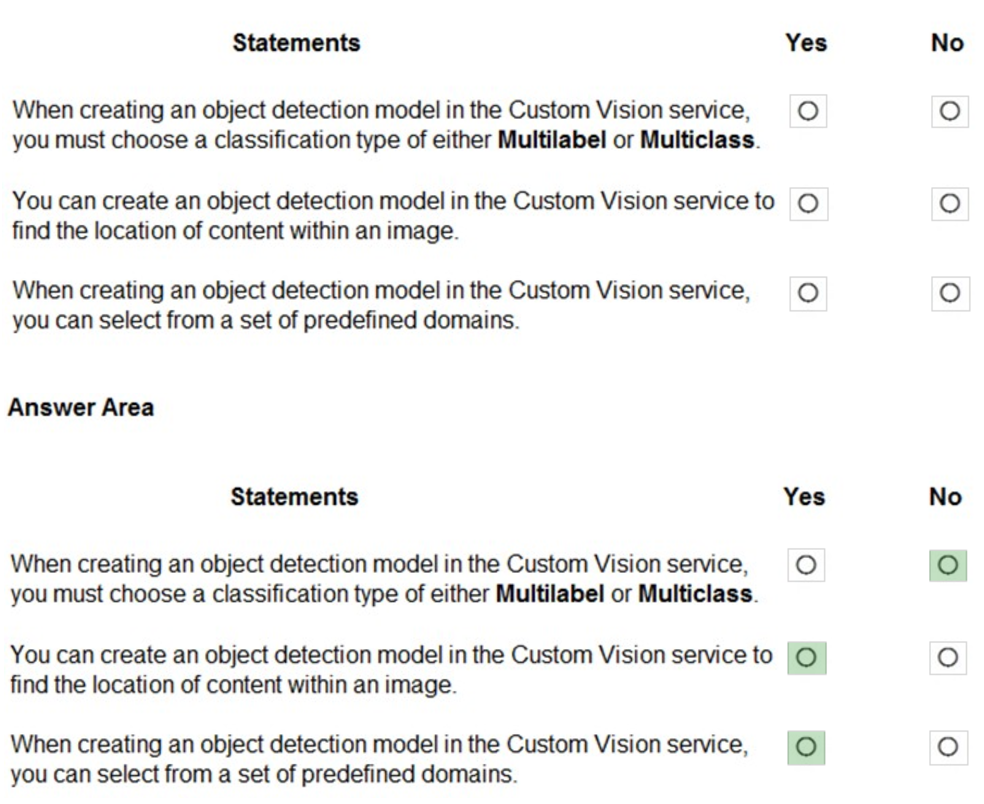
Reference:
https://docs.microsoft.com/en-us/azure/cognitive-services/custom-vision-service/get-started-build-detector
In which two scenarios can you use the Form Recognizer service? Each correct answer presents a complete solution.
NOTE: Each correct selection is worth one point.
- A. Extract the invoice number from an invoice.
- B. Translate a form from French to English.
- C. Find image of product in a catalog.
- D. Identify the retailer from a receipt.
HOTSPOT –
Select the answer that correctly completes the sentence.
Hot Area:
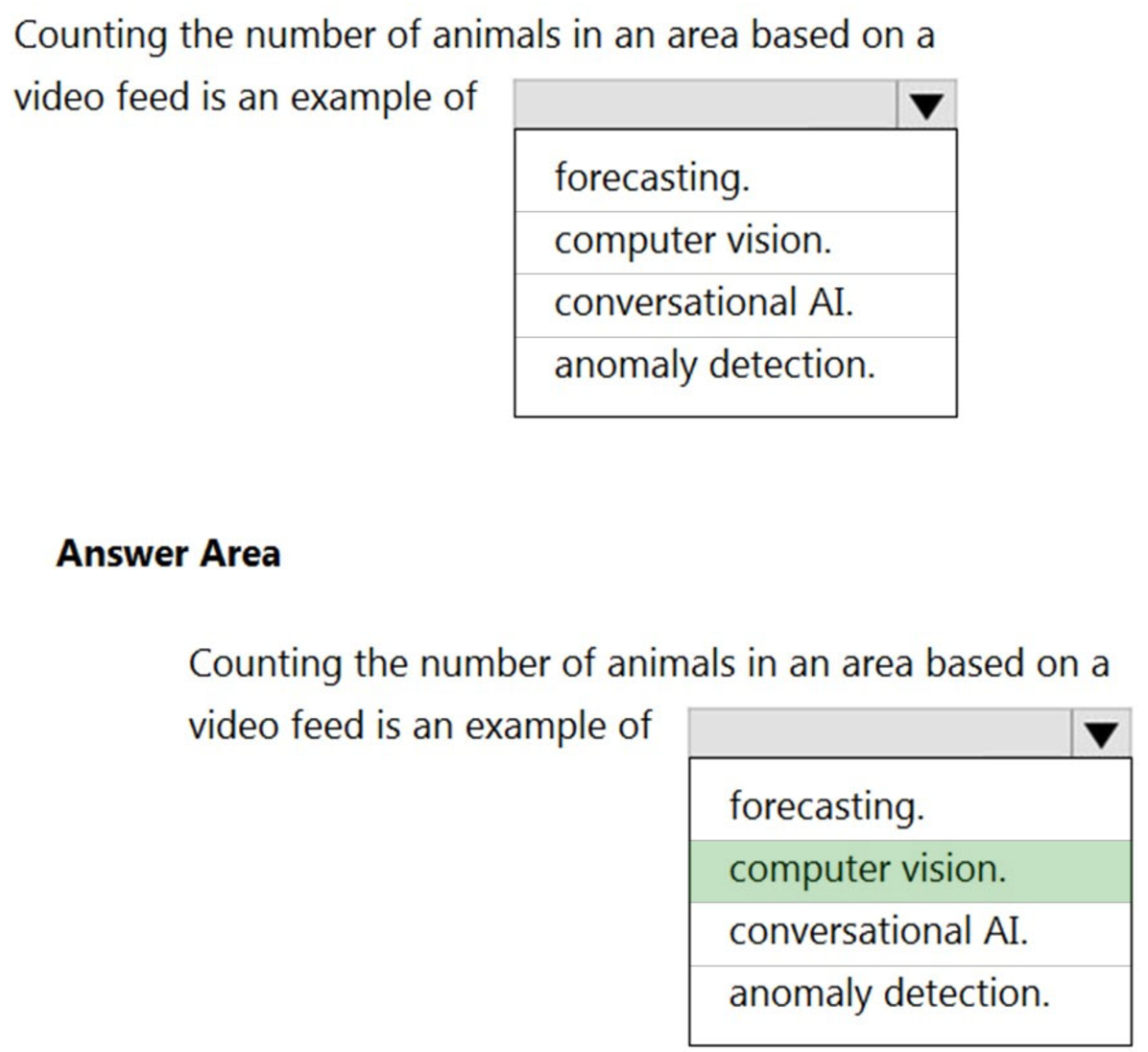
Reference:
https://docs.microsoft.com/en-us/azure/cognitive-services/computer-vision/overview https://docs.microsoft.com/en-us/azure/cognitive-services/computer-vision/intro-to-spatial-analysis-public-preview
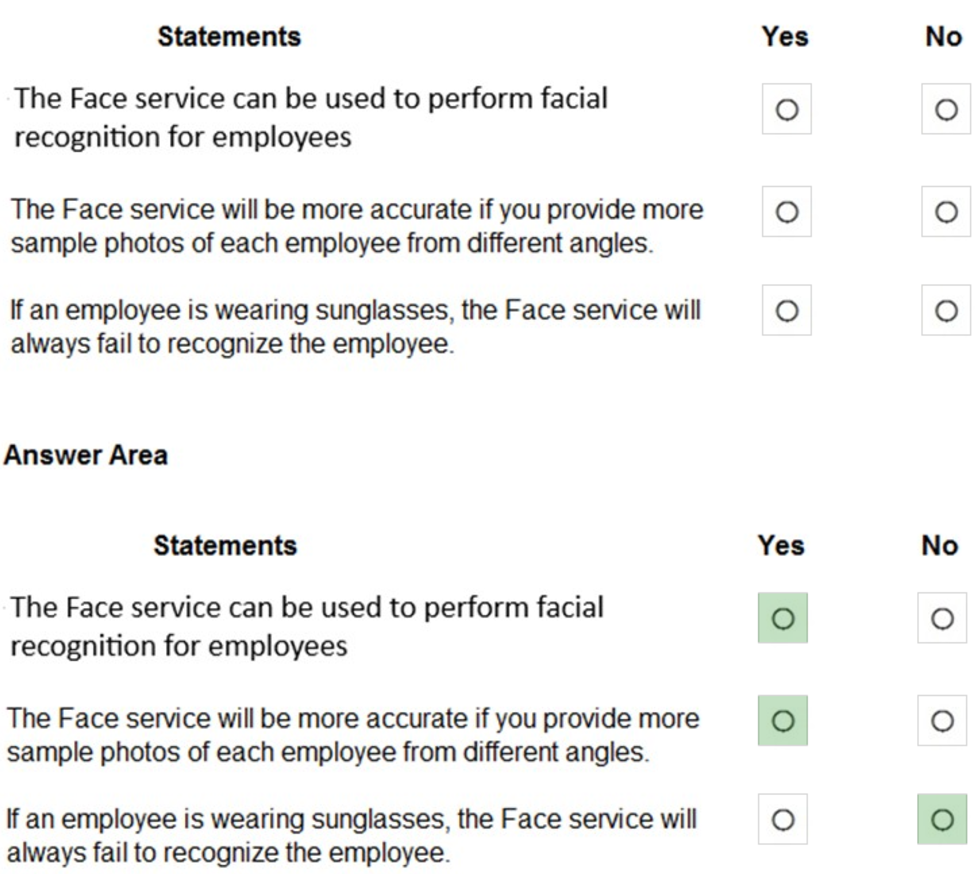
HOTSPOT –
You have a database that contains a list of employees and their photos.
You are tagging new photos of the employees.
For each of the following statements select Yes if the statement is true. Otherwise, select No.
NOTE: Each correct selection is worth one point.
Hot Area:
Reference:
https://docs.microsoft.com/en-us/azure/cognitive-services/face/overview https://docs.microsoft.com/en-us/azure/cognitive-services/face/concepts/face-detection
You need to develop a mobile app for employees to scan and store their expenses while travelling.
Which type of computer vision should you use?
- A. semantic segmentation
- B. image classification
- C. object detection
- D. optical character recognition (OCR)
HOTSPOT –
For each of the following statements, select Yes if the statement is true. Otherwise, select No.
NOTE: Each correct selection is worth one point.
Hot Area:
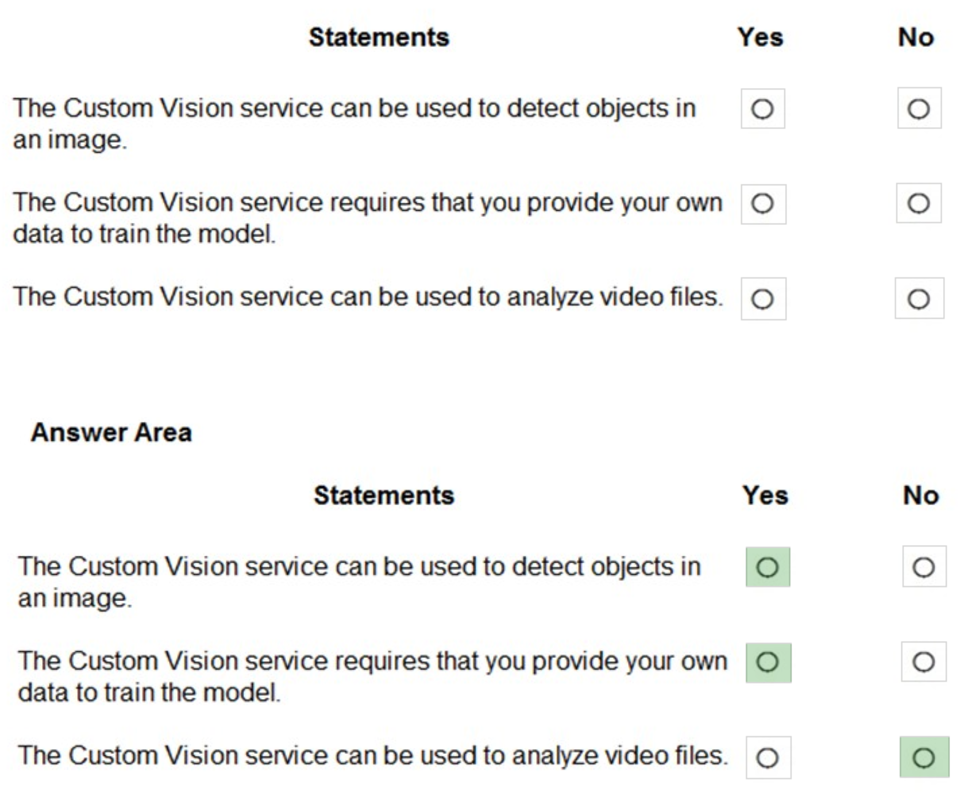
Box 1: Yes –
Custom Vision functionality can be divided into two features. Image classification applies one or more labels to an image. Object detection is similar, but it also returns the coordinates in the image where the applied label(s) can be found.
Box 2: Yes –
The Custom Vision service uses a machine learning algorithm to analyze images. You, the developer, submit groups of images that feature and lack the characteristics in question. You label the images yourself at the time of submission. Then, the algorithm trains to this data and calculates its own accuracy by testing itself on those same images.
Box 3: No –
Custom Vision service can be used only on graphic files.
Reference:
https://docs.microsoft.com/en-us/azure/cognitive-services/Custom-Vision-Service/overview
You are processing photos of runners in a race.
You need to read the numbers on the runners’ shirts to identity the runners in the photos.
Which type of computer vision should you use?
- A. facial recognition
- B. optical character recognition (OCR)
- C. image classification
- D. object detection
DRAG DROP –
Match the types of machine learning to the appropriate scenarios.
To answer, drag the appropriate machine learning type from the column on the left to its scenario on the right. Each machine learning type may be used once, more than once, or not at all.
NOTE: Each correct selection is worth one point.
Select and Place:
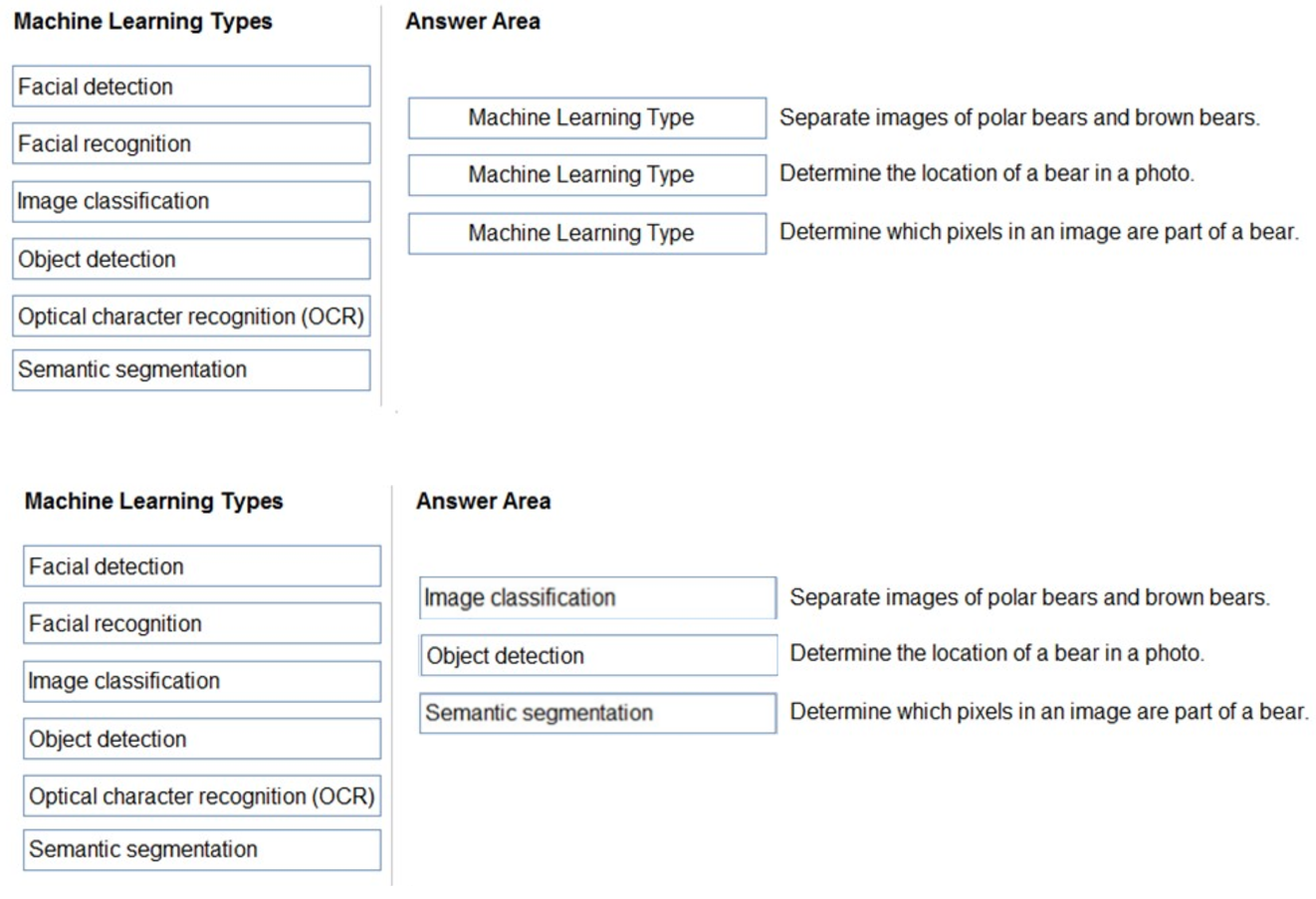
Box 1: Image classification –
Image classification is a supervised learning problem: define a set of target classes (objects to identify in images), and train a model to recognize them using labeled example photos.
Box 2: Object detection –
Object detection is a computer vision problem. While closely related to image classification, object detection performs image classification at a more granular scale. Object detection both locates and categorizes entities within images.
Box 3: Semantic Segmentation –
Semantic segmentation achieves fine-grained inference by making dense predictions inferring labels for every pixel, so that each pixel is labeled with the class of its enclosing object ore region.
Reference:
https://developers.google.com/machine-learning/practica/image-classification https://docs.microsoft.com/en-us/dotnet/machine-learning/tutorials/object-detection-model-builder https://nanonets.com/blog/how-to-do-semantic-segmentation-using-deep-learning/
You use drones to identify where weeds grow between rows of crops to send an instruction for the removal of the weeds.
This is an example of which type of computer vision?
- A. object detection
- B. optical character recognition (OCR)
- C. scene segmentation
DRAG DROP –
Match the facial recognition tasks to the appropriate questions.
To answer, drag the appropriate task from the column on the left to its question on the right. Each task may be used once, more than once, or not at all.
NOTE: Each correct selection is worth one point.
Select and Place:
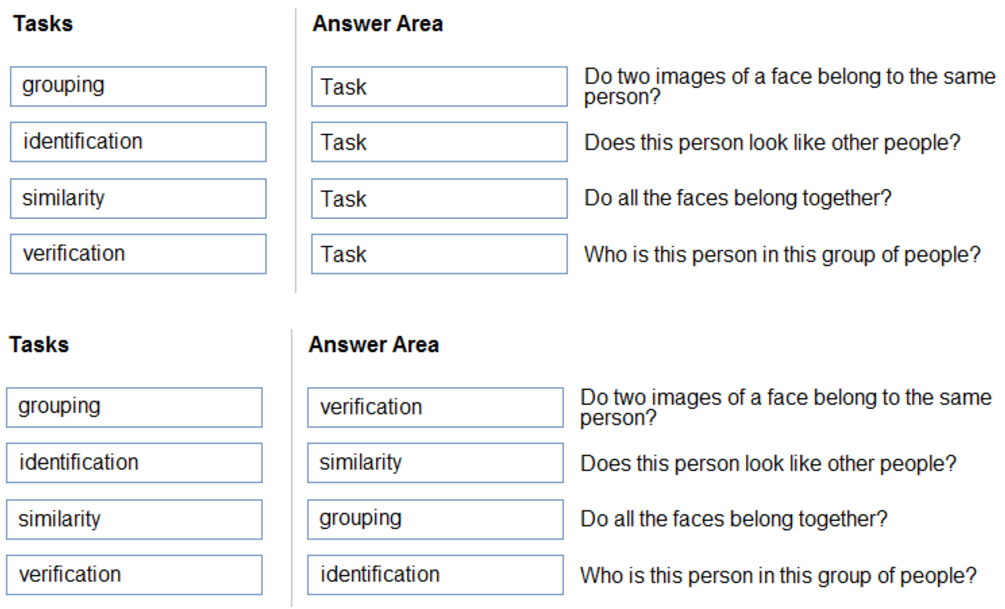
Box 1: verification –
Face verification: Check the likelihood that two faces belong to the same person and receive a confidence score.
Box 2: similarity –
Box 3: Grouping –
Box 4: identification –
Face detection: Detect one or more human faces along with attributes such as: age, emotion, pose, smile, and facial hair, including 27 landmarks for each face in the image.
Reference:
https://azure.microsoft.com/en-us/services/cognitive-services/face/#features