
Pass Microsoft AZ-900 in Just 3 Days – Stress-Free, No Study Needed!
Have questions? Contact us directly on WhatsApp for quick support!
What are two benefits of cloud computing? Each correct answer presents a complete solution.
NOTE: Each correct selection is worth one point.
- A. enables the rapid provisioning of resources
- B. has increased administrative complexity
- C. has the same configuration options as on-premises
- D. shifts capital expenditures (CAPEX) to operating expenditures (OPEX)
What is a feature of an Azure virtual network?
- A. resource cost analysis
- B. packet inspection
- C. geo-redundancy
- D. isolation and segmentation
HOTSPOT –
Select the answer that correctly completes the sentence.
Hot Area:
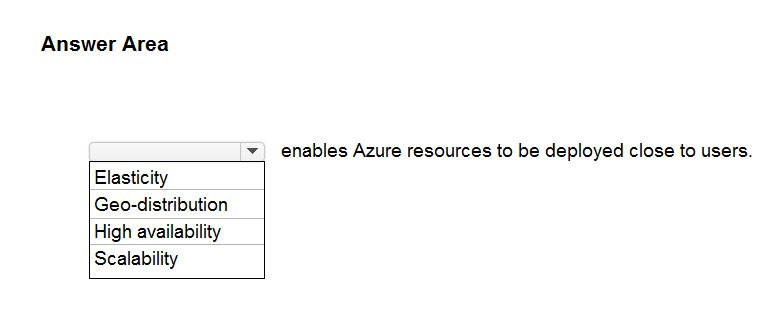
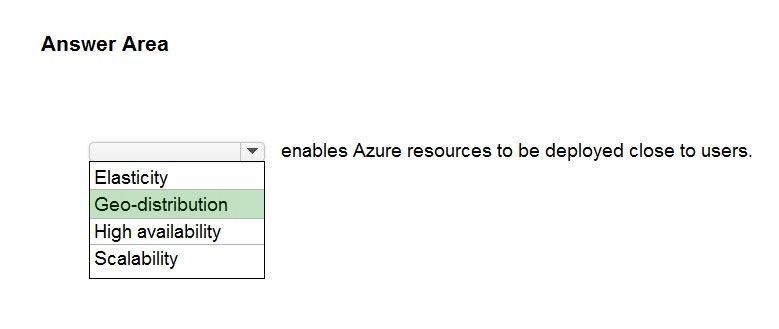
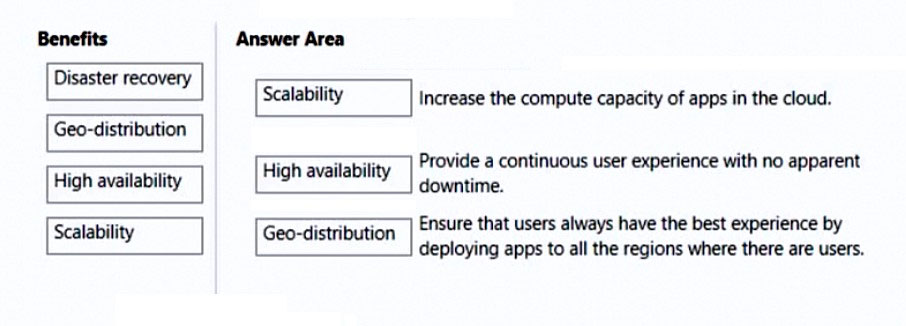
Because of geo-distribution you can deploy apps and data to regional datacenters around the globe, thereby ensuring that your customers always have the best performance in their region.
Reference:
https://docs.microsoft.com/learn/modules/fundamental-azure-concepts/benefits-of-cloud-computing
DRAG DROP –
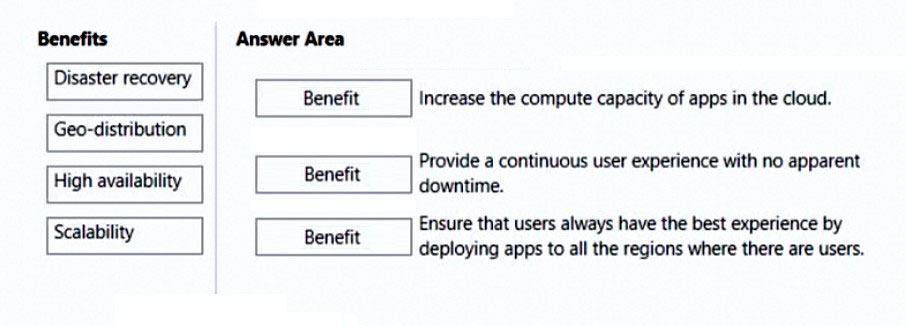
Match the cloud computing benefits to the appropriate descriptions.
To answer, drag the appropriate benefit from the column on the left to its description on the right. Each benefit may be used once, more than once, or not at all.
NOTE: Each correct match is worth one point.
Select and Place:
Reference:
https://docs.microsoft.com/learn/modules/fundamental-azure-concepts/benefits-of-cloud-computing
Which cloud computing benefit provides continuous user access to a cloud-based application with minimal downtime?
- A. agility
- B. scalability
- C. elasticity
- D. high availability
You need to identify the type of failure for which an Azure Availability Zone can be used to protect access to Azure services.
What should you identify?
- A. a physical server failure
- B. an Azure region failure
- C. a storage failure
- D. an Azure data center failure
HOTSPOT –
You plan to extend your company’s network to Azure.
The network contains a VPN appliance that uses an IP address of 131.107.200.1.
You need to create an Azure resource that defines the VPN appliance in Azure.
Which Azure resource should you create? To answer, select the appropriate resource in the answer area.
Hot Area:
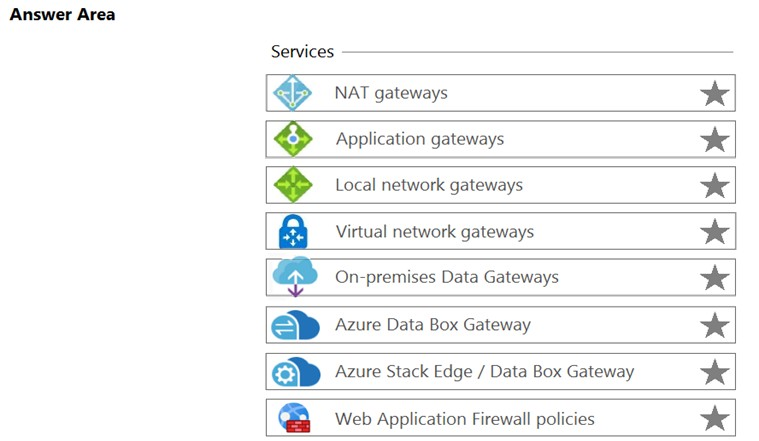
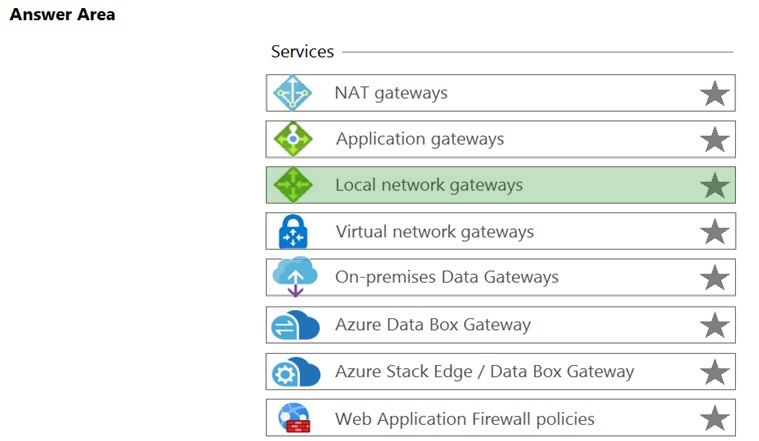
A Local Network Gateway is an object in Azure that represents your on-premise VPN device. A Virtual Network Gateway is the VPN object at the Azure end of the
VPN. A ‘connection’ is what connects the Local Network Gateway and the Virtual Network Gateway to bring up the VPN.
The local network gateway typically refers to your on-premises location. You give the site a name by which Azure can refer to it, then specify the IP address of the on-premises VPN device to which you will create a connection. You also specify the IP address prefixes that will be routed through the VPN gateway to the VPN device. The address prefixes you specify are the prefixes located on your on-premises network. If your on-premises network changes or you need to change the public IP address for the VPN device, you can easily update the values later.
Reference:
https://docs.microsoft.com/en-us/azure/vpn-gateway/vpn-gateway-howto-site-to-site-resource-manager-portal
Note: This question is part of a series of questions that present the same scenario. Each question in the series contains a unique solution that might meet the stated goals. Some question sets might have more than one correct solution, while others might not have a correct solution.
After you answer a question in this section, you will NOT be able to return to it. As a result, these questions will not appear in the review screen.
You plan to deploy several Azure virtual machines.
You need to ensure that the services running on the virtual machines are available if a single data center fails.
Solution: You deploy the virtual machines to two or more resource groups.
Does this meet the goal?
- A. Yes
- B. No
Note: This question is part of a series of questions that present the same scenario. Each question in the series contains a unique solution that might meet the stated goals. Some question sets might have more than one correct solution, while others might not have a correct solution.
After you answer a question in this section, you will NOT be able to return to it. As a result, these questions will not appear in the review screen.
You plan to deploy several Azure virtual machines.
You need to ensure that the services running on the virtual machines are available if a single data center fails.
Solution: You deploy the virtual machines to a scale set.
Does this meet the goal?
- A. Yes
- B. No
HOTSPOT –
For each of the following statements, select Yes if the statement is true. Otherwise, select No.
NOTE: Each correct selection is worth one point.
Hot Area:
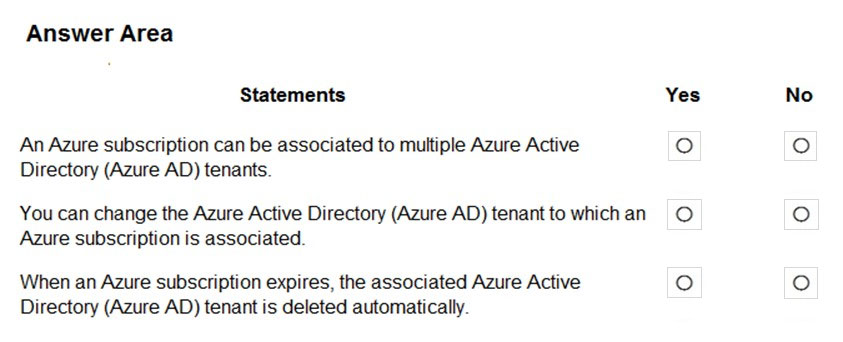
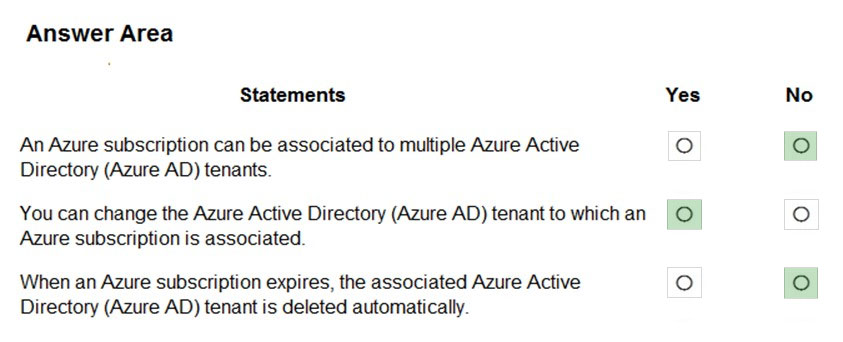
Box 1: No –
An Azure AD tenant can have multiple subscriptions but an Azure subscription can only be associated with one Azure AD tenant.
Box 2: Yes –
Box 3: No –
If your subscription expires, you lose access to all the other resources associated with the subscription. However, the Azure AD directory remains in Azure. You can associate and manage the directory using a different Azure subscription.
References:
https://docs.microsoft.com/en-us/azure/active-directory/fundamentals/active-directory-how-subscriptions-associated-directory