Free AZ-900 Dumps – 100% Updated and Complete, No Payment Required
Note: The question is included in a number of questions that depicts the identical set-up. However, every question has a distinctive result. Establish if the solution satisfies the requirements.
You are planning a strategy to deploy numerous web servers and database servers to Azure.
This strategy should allow for connection types between the web servers and database servers to be controlled.
Solution: You include network security groups (NSGs) in your strategy.
Does the solution meet the goal?
Note: The question is included in a number of questions that depicts the identical set-up. However, every question has a distinctive result. Establish if the solution satisfies the requirements.
You are planning a strategy to deploy numerous web servers and database servers to Azure.
This strategy should allow for connection types between the web servers and database servers to be controlled.
Solution: You include a local network gateway in your strategy.
Does the solution meet the goal?
Note: The question is included in a number of questions that depicts the identical set-up. However, every question has a distinctive result. Establish if the solution satisfies the requirements.
Your company’s Active Directory forest includes thousands of user accounts.
You have been informed that all network resources will be migrated to Azure. Thereafter, the on-premises data center will be retired.
You are required to employ a strategy that reduces the effect on users, once the planned migration has been completed.
Solution: You plan to require Azure Multi-Factor Authentication (MFA).
Does the solution meet the goal?
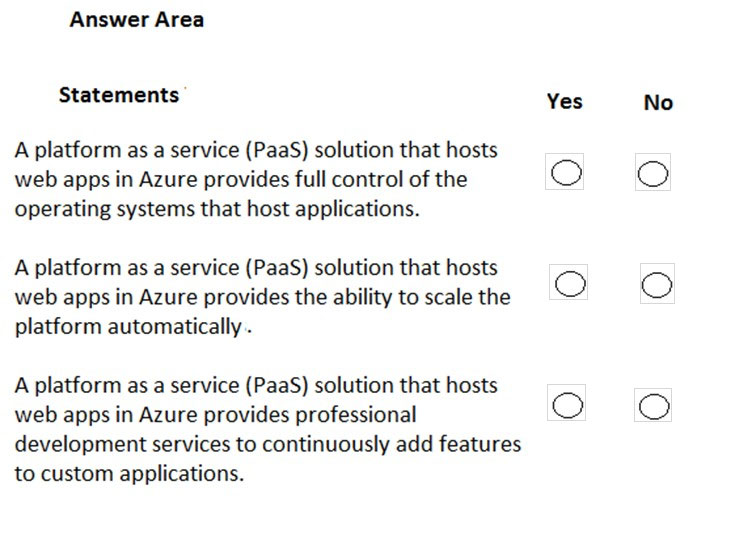
HOTSPOT –
For each of the following statements, select Yes if the statement is true. Otherwise, select No.
NOTE: Each correct selection is worth one point.
Hot Area:
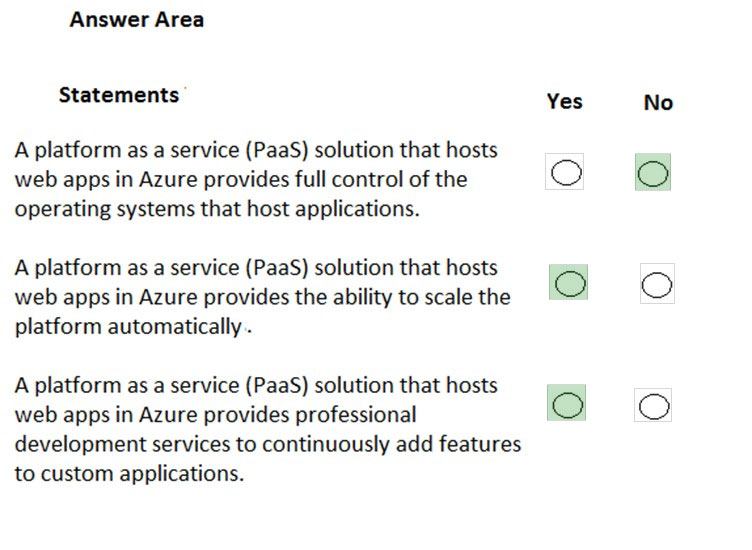
Box 1: No –
A PaaS solution does not provide access to the operating system. The Azure Web Apps service provides an environment for you to host your web applications.
Behind the scenes, the web apps are hosted on virtual machines running IIS. However, you have no direct access to the virtual machine, the operating system or
IIS.Box 2: Yes –
A PaaS solution that hosts web apps in Azure does provide the ability to scale the platform automatically. This is known as autoscaling. Behind the scenes, the web apps are hosted on virtual machines running IIS. Autoscaling means adding more load balanced virtual machines to host the web apps.Box 3: Yes –
PaaS provides a framework that developers can build upon to develop or customize cloud-based applications. PaaS development tools can cut the time it takes to code new apps with pre-coded application components built into the platform, such as workflow, directory services, security features, search and so on.
References:
https://azure.microsoft.com/en-gb/overview/what-is-paas/
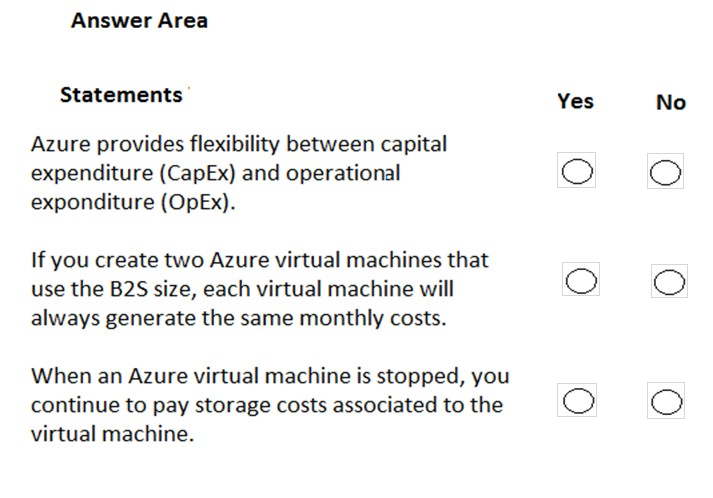
HOTSPOT –
For each of the following statements, select Yes if the statement is true. Otherwise, select No.
NOTE: Each correct selection is worth one point.
Hot Area:
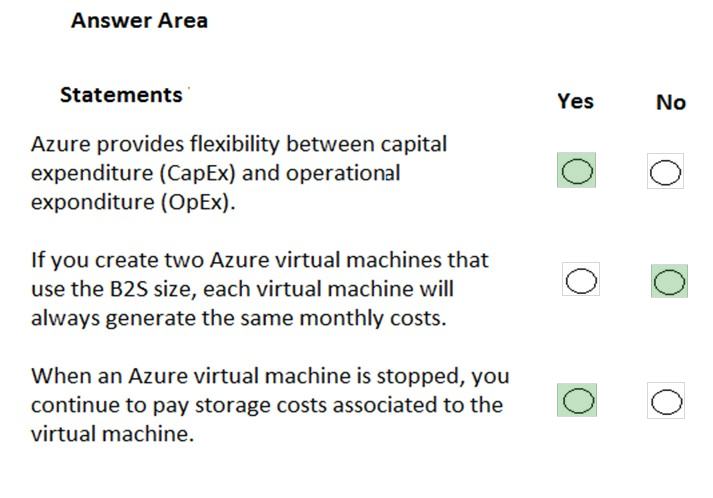
Box 1: Yes –
Traditionally, IT expenses have been considered a Capital Expenditure (CapEx). Today, with the move to the cloud and the pay-as-you-go model, organizations have the ability to stretch their budgets and are shifting their IT CapEx costs to Operating Expenditures (OpEx) instead. This flexibility, in accounting terms, is now an option due to the ג€as a Serviceג€ model of purchasing software, cloud storage and other IT related resources.Box 2: No –
Two virtual machines using the same size could have different disk configurations. Therefore, the monthly costs could be different.Box 3: Yes –
When an Azure virtual machine is stopped, you don’t pay for the virtual machine. However, you do still pay for the storage costs associated to the virtual machine.
The most common storage costs are for the disks attached to the virtual machines. There are also other storage costs associated with a virtual machine such as storage for diagnostic data and virtual machine backups.
References:
https://meritsolutions.com/capex-vs-opex-cloud-computing-blog/
HOTSPOT –
To complete the sentence, select the appropriate option in the answer area.
Hot Area:
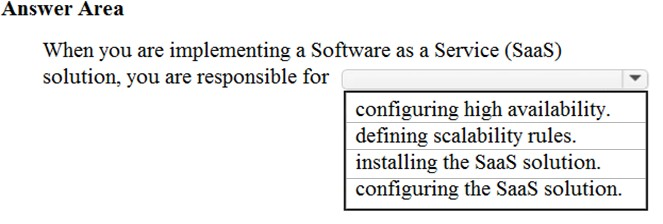
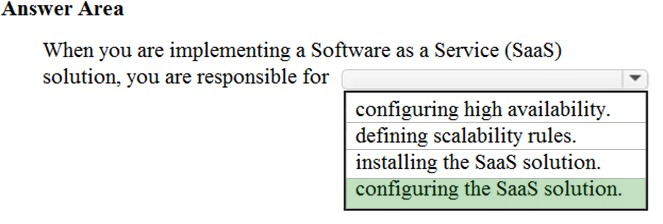
When you are implementing a Software as a Service (SaaS) solution, you are responsible for configuring the SaaS solution. Everything else is managed by the cloud provider.
SaaS requires the least amount of management. The cloud provider is responsible for managing everything, and the end user just uses the software.
Software as a service (SaaS) allows users to connect to and use cloud-based apps over the Internet. Common examples are email, calendaring and office tools
(such as Microsoft Office 365).
SaaS provides a complete software solution which you purchase on a pay-as-you-go basis from a cloud service provider. You rent the use of an app for your organization and your users connect to it over the Internet, usually with a web browser. All of the underlying infrastructure, middleware, app software and app data are located in the service provider’s data center. The service provider manages the hardware and software and with the appropriate service agreement, will ensure the availability and the security of the app and your data as well.
Reference:
https://azure.microsoft.com/en-in/overview/what-is-saas/
https://docs.microsoft.com/en-gb/learn/modules/principles-cloud-computing/5-types-of-cloud-services
You have an on-premises network that contains several servers.
You plan to migrate all the servers to Azure.
You need to recommend a solution to ensure that some of the servers are available if a single Azure data center goes offline for an extended period.
What should you include in the recommendation?
- A. fault tolerance
- B. elasticity
- C. scalability
- D. low latency
HOTSPOT –
To complete the sentence, select the appropriate option in the answer area.
Hot Area:
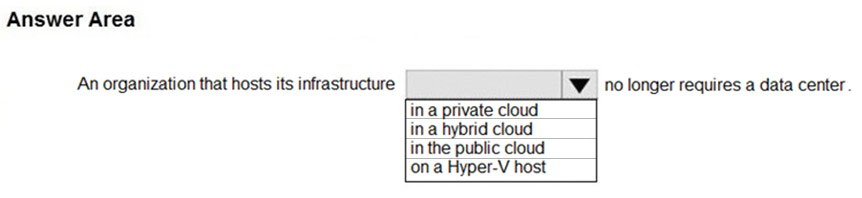
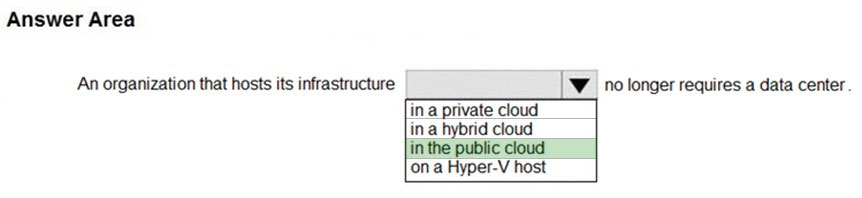
A private cloud is hosted in your datacenter. Therefore, you cannot close your datacenter if you are using a private cloud.
A public cloud is hosted externally, for example, in Microsoft Azure. An organization that hosts its infrastructure in a public cloud can close its data center.
Public cloud is the most common deployment model. In this case, you have no local hardware to manage or keep up-to-date ג€” everything runs on your cloud provider’s hardware.
Microsoft Azure is an example of a public cloud provider.
In a private cloud, you create a cloud environment in your own datacenter and provide self-service access to compute resources to users in your organization.
This offers a simulation of a public cloud to your users, but you remain completely responsible for the purchase and maintenance of the hardware and software services you provide.
Reference:
https://docs.microsoft.com/en-gb/learn/modules/principles-cloud-computing/4-cloud-deployment-models
What are two characteristics of the public cloud? Each correct answer presents a complete solution.
NOTE: Each correct selection is worth one point.
- A. dedicated hardware
- B. unsecured connections
- C. limited storage
- D. metered pricing
- E. self-service management
HOTSPOT –
To complete the sentence, select the appropriate option in the answer area.
Hot Area:
Pages: Page 1, Page 2, Page 3, Page 4, Page 5, Page 6, Page 7, Page 8, Page 9, Page 10, Page 11, Page 12, Page 13, Page 14, Page 15, Page 16, Page 17, Page 18, Page 19, Page 20, Page 21, Page 22, Page 23, Page 24, Page 25, Page 26, Page 27, Page 28, Page 29, Page 30, Page 31, Page 32, Page 33, Page 34, Page 35, Page 36, Page 37, Page 38, Page 39, Page 40, Page 41, Page 42, Page 43, Page 44, Page 45