
Pass Microsoft AZ-900 in Just 3 Days – Stress-Free, No Study Needed!
Have questions? Contact us directly on WhatsApp for quick support!
In which type of cloud model are all the hardware resources owned by a third-party and shared between multiple tenants?
- A. private
- B. hybrid
- C. public
HOTSPOT –
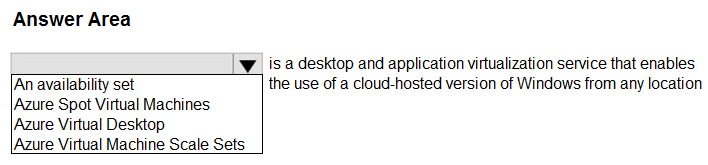
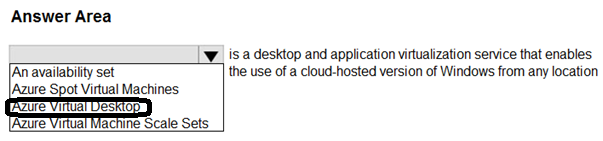
Select the answer that correctly completes the sentence.
You have 1,000 virtual machines hosted on the Hyper-V hosts in a data center.
You plan to migrate all the virtual machines to an Azure pay-as-you-go subscription.
You need to identify which expenditure model to use for the planned Azure solution.
Which expenditure model should you identify?
- A. operational
- B. elastic
- C. capital
- D. scalable
DRAG DROP –
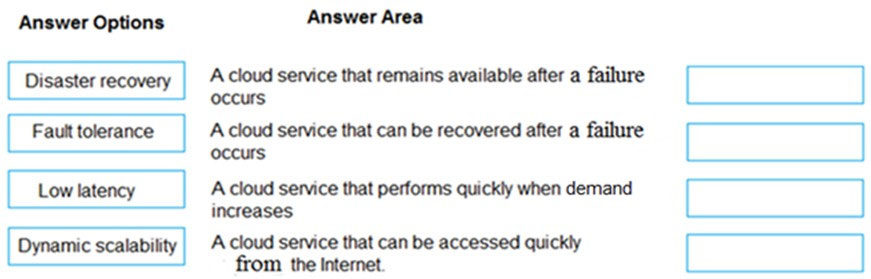
Match the Azure services benefits to the correct descriptions.
Instructions: To answer, drag the appropriate benefit from the column on the left to its description on the right. Each benefit may be used once, more than once, or not at all.
NOTE: Each correct match is worth one point.
Select and Place:
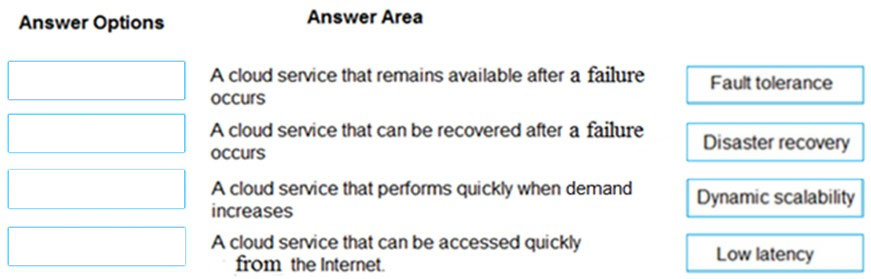
Box 1:
Fault tolerance is the ability of a service to remain available after a failure of one of the components of the service. For example, a service running on multiple servers can withstand the failure of one of the servers.
Box 2:
Disaster recovery is the recovery of a service after a failure. For example, restoring a virtual machine from backup after a virtual machine failure.
Box 3:
Dynamic scalability is the ability for compute resources to be added to a service when the service is under heavy load. For example, in a virtual machine scale set, additional instances of the virtual machine are added when the existing virtual machines are under heavy load.
Box 4:
Latency is the time a service to respond to requests. For example, the time it takes for a web page to be returned from a web server. Low latency means low response time which means a quicker response.
References:
https://msdn.microsoft.com/en-us/magazine/mt422582.aspx
https://searchdisasterrecovery.techtarget.com/definition/cloud-disaster-recovery-cloud-DR http://www.siasmsp.com/the-benefit-of-scalability-in-cloud-computing-2/ https://azure.microsoft.com/en-in/overview/what-is-cloud-computing/
HOTSPOT –
For each of the following statements, select Yes if the statement is true. Otherwise, select No.
NOTE: Each correct selection is worth one point.
Hot Area:
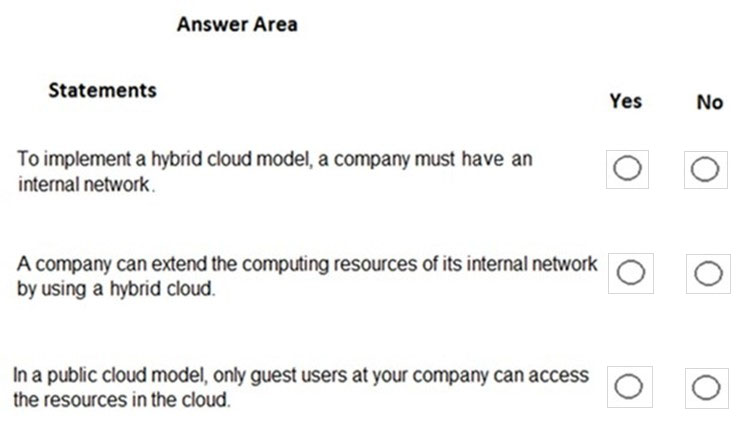
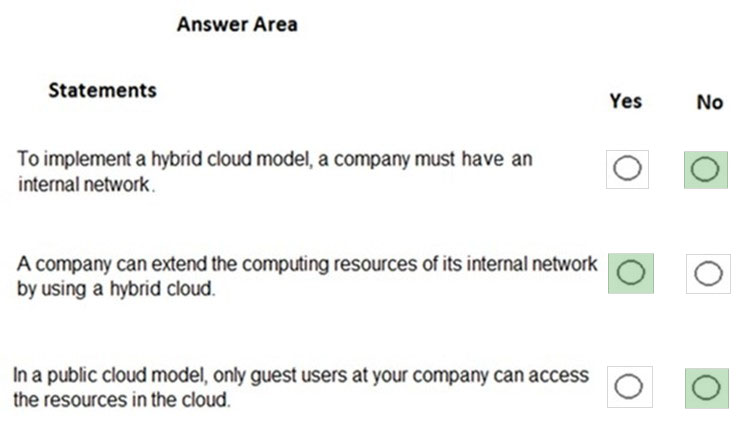
Box 1: No –
It is not true that a company must always migrate from an internal network to implement a hybrid cloud. You could start with a public cloud and then combine that with an on-premise infrastructure to implement a hybrid cloud.
Box 2: Yes –
A company can extend the computing resources of its internal network by using the public cloud. This is very common. When you need more resources, rather than pay out for new on-premises infrastructure, you can configure a cloud environment and connect your on-premises network to the cloud environment by using a VPN.
Box 3: No –
It is not true that only guest users can access cloud resources. You can give anyone with an account in Azure Active Directory access to the cloud resources.
There are many authentication scenarios but a common one is to replicate your on-premises Active Directory accounts to Azure Active Directory and provide access to the Azure Active Directory accounts. Another commonly used authentication method is ‘Federation’ where authentication for access to cloud resources is passed to another authentication provider such as an on-premises Active Directory.
Reference:
https://azure.microsoft.com/en-gb/overview/what-is-hybrid-cloud-computing/
NOTE: Each correct selection is worth one point.
Hot Area:
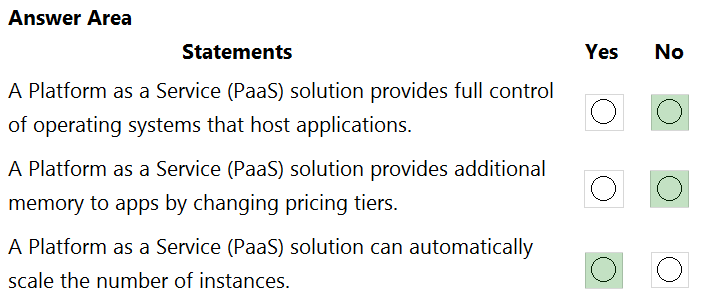
Your company has an on-premises network that contains multiple servers.
The company plans to reduce the following administrative responsibilities:
✑ Backing up application data
✑ Replacing failed server hardware
✑ Managing physical server security
✑ Updating server operating systems
✑ Managing permissions to shared documents
The company plans to migrate servers to Azure virtual machines.
You need to identify which administrative responsibilities will be eliminated after the planned migration.
Which two responsibilities should you identify? Each correct answer presents a complete solution.
NOTE: Each correct selection is worth one point.
- A. Replacing failed server hardware
- B. Backing up application data
- C. Managing physical server security
- D. Updating server operating systems
- E. Managing permissions to shared documents
HOTSPOT –
For each of the following statements, select Yes if the statement is true. Otherwise, select No.
NOTE: Each correct selection is worth one point.
Hot Area:
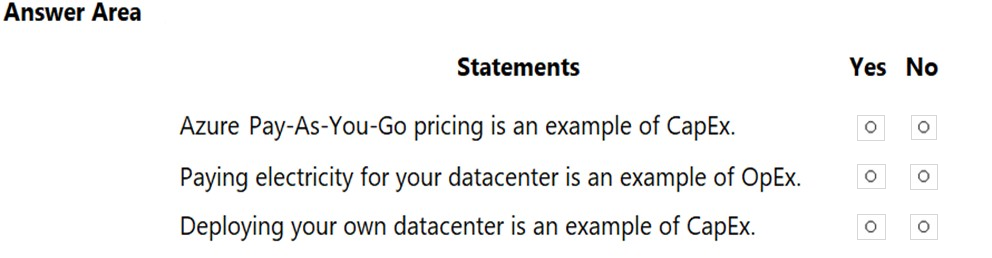
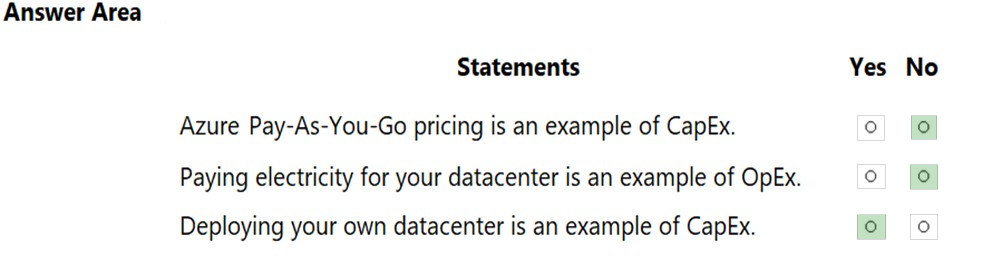
One of the major changes that you will face when you move from on-premises cloud to the public cloud is the switch from capital expenditure (buying hardware) to operating expenditure (paying for service as you use it).
Box 1: No –
With the pay-as-go model, you pay for services as you use them. This is Opex (Operational Expenditure), not CapEx (Captial Expenditure). CapEx is where you pay for something upfront. For example, buying a new physical server.
Box 2: No –
Paying for electricity for your own datacenter will be classed as CapEx, not OpEx.
Box 3: Yes –
Deploying your own datacenter is an example of CapEx. This is because you need to purchase all the infrastructure upfront before you can use it.
Reference:
https://docs.microsoft.com/en-us/azure/architecture/cloud-adoption/appendix/azure-scaffold
You plan to provision Infrastructure as a Service (IaaS) resources in Azure.
Which resource is an example of IaaS?
- A. an Azure web app
- B. an Azure virtual machine
- C. an Azure logic app
- D. an Azure SQL database
To which cloud models can you deploy physical servers?
- A. private cloud and hybrid cloud only
- B. private cloud only
- C. private cloud, hybrid cloud and public cloud
- D. hybrid cloud only