
Pass Microsoft AZ-900 in Just 3 Days – Stress-Free, No Study Needed!
Have questions? Contact us directly on WhatsApp for quick support!
DRAG DROP –
Match the cloud model to the correct advantage.
Instructions: To answer, drag the appropriate cloud model from the column on the left to its advantage on the right. Each cloud model may be used once, more than once, or not at all.
NOTE: Each correct match is worth one point
Select and Place:


Box 1: Public Cloud –
With a public cloud, there is no capital expenditure on server hardware etc. You only pay for cloud resources that you use as you use them.
Box 2: Private Cloud –
A private cloud exists on premises, so you have complete control over security.
Box 3: Hybrid Cloud –
A hybrid cloud is a mix of public cloud resources and on-premises resources. Therefore, you have a choice to use either.
HOTSPOT –
For each of the following statements, select Yes if the statement is true. Otherwise, select No.
NOTE: Each correct selection is worth one point.
Hot Area:
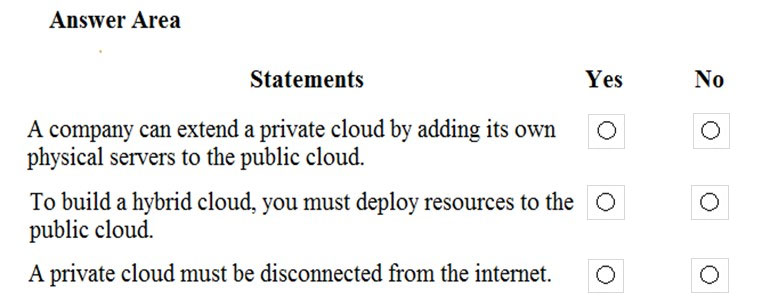
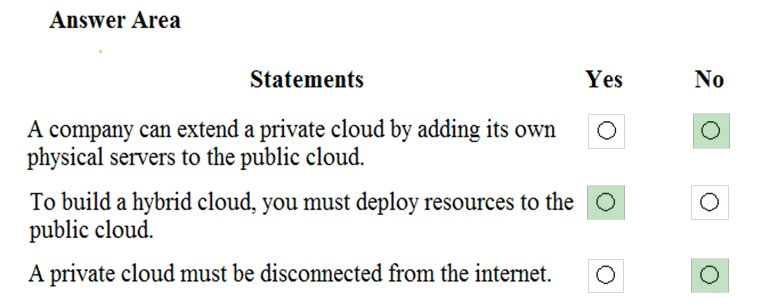
Box 1: No –
You cannot add physical servers to the public cloud. You can only deploy virtual servers in the public cloud. You can extend a private cloud by deploying virtual servers in a public cloud. This would create a hybrid cloud.
Box 2: Yes –
A hybrid cloud is a combination of a private cloud and public cloud. Therefore, to create a hybrid cloud, you must deploy resources to a public cloud.
Box 3: No.
It is not true that a private cloud must be disconnected from the Internet. Private clouds can be and most commonly are connected to the Internet. ג€Private cloudג€ means that the physical servers are managed by you. It does not mean that it is disconnected from the Internet.
Reference:
https://azure.microsoft.com/en-gb/overview/what-are-private-public-hybrid-clouds/
You have 50 virtual machines hosted on-premises and 50 virtual machines hosted in Azure. The on-premises virtual machines and the Azure virtual machines connect to each other.
Which type of cloud model is this?
- A. hybrid
- B. private
- C. public
HOTSPOT –
For each of the following statements, select Yes if the statement is true. Otherwise, select No.
NOTE: Each correct selection is worth one point.
Hot Area:
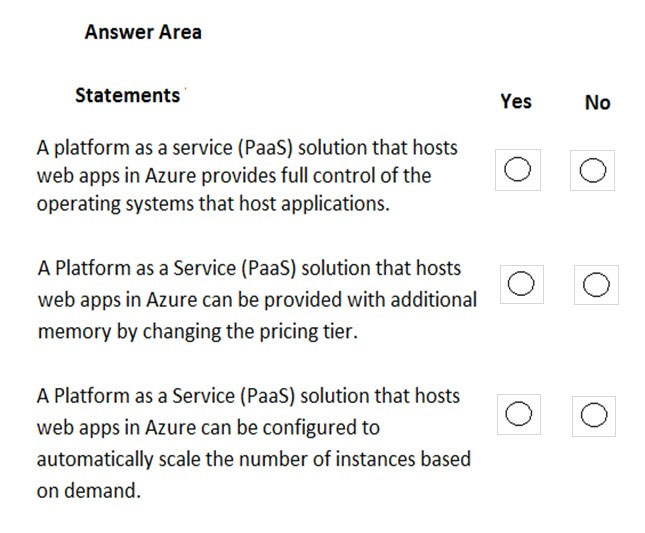
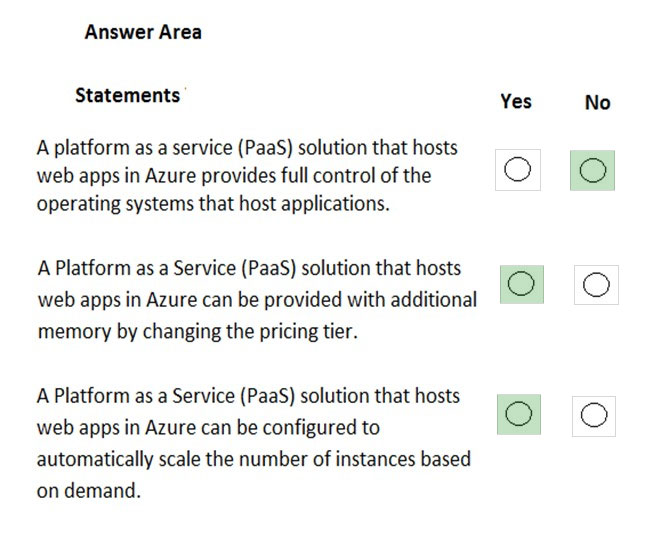
A PaaS solution does not provide access to the operating system. The Azure Web Apps service provides an environment for you to host your web applications.
Behind the scenes, the web apps are hosted on virtual machines running IIS. However, you have no direct access to the virtual machine, the operating system or
IIS.Box 2: Yes -Box 3: Yes –
A PaaS solution that hosts web apps in Azure does provide the ability to scale the platform automatically. This is known as autoscaling. Behind the scenes, the web apps are hosted on virtual machines running IIS. Autoscaling means adding more load balanced virtual machines to host the web apps.
References:
https://azure.microsoft.com/en-gb/overview/what-is-paas/
Note: This question is part of a series of questions that present the same scenario. Each question in the series contains a unique solution that might meet the stated goals. Some question sets might have more than one correct solution, while others might not have a correct solution.
After you answer a question in this section, you will NOT be able to return to it. As a result, these questions will not appear in the review screen.
Your company plans to migrate all its data and resources to Azure.
The company’s migration plan states that only Platform as a Service (PaaS) solutions must be used in Azure.
You need to deploy an Azure environment that meets the company migration plan.
Solution: You create Azure virtual machines, Azure SQL databases, and Azure Storage accounts.
Does this meet the goal?
- A. Yes
- B. No
Your company plans to deploy several custom applications to Azure. The applications will provide invoicing services to the customers of the company. Each application will have several prerequisite applications and services installed.
You need to recommend a cloud deployment solution for all the applications.
What should you recommend?
- A. Software as a Service (SaaS)
- B. Platform as a Service (PaaS)
- C. Infrastructure as a Service (laaS)
HOTSPOT –
For each of the following statements, select Yes if the statement is true. Otherwise, select No.
NOTE: Each correct selection is worth one point.
Hot Area:
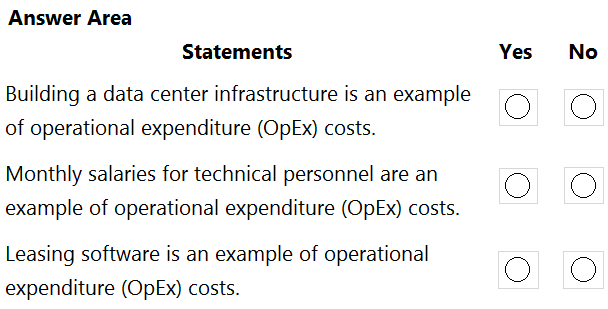
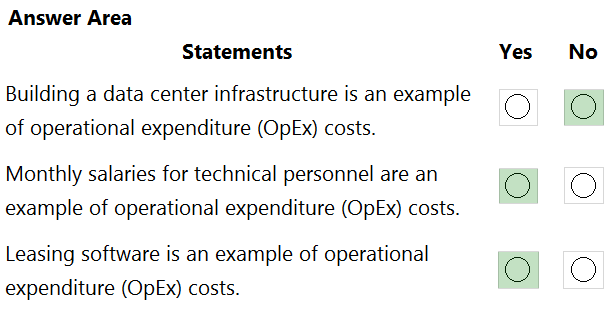
Box 1: No –
Building a data center infrastructure is capital expenditure, not operation expenditure.
Box 2: Yes –
OpEx is ongoing costs (costs of operations) such as staff salaries.
Box 2: Yes –
OpEx is ongoing costs (costs of operations) such as leasing software. If you purchased software as a one-off purchase, that would be CapEx, but leasing software is ongoing so it’s OpEx.
HOTSPOT –
To complete the sentence, select the appropriate option in the answer area.
Hot Area:
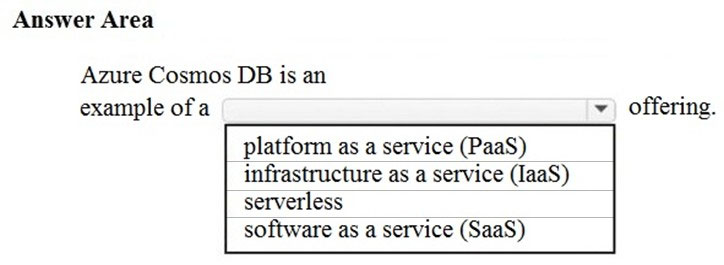
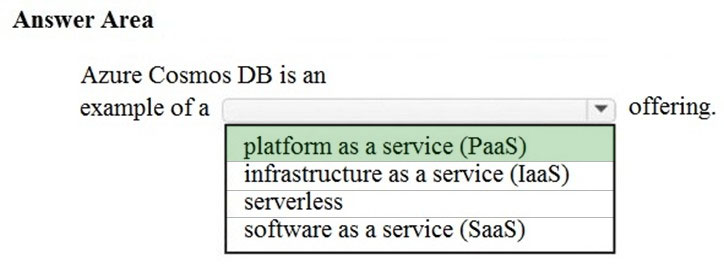
Azure Cosmos DB is an example of a platform as a service (PaaS) cloud database provider.
Reference:
https://docs.microsoft.com/en-us/azure/cosmos-db/database-security
HOTSPOT –
For each of the following statements, select Yes if the statement is true. Otherwise, select No.
NOTE: Each correct selection is worth one point.
Hot Area:
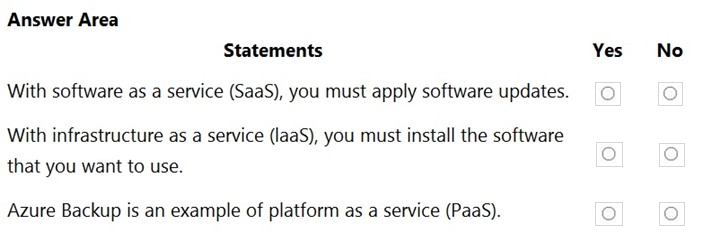
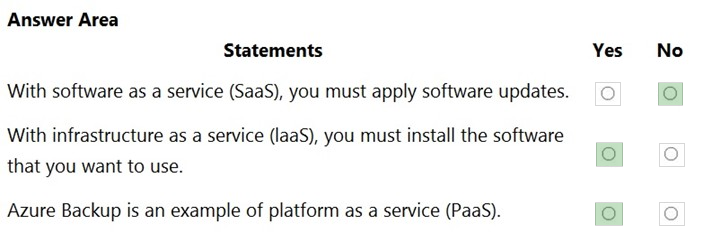
Reference:
https://azure.microsoft.com/en-us/overview/what-is-saas/
https://azure.microsoft.com/en-us/overview/what-is-iaas/
https://azure.microsoft.com/en-us/overview/what-is-paas/
HOTSPOT –
For each of the following statements, select Yes if the statement is true. Otherwise, select No.
NOTE: Each correct selection is worth one point.
Hot Area:
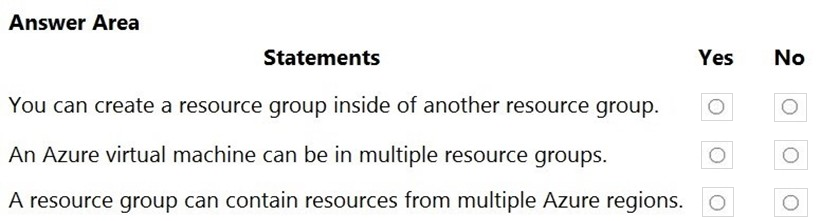
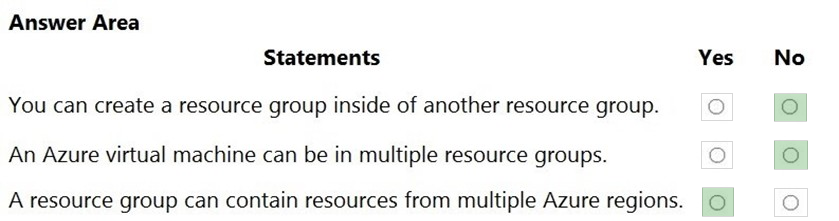
Box 1: No –
Box 2: No –
Each resource can exist in only one resource group.
Box 3: Yes –
Resources from multiple different regions can be placed in a resource group. The resource group only contains metadata about the resources it contains.
Reference:
https://docs.microsoft.com/en-us/azure/azure-resource-manager/resource-group-overview https://www.codeisahighway.com/effective-ways-to-delete-resources-in-a-resource-group-on-azure/