


Microsoft SC-100 Free Exam Questions 321-340 with Answers
Scenario-based practice questions for the Microsoft SC-100 Cybersecurity Architect exam. Each question includes a clear answer, a plain-English explanation, and a reference link to official Microsoft documentation. Work through them as a diagnostic, then focus your study time on the gaps they reveal.
SC-100 Practice Questions 321-325
Question 321
HOTSPOT
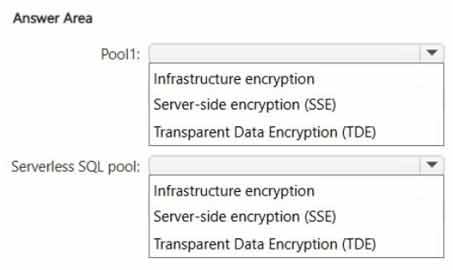
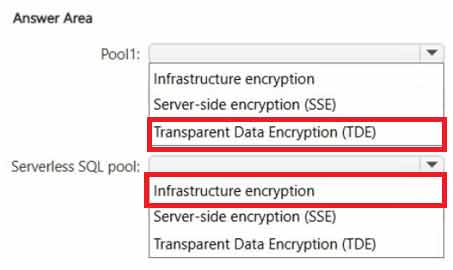
You have an Azure subscription that contains an Azure Synapse Analytics workspace named workspace1. workspace1 contains a built-in serverless SQL pool and a dedicated SQL pool named Pool1.
You need to recommend a second layer of data encryption for workspace1.
What should you include in the recommendation for each pool? To answer, select the appropriate options in the answer area.
NOTE: Each correct selection is worth one point.
Reference: Azure Synapse Analytics workspace encryption
Question 322
You have an on-premises app that processes Personally Identifiable Information (PII) and sends the data to Azure. The app includes the following components:
• APIs that receive and send the PII
• A data ingestion pipeline that stores the PII in an Azure Data Lake Storage Gen2 account
A compliance policy requires that all the PII data be encrypted by using encryption keys that are regularly rotated and stored in a central repository.
You need to recommend a solution that adhere to the compliance policy. The solution must minimize administrative effort.
Which two components should you include in the recommendation? Each correct answer presents part of the solution.
NOTE: Each correct selection is worth one point
Reference: Azure Storage service-side encryption
Question 323
HOTSPOT
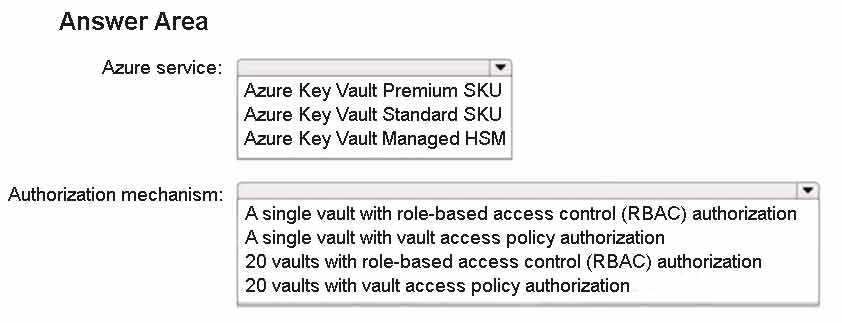
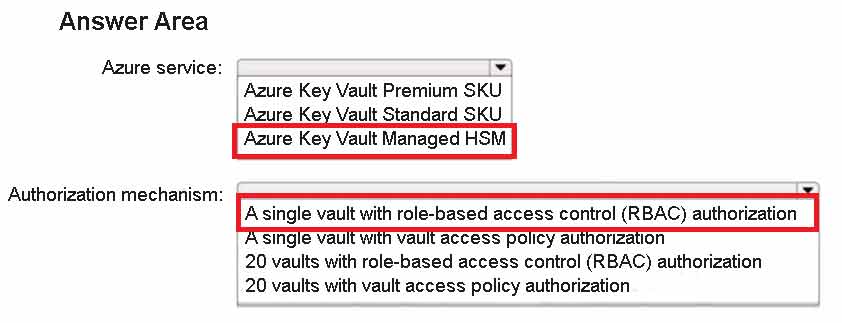
You have an Azure subscription. The subscription contains 20 App Service web apps that provide services to external customers. Each web app has a unique certificate and key.
You need to recommend a solution to manage the keys and certificates of the web apps. The solution must meet the follow requirements:
• Provide a single tenancy to store the keys and certificates.
• Maintain FIPS 140-2 Level 3 compliance.
• Follow the principle of least privilege.
• Minimize costs.
• Minimize administrative effort.
What should you include in the recommendation? To answer, select the appropriate options in the answer area.
NOTE: Each correct selection is worth one point.
Reference: Azure Key Vault overview
Question 324
You have a Microsoft Entra tenant that contains 800 Microsoft Entra joined devices and 700 users. Each user is assigned a single device. All the devices are onboarded to Global Secure Access.
You use a software as a service (SaaS) app named App1 that is hosted by a third party. Users access App1 through the internet.
You need to ensure that all the devices access App1 by using the Global Secure Access client.
What should you use?
Reference: Traffic forwarding profiles in Global Secure Access
Question 325
You have a Microsoft Entra tenant that uses Microsoft Entra Private Access.
You plan to publish a group of internal web apps by using a Global Secure Access application.
You need to ensure that users can access the web apps by connecting through the Global Secure Access application.
What should you use?
Reference: Connectors in Microsoft Entra Private Access
SC-100 Practice Questions 326-330
Question 326
Your company wants to optimize using Microsoft Defender for Endpoint to protect its resources against ransomware based on Microsoft Security Best Practices.
You need to prepare a post-breach response plan for compromised computers based on the Microsoft Detection and Response Team (DART) approach in Microsoft Security Best Practices.
What should you include in the response plan?
Reference: Take response actions on a device in Defender for Endpoint
Question 327
You have an operational model based on the Microsoft Cloud Adoption Framework for Azure.
You need to recommend a solution that focuses on cloud-centric control areas to protect resources such as endpoints, databases, files, and storage accounts.
What should you include in the recommendation?
Reference: Microsoft cloud security benchmark overview
Question 328
HOTSPOT
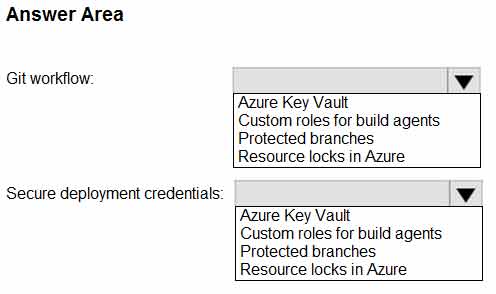
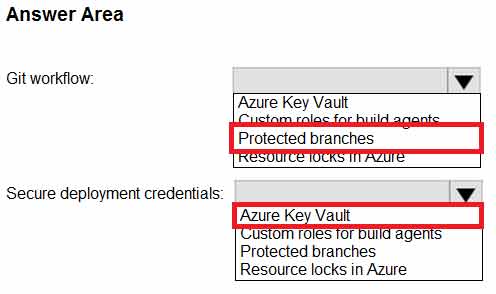
You use Azure Policy with Azure Repos to implement continuous integration and continuous deployment (CI/CD) workflows.
You need to recommend best practices to secure the stages of the CI/CD workflows based on the Microsoft Cloud Adoption Framework for Azure.
What should you include in the recommendation for each stage? To answer, select the appropriate options in the answer area.
NOTE: Each correct selection is worth one point.
Reference: Secure DevOps in the Microsoft Cloud Adoption Framework
Question 329
HOTSPOT
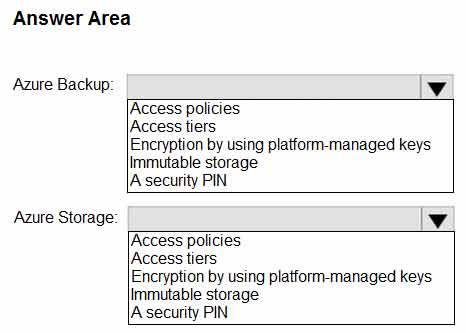
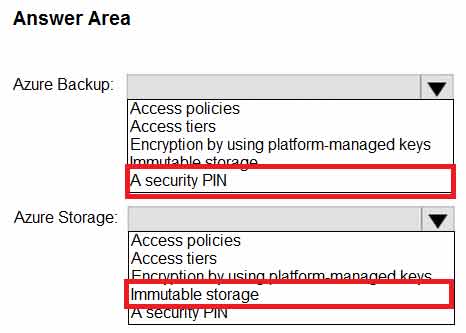
Your company wants to optimize using Azure to protect its resources from ransomware.
You need to recommend which capabilities of Azure Backup and Azure Storage provide the strongest protection against ransomware attacks. The solution must follow Microsoft Security Best Practices.
What should you recommend? To answer, select the appropriate options in the answer area.
NOTE: Each correct selection is worth one point.
Reference: Immutable vault for Azure Backup
Question 330
You have an Azure AD tenant that syncs with an Active Directory Domain Services (AD DS) domain.
You have an on-premises datacenter that contains 100 servers. The servers run Windows Server and are backed up by using Microsoft Azure Backup Server (MABS).
You are designing a recovery solution for ransomware attacks. The solution follows Microsoft Security Best Practices.
You need to ensure that a compromised administrator account cannot be used to delete the backups.
What should you do?
Reference: Multi-user authorization for Azure Backup
SC-100 Practice Questions 331-335
Question 331
You are designing a ransomware response plan that follows Microsoft Security Best Practices.
You need to recommend a solution to limit the scope of damage of ransomware attacks without being locked out.
What should you include in the recommendation?
Reference: Manage emergency access accounts in Microsoft Entra ID
Question 332
You design cloud-based software as a service (SaaS) solutions.
You need to recommend a recovery solution for ransomware attacks. The solution must follow Microsoft Security Best Practices.
What should you recommend doing first?
Reference: Security rapid modernization plan in Microsoft Security Best Practices
Question 333
HOTSPOT
You need to recommend a security methodology for a DevOps development process based on the Microsoft Cloud Adoption Framework for Azure.
During which stage of a continuous integration and continuous deployment (CI/CD) DevOps process should each security-related task be performed? To answer, select the appropriate options in the answer area.
NOTE: Each correct selection is worth one point.
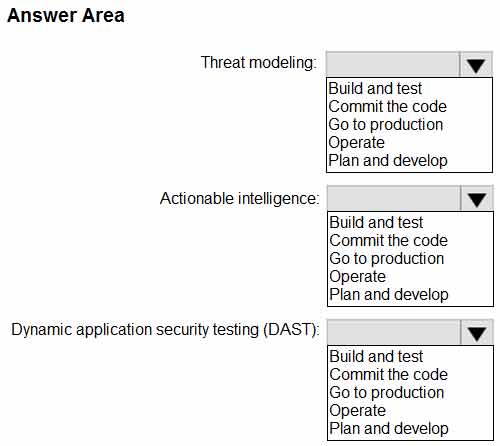
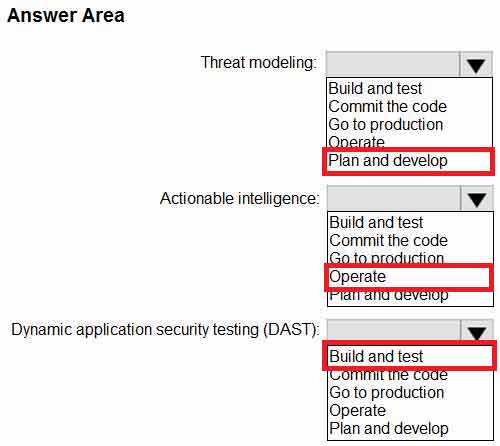
Reference: Secure DevOps in the Microsoft Cloud Adoption Framework
Question 334
You use Azure Pipelines with Azure Repos to implement continuous integration and continuous deployment (CI/CD) workflows for the deployment of applications to Azure.
You need to recommend what to include in dynamic application security testing (DAST) based on the principles of the Microsoft Cloud Adoption Framework for Azure.
What should you recommend?
Reference: Secure DevOps in the Microsoft Cloud Adoption Framework
Question 335
You have a Microsoft 365 subscription.
You are designing a user access solution that follows the Zero Trust principles of the Microsoft Cybersecurity Reference Architectures (MCRA).
You need to recommend a solution that automatically restricts access to Microsoft Exchange Online, SharePoint Online, and Teams in near-real-time (NRT) in response to the following Azure AD events:
• A user account is disabled or deleted.
• The password of a user is changed or reset.
• All the refresh tokens for a user are revoked.
• Multi-factor authentication (MFA) is enabled for a user.
Which two features should you include in the recommendation? Each correct answer presents part of the solution.
NOTE: Each correct selection is worth one point.
Reference: Continuous access evaluation in Microsoft Entra ID
Question 336
HOTSPOT
You have an Azure subscription and an on-premises datacenter. The datacenter contains 100 servers that run Windows Server. All the servers are backed up to a Recovery Services vault by using Azure Backup and the Microsoft Azure Recovery Services (MARS) agent.
You need to design a recovery solution for ransomware attacks that encrypt the on-premises servers. The solution must follow Microsoft Security Best Practices and protect against the following risks:
• A compromised administrator account used to delete the backups from Azure Backup before encrypting the servers
• A compromised administrator account used to disable the backups on the MARS agent before encrypting the servers
What should you use for each risk? To answer, select the appropriate options in the answer area.
NOTE: Each correct selection is worth one point.
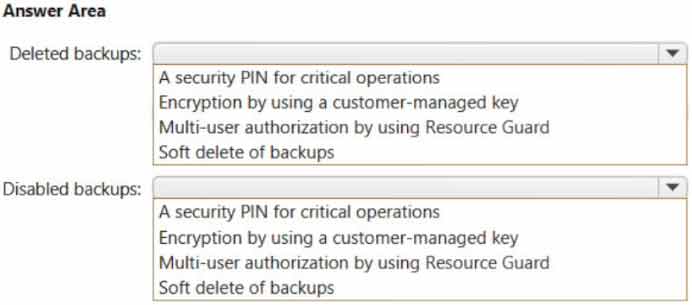
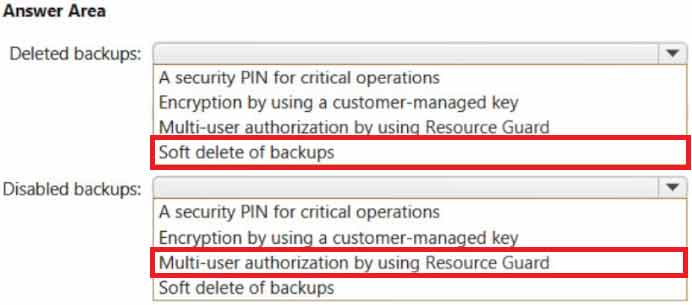
Reference: Multi-user authorization for Azure Backup
Question 337
You have an Azure subscription.
You plan to deploy Azure Kubernetes Service (AKS) clusters that will be used to host web services.
You need to recommend an ingress controller solution that will protect the hosted web services.
What should you include in the recommendation?
Reference: What is Application Gateway Ingress Controller?
Question 338
Your company has an Azure subscription that uses Microsoft Defender for Cloud.
The company signs a contract with the United States government.
You need to review the current subscription for NIST 800-53 compliance.
What should you do first?
Reference: NIST SP 800-53 Revision 5 regulatory compliance controls in Azure Policy
Question 339
Your company has on-premises datacenters in Seattle, Chicago, and New York City.
You plan to migrate the on-premises workloads to the East US Azure region.
You need to design a governance solution for the management group hierarchy. The solution must be based on Microsoft Cloud Adoption Framework for Azure principles and must ensure that the hierarchy aligns with the Azure landing conceptual architecture.
What should you use to identify which archetype-aligned management groups to create beneath the landing zones management group?
Reference: Management groups in the Azure landing zone design area
Question 340
HOTSPOT
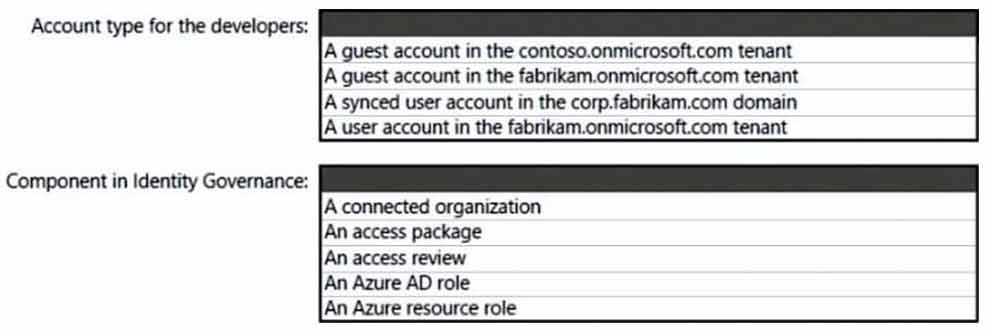
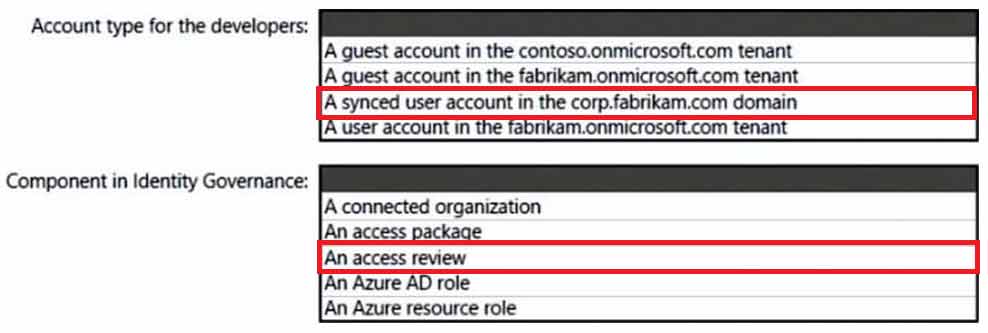
What should you create in Azure AD to meet the Contoso developer requirements?
Hot Area:
Reference: Role-based access control in Microsoft Entra ID