


Microsoft SC-100 Free Exam Questions 221-240 with Answers
Scenario-based practice questions for the Microsoft SC-100 Cybersecurity Architect exam. Each question includes a clear answer, a plain-English explanation, and a reference link to official Microsoft documentation. Work through them as a diagnostic, then focus your study time on the gaps they reveal.
SC-100 Practice Questions 221-225
Question 221
You have a multicloud environment that contains an Azure subscription, an Amazon Web Services (AWS) subscription, and a Google Cloud Platform (GCP) subscription.
You plan to assess data security and compliance.
You need to design a Compliance Manager solution that meets the following requirements:
• Provides recommended improvement actions that include detailed implementation guidance
• Automatically monitors regulatory compliance
• Minimizes administrative effort
What should you include in the solution?
Reference: Compliance Manager connectors
Question 222
HOTSPOT
You have 1,000 on-premises servers that run Linux.
You have an Azure subscription that contains a Microsoft Sentinel workspace named WS1 and 1,000 virtual machines that run Linux.
All the on-premises Linux servers are onboarded to Azure Arc.
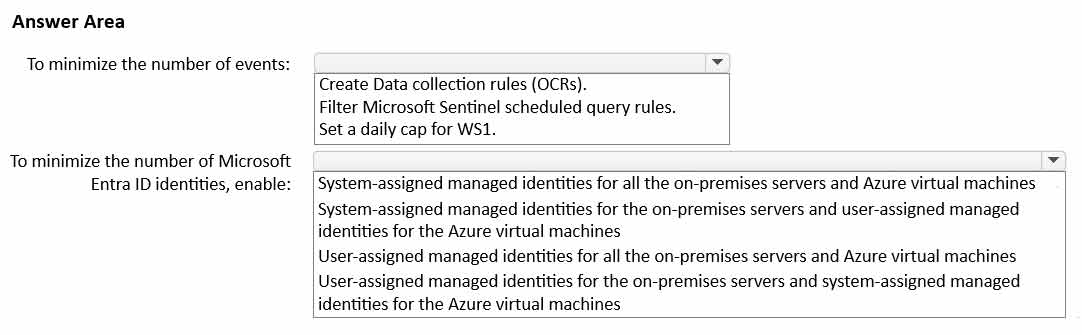
You plan to collect Common Event Format (CEF) logs by using the Azure Monitor Agent connector in Microsoft Sentinel.
You need to design a solution for collecting specific events from the logs. The solution must meet the following requirements:
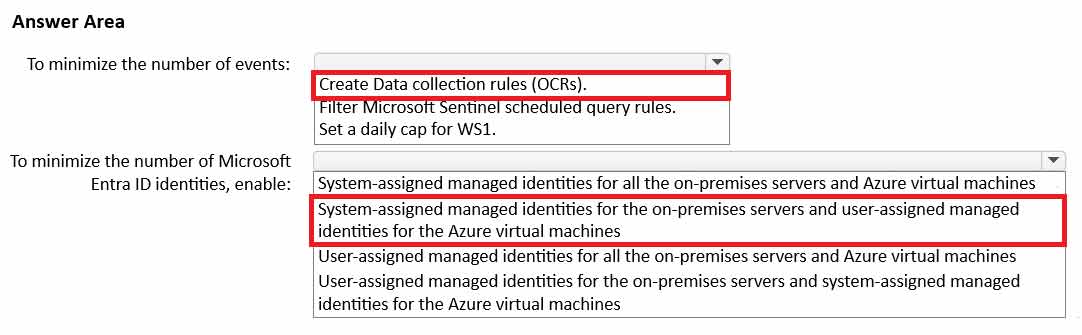
• Minimize the number of Microsoft Entra ID identities required.
• Minimize the number of events delivered to WS1.
• Ensure that all the required events are ingested.
• Minimize administrative effort.
What should you include in the solution? To answer, select the options in the answer area.
NOTE: Each correct answer is worth one point.
Reference: Ingest CEF logs with the AMA connector in Microsoft Sentinel
Question 223
Your on-premises network contains an Active Directory Domain Services (AD DS) domain. The domain contains a server named Serve1 that runs Windows Server 2022.
You have an Azure subscription that is linked to a hybrid Microsoft Entra tenant and contains a user named User1. User1 works remotely.
You need to ensure that User1 can establish RDP connections to Server1 via the internet. The solution must ensure that User1 authenticates by using multifactor authentication (MFA).
What should you include in the solution?
Reference: What is Microsoft Entra Private Access?
Question 224
You have a multicloud environment that contains an Azure subscription, an Amazon Web Services (AWS) subscription, and a Google Cloud Platform (GCP) subscription.
You plan to implement Cloud Security Posture Management (CSPM) by using Microsoft Defender for Cloud.
You need to design a solution that will provide attack path analysis functionality for each subscription.
What should you include in the solution?
Reference: Attack path analysis in Defender for Cloud
Question 225
You have an Azure subscription. The subscription contains 200 virtual machines that run Windows Server 2022 and are protected by using Microsoft Defender for Servers Plan 1. You have an Amazon Web Services (AWS) subscription.
To the AWS subscription, you plan to deploy 100 virtual machines that run Windows Server 2022.
You need to recommend which agent to deploy to the virtual machines in the AWS subscription. The solution must meet the following requirements:
• Provide consistent workload protection across all cloud platforms.
• Minimize the number of agents deployed to each virtual machine.
What should you recommend?
Reference: Multicloud security with Microsoft Defender for Cloud
SC-100 Practice Questions 226-230
Question 226
You have an Azure subscription. The subscription contains 100 virtual machines that run Linux on Windows Server. The subscription uses Microsoft Defender for Servers Plan 1.
You need to recommend a solution to identify and remediate virtual machines that have the following characteristics:
• Are NOT onboarded to Defender for Servers
• Are missing critical updates
• Have risky apps installed
The solution must minimize administrative effort.
What should you include in the recommendation?
Reference: Microsoft Defender Vulnerability Management overview
Question 227
You have a Microsoft 365 E5 subscription. The subscription contains 500 devices that run Windows 11 Pro and are enrolled in Microsoft Intune.
You need to evaluate the use of Microsoft Defender Vulnerability Management to provide recommended configuration changes for the devices.
Which Endpoint security settings should you use to review the recommended changes?
Reference: Manage vulnerabilities with security tasks in Intune
Question 228
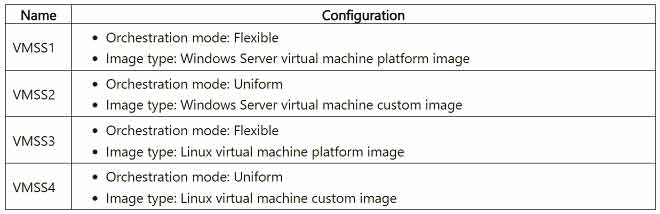
You have an Azure subscription that contains the Azure Virtual Machine Scale Sets shown in the following table.
You are evaluating Azure Update Manager and automatic virtual machine guest patching.
Which virtual machine scale sets will automatic guest patching support?
Reference: Automatic OS image upgrades in VM scale sets
Question 229
HOTSPOT
You have a Microsoft 365 E5 subscription that uses Microsoft Teams.
Your company has an investment department and a research department. Each department has a compliance team.
You are designing a Microsoft Purview Information Barriers (IBs) solution to restrict communication between the departments. The solution must meet the following requirements:
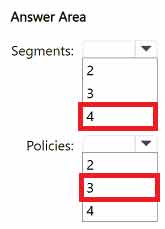
• The employees in each department must only be able to communicate with the employees in their respective department.
• The employees on the compliance team of each department must be able to communicate with the employees on the compliance team of the other department.
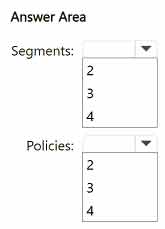
What is the minimum number of segments and IB policies required? To answer, select the appropriate options in the answer area.
NOTE: Each correct selection is worth one point.
Reference: Information barriers policies in Microsoft Purview
Question 230
HOTSPOT
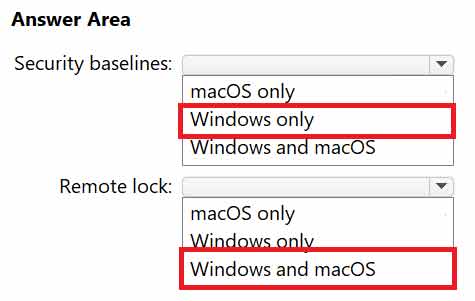
You have 500 Windows 11 devices and 200 macOS devices. The devices are managed by using Microsoft Intune and are subject to compliance policies.
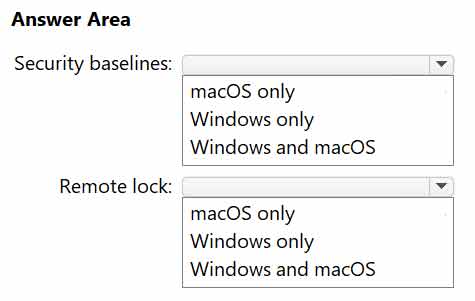
You plan to deploy the following Intune features:
• Security baselines
• Remote lock of noncompliant devices
Which feature will be supported by each platform? To answer, select the appropriate options in the answer area.
NOTE: Each correct selection is worth one point
Reference: Security baselines in Microsoft Intune
SC-100 Practice Questions 231-235
Question 231
You have an Azure subscription named Sub1 that is linked to a Microsoft Entra tenant named contoso.com. Sub1 contains 20 virtual networks named Sub1_VNet1 through Sub1_VNet20.
You have an Azure subscription named Sub2 that is linked to a Microsoft Entra tenant named fabrikam.com. Sub2 contains 20 virtual networks named Sub2_VNet1 through Sub2_VNet20.
You need to deploy an Azure Virtual Network Manager solution that meets the following requirements:
• Blocks SSH traffic on Sub1_VNet20 and Sub2_VNet20 by using network security groups (NSGs)
• Blocks SSH traffic on Sub1_VNet1 through Sub1_VNet19 and Sub2_VNet1 through Sub2_VNet19
• Allows SSH traffic on Sub1_VNet20 and Sub2_VNet20
• Blocks FTP traffic on all the virtual networks
• Minimizes administrative effort
What is minimum number of components required for the deployment?
Reference: Security admin rules in Azure Virtual Network Manager
Question 232
You have an Azure subscription.
You have a subscription to a third-party cloud provider. The subscription contains 100 virtual machines.
You manage cloud security for both subscriptions from the Azure subscription.
You need to recommend a solution to validate the security posture of the virtual machines.
Which two services should you include in the recommendation? Each correct answer presents part of the solution.
NOTE: Each correct answer is worth one point.
Reference: Azure Arc-enabled servers overview
Question 233
You have an Azure subscription that uses Microsoft Defender for Cloud.
You have Amazon Web Services (AWS), Google Cloud Platform (GCP), and Oracle Cloud Infrastructure (OCI) subscriptions.
You create a custom security standard in Defender for Cloud.
To which subscriptions can the Defender for Cloud standard be applied?
Reference: Multicloud security with Microsoft Defender for Cloud
Question 234
HOTSPOT
You have an Azure subscription.
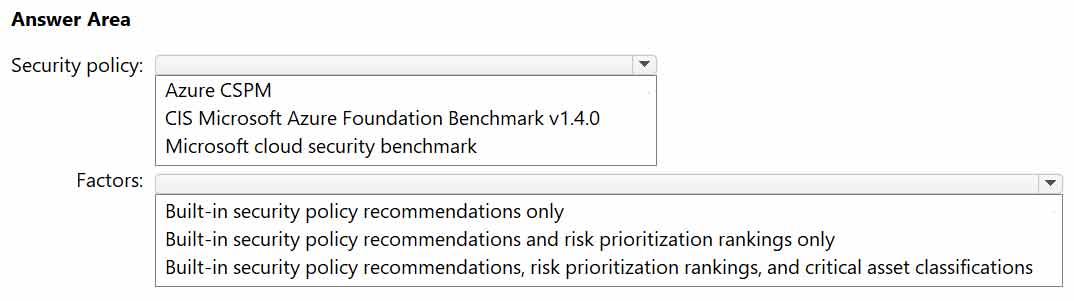
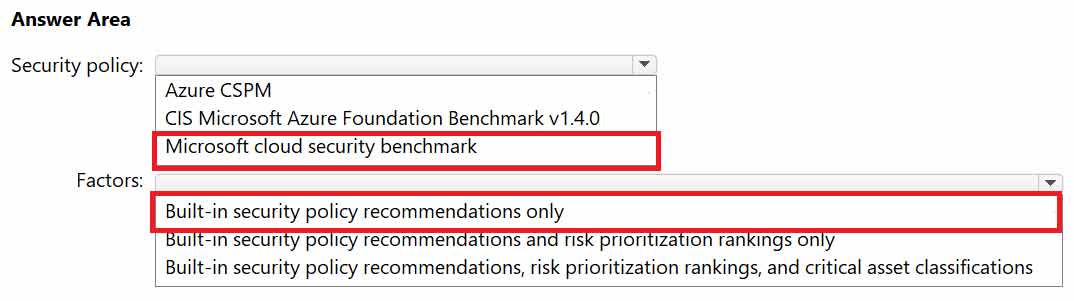
You enable the Defender Cloud Security Posture Management (CSPM) plan.
You need to optimize the security posture of the subscription by implementing Microsoft Defender for Cloud secure score recommendations.
Which security policy should you enable, and which factors will have a direct impact on the secure score? To answer, select the appropriate options in the answer area.
NOTE: Each correct selection is worth one point.
Reference: Secure score in Microsoft Defender for Cloud
Question 235
You have a Microsoft 365 subscription.
You have a Conditional Access policy that has the following settings:
• Name: Policy 1
• Assignments
o Users:
– Include: All users
o Target resources
– Include: Select apps; Office 365
o Network
– Include: Any network or location
– Exclude: Selected networks and locations; Site1
o Access controls
– Grant: Require multifactor authentication, Require Hybrid Microsoft Entra joined device
You plan to implement Zero Trust Rapid Modernization Plan (RaMP).
You need to ensure that Policy1 aligns with best practice recommendations in RaMP.
Which setting should you change?
Reference: Rapid Modernization Plan for Zero Trust
Question 236
Your network contains an on-premises Active Directory Domain Services (AD DS) domain that syncs with a Microsoft Entra tenant.
You need to assess the domain to identify potential credential exposure risks. The solution must meet the following requirements:
• Provide actionable recommendations to mitigate the risks.
• Minimize administrative effort.
What should you use?
Reference: Security posture assessments in Microsoft Defender for Identity
Question 237
You have 500 on-premises Windows devices enrolled in Microsoft Intune.
You have a Microsoft 365 subscription.
You need to ensure that all the outbound HTTP and HTTPS traffic from the devices is inspected by using Microsoft Entra Internet Access. The solution must minimize infrastructure and operational costs.
What should you include in the solution?
Reference: Install the Global Secure Access client for Windows
Question 238
You have an Azure subscription that contains 1,000 virtual machines.
You plan to enforce a corporate standard that all virtual machines must have just-in-time VM access enabled.
You need to recommend a solution to identify which virtual machines support JIT VM access.
What should you include in the recommendation?
Reference: Just-in-time VM access in Defender for Cloud
Question 239
HOTSPOT
You have 500 on-premises Windows devices that are joined to a Microsoft Entra tenant named Tenant1 and enrolled in Microsoft Intune.
You have an Azure subscription named Sub1 that is linked to Tenant1.
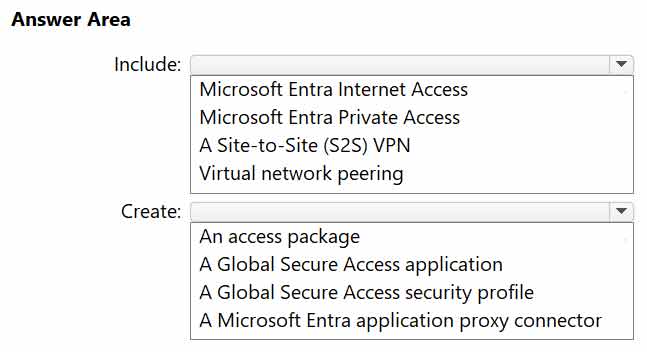
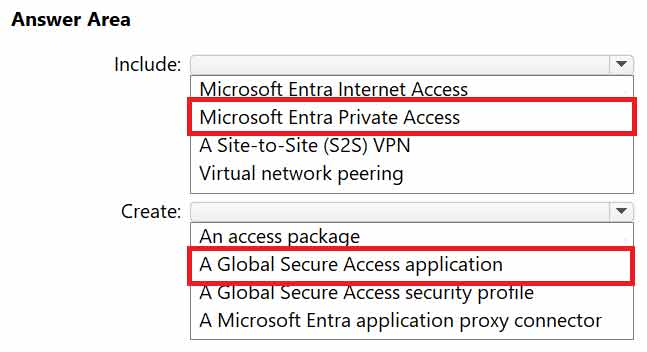
You have a partner company that has an Azure subscription named Sub2. Sub2 contains a virtual network named VNet2 and a storage account named storage1. storage1 is secured by using an Azure Private Link endpoint on VNet2.
You need to recommend a solution to ensures that all the users at your company can access storage1. The solution must meet the following requirements:
• The users must sign in from a compliant device before accessing storage1.
• Access must NOT expose or provide connectivity to any other resources in Sub2.
What should you include in the recommendation, and what should you recommend creating in Tenant1? To answer, select the appropriate options in the answer area.
NOTE: Each correct selection is worth one point.
Reference: Azure Private Endpoint overview
Question 240
You have an Azure subscription. The subscription contains five Azure App Service instances that host public web apps. Each instance is deployed across three Azure regions.
The web apps handle sensitive customer data and must be protected from common web exploits and malicious bots.
You need to recommend a security solution that meets the following requirements:
• Provides centralized management and updates for protection rules
• Protects all the web apps without modifying the application code
• Minimizes costs
What should you include in the recommendation?
Reference: Azure Web Application Firewall on Azure Front Door