


Microsoft SC-100 Free Exam Questions 241-260 with Answers
Scenario-based practice questions for the Microsoft SC-100 Cybersecurity Architect exam. Each question includes a clear answer, a plain-English explanation, and a reference link to official Microsoft documentation. Work through them as a diagnostic, then focus your study time on the gaps they reveal.
SC-100 Practice Questions 241-245
Question 241
You have an Azure subscription that contains 100 virtual machines. The virtual machines run either Linux or Windows Server.
You need to recommend a solution to discover which virtual machines are internet-facing.
What should you include in the recommendation?
Reference: Cloud security posture management in Defender for Cloud
Question 242
You have a Microsoft 365 subscription and an Azure subscription. Microsoft 365 Defender and Microsoft Defender for Cloud are enabled.
The Azure subscription contains 50 virtual machines. Each virtual machine runs different applications on Windows Server 2019.
You need to recommend a solution to ensure that only authorized applications can run on the virtual machines. If an unauthorized application attempts to run or be installed, the application must be blocked automatically until an administrator authorizes the application.
Which security control should you recommend?
Reference: Application control in Microsoft Defender for Endpoint
Question 243
Your company plans to provision blob storage by using an Azure Storage account. The blob storage will be accessible from 20 application servers on the internet.
You need to recommend a solution to ensure that only the application servers can access the storage account.
What should you recommend using to secure the blob storage?
Reference: Configure Azure Storage firewalls and virtual networks
Question 244
Your company is developing a modern application that will un as an Azure App Service web app.
You plan to perform threat modeling to identity potential security issues by using the Microsoft Threat Modeling Tool.
Which type of diagram should you create?
Reference: Microsoft Threat Modeling Tool
Question 245
Your company has an on-premises network and an Azure subscription.
The company does NOT have a Site-to-Site VPN or an ExpressRoute connection to Azure.
You are designing the security standards for Azure App Service web apps. The web apps will access Microsoft SQL Server databases on the network.
You need to recommend security standards that will allow the web apps to access the databases. The solution must minimize the number of open internet-accessible endpoints to the on-premises network.
What should you include in the recommendation?
Reference: Azure App Service Hybrid Connections
SC-100 Practice Questions 246-250
Question 246
You are creating an application lifecycle management process based on the Microsoft Security Development Lifecycle (SDL).
You need to recommend a security standard for onboarding applications to Azure. The standard will include recommendations for application design, development, and deployment.
What should you include during the application design phase?
Reference: Microsoft Threat Modeling Tool
Question 247
DRAG DROP
Your company has Microsoft 365 E5 licenses and Azure subscriptions.
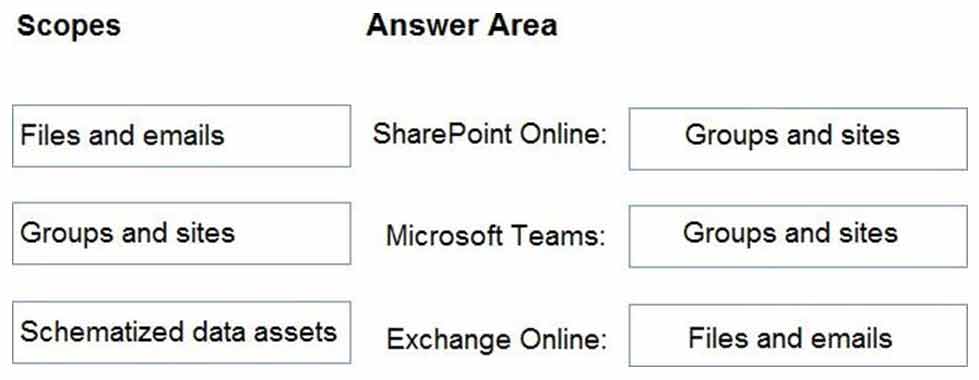
The company plans to automatically label sensitive data stored in the following locations:
– Microsoft SharePoint Online
– Microsoft Exchange Online
– Microsoft Teams
You need to recommend a strategy to identify and protect sensitive data.
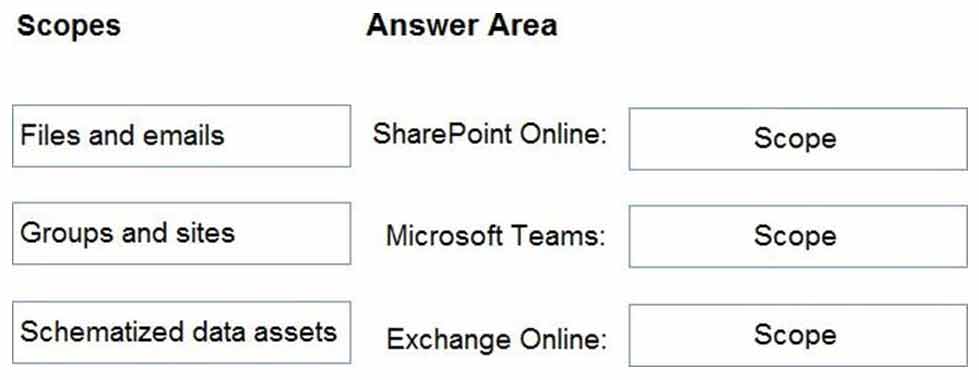
Which scope should you recommend for the sensitivity label policies? To answer, drag the appropriate scopes to the correct locations. Each scope may only be used once, more than once, or not at all. You may need to drag the split bar between panes or scroll to view content.
NOTE: Each correct selection is worth one point.
Select and Place:
Reference: Sensitivity labels in Microsoft Purview
Question 248
Your company is developing a new Azure App Service web app.
You are providing design assistance to verify the security of the web app.
You need to recommend a solution to test the web app for vulnerabilities such as insecure server configurations, cross-site scripting (XSS), and SQL injection.
What should you include in the recommendation?
Reference: Secure DevOps in the Cloud Adoption Framework
Question 249
Your company develops several applications that are accessed as custom enterprise applications in Azure Active Directory (Azure AD).
You need to recommend a solution to prevent users on a specific list of countries from connecting to the applications.
What should you include in the recommendation?
Reference: Location condition in Conditional Access
Question 250
Your company has an Azure subscription that uses Azure Storage.
The company plans to share specific blobs with vendors.
You need to recommend a solution to provide the vendors with secure access to specific blobs without exposing the blobs publicly. The access must be time-limited.
What should you include in the recommendation?
Reference: Grant limited access to Azure Storage resources using SAS
SC-100 Practice Questions 251-255
Question 251
Your company is developing an invoicing application that will use Azure Active Directory (Azure AD) B2C. The application will be deployed as an App Service web app.
You need to recommend a solution to the application development team to secure the application from identity-related attacks.
Which two configurations should you recommend? Each correct answer presents part of the solution.
NOTE: Each correct selection is worth one point.
Reference: Conditional Access and Identity Protection in Azure AD B2C
Question 252
Your company has a Microsoft 365 E5 subscription.
Users use Microsoft Teams, Exchange Online, SharePoint Online, and OneDrive for sharing and collaborating.
The company identifies protected health information (PHI) within stored documents and communications.
What should you recommend using to prevent the PHI from being shared outside the company?
Reference: Learn about data loss prevention in Microsoft Purview
Question 253
Your company has a Microsoft 365 E5 subscription.
The company wants to identify and classify data in Microsoft Teams, SharePoint Online, and Exchange Online.
You need to recommend a solution to identify documents that contain sensitive information.
What should you include in the recommendation?
Reference: Content explorer in Microsoft Purview
Question 254
Note: This question is part of a series of questions that present the same scenario. Each question in the series contains a unique solution that might meet the stated goals. Some question sets might have more than one correct solution, while others might not have a correct solution.
After you answer a question in this section, you will NOT be able to return to it. As a result, these questions will not appear in the review screen.
You are designing a security strategy for providing access to Azure App Service web apps through an Azure Front Door instance.
You need to recommend a solution to ensure that the web apps only allow access through the Front Door instance.
Solution: You recommend configuring gateway-required virtual network integration.
Does this meet the goal?
Reference: Azure App Service virtual network integration
Question 255
Note: This question is part of a series of questions that present the same scenario. Each question in the series contains a unique solution that might meet the stated goals. Some question sets might have more than one correct solution, while others might not have a correct solution.
After you answer a question in this section, you will NOT be able to return to it. As a result, these questions will not appear in the review screen.
You are designing a security strategy for providing access to Azure App Service web apps through an Azure Front Door instance.
You need to recommend a solution to ensure that the web apps only allow access through the Front Door instance.
Solution: You recommend access restrictions that allow traffic from the Front Door service tags.
Does this meet the goal?
Reference: Access restrictions in Azure App Service
SC-100 Practice Questions 256-260
Question 256
Note: This question is part of a series of questions that present the same scenario. Each question in the series contains a unique solution that might meet the stated goals. Some question sets might have more than one correct solution, while others might not have a correct solution.
After you answer a question in this section, you will NOT be able to return to it. As a result, these questions will not appear in the review screen.
You are designing a security strategy for providing access to Azure App Service web apps through an Azure Front Door instance.
You need to recommend a solution to ensure that the web apps only allow access through the Front Door instance.
Solution: You recommend access restrictions based on HTTP headers that have the Front Door ID.
Does this meet the goal?
Reference: Access restrictions in Azure App Service
Question 257
Your company has an on-premises network, an Azure subscription, and a Microsoft 365 E5 subscription.
The company uses the following devices:
– Computers that run either Windows 10 or Windows 11
– Tablets and phones that run either Android or iOS
You need to recommend a solution to classify and encrypt sensitive Microsoft Office 365 data regardless of where the data is stored.
What should you include in the recommendation?
Reference: Microsoft Purview Information Protection
Question 258
You have a Microsoft 365 E5 subscription.
You are designing a solution to protect confidential data in Microsoft SharePoint Online sites that contain more than one million documents.
You need to recommend a solution to prevent Personally Identifiable Information (PII) from being shared.
Which two components should you include in the recommendation? Each correct answer presents part of the solution.
NOTE: Each correct selection is worth one point.
Reference: Learn about data loss prevention in Microsoft Purview
Question 259
Your company has the virtual machine infrastructure shown in the following table.

The company plans to use Microsoft Azure Backup Server (MABS) to back up the virtual machines to Azure.
You need to provide recommendations to increase the resiliency of the backup strategy to mitigate attacks such as ransomware.
What should you include in the recommendation?
Reference: Azure Backup security features
Question 260
You have a Microsoft 365 tenant that uses Microsoft SharePoint Online and Microsoft Purview. Microsoft Purview has a sensitivity label named Label1 that is applied to the files stored on SharePoint Online sites.
You need to recommend a Microsoft Purview Data Loss Prevention (DLP) policy that meets the following requirements:
• Prevents users from uploading the files to third-party external websites
• Allows users to upload the files to Microsoft OneDrive for Business
To which location should you apply the DLP policy?
Reference: Learn about Endpoint data loss prevention