


Microsoft SC-100 Free Exam Questions 61-80 with Answers
Scenario-based practice questions for the Microsoft SC-100 Cybersecurity Architect exam. Each question includes a clear answer, a plain-English explanation, and a reference link to official Microsoft documentation. Work through them as a diagnostic, then focus your study time on the gaps they reveal.
SC-100 Practice Questions 61-65
Question 61
Your company has an Azure subscription that has enhanced security enabled for Microsoft Defender for Cloud.
The company signs a contract with the United States government.
You need to review the current subscription for NIST 800-53 compliance.
What should you do first?
Reference: NIST SP 800-53 R5 regulatory compliance built-in initiative
Question 62
You have an Azure subscription that has Microsoft Defender for Cloud enabled.
You have an Amazon Web Services (AWS) implementation.
You plan to extend the Azure security strategy to the AWS implementation. The solution will NOT use Azure Arc.
Which three services can you use to provide security for the AWS resources? Each correct answer presents a complete solution.
NOTE: Each correct selection is worth one point.
Reference: Multicloud security with Microsoft Defender for Cloud
Question 63
Your company has on-premises network in Seattle and an Azure subscription. The on-premises network contains a Remote Desktop server.
The company contracts a third-party development firm from France to develop and deploy resources to the virtual machines hosted in the Azure subscription.
Currently, the firm establishes an RDP connection to the Remote Desktop server. From the Remote Desktop connection, the firm can access the virtual machines hosted in Azure by using custom administrative tools installed on the Remote Desktop server. All the traffic to the Remote Desktop server is captured by a firewall, and the firewall only allows specific connections from France to the server.
You need to recommend a modern security solution based on the Zero Trust model. The solution must minimize latency for developers.
Which three actions should you recommend? Each correct answer presents part of the solution.
NOTE: Each correct selection is worth one point.
Reference: What is Azure Virtual Desktop?
Question 64
HOTSPOT
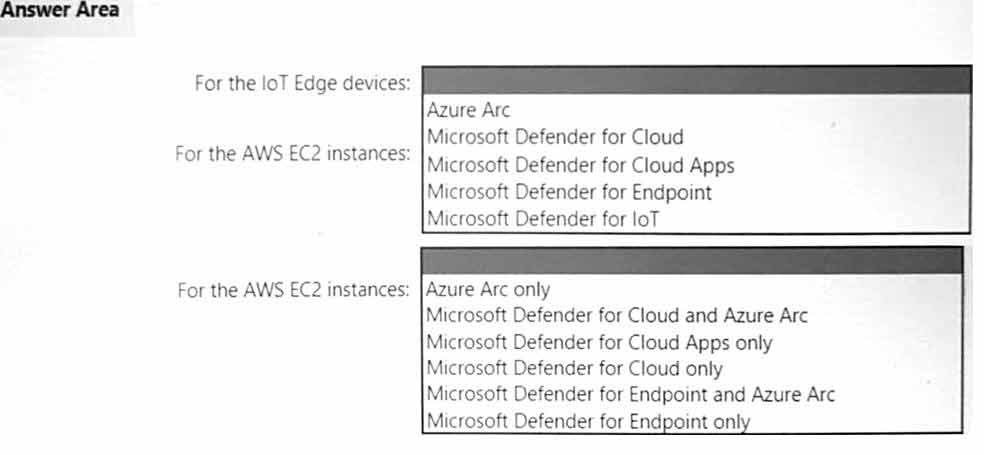
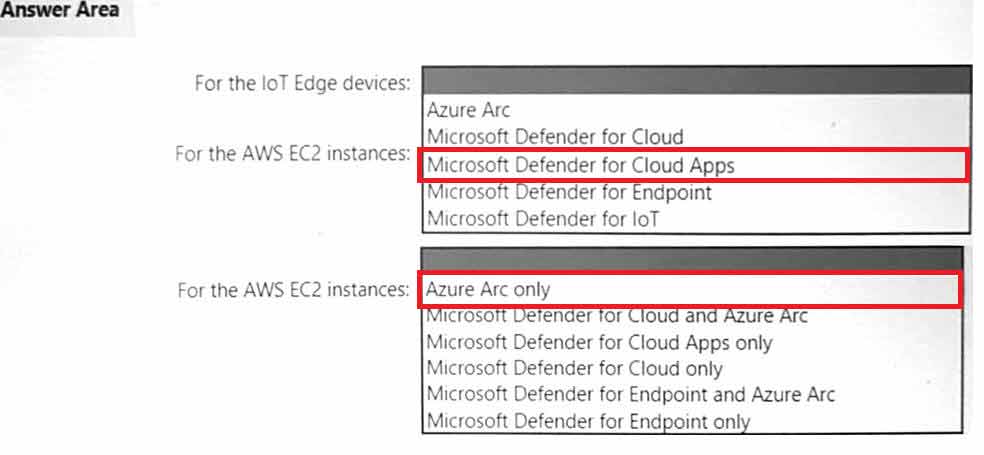
Your company has a multi-cloud environment that contains a Microsoft 365 subscription, an Azure subscription, and Amazon Web Services (AWS) implementation.
You need to recommend a security posture management solution for the following components:
– Azure IoT Edge devices
– AWS EC2 instances
Which services should you include in the recommendation? To answer, select the appropriate options in the answer area.
NOTE: Each correct selection is worth one point.
Hot Area:
Reference: Multicloud security with Microsoft Defender for Cloud
Question 65
Your company has a hybrid cloud infrastructure.
The company plans to hire several temporary employees within a brief period. The temporary employees will need to access applications and data on the company’s on-premises network.
The company’s security policy prevents the use of personal devices for accessing company data and applications.
You need to recommend a solution to provide the temporary employee with access to company resources. The solution must be able to scale on demand.
What should you include in the recommendation?
Reference: What is Azure Virtual Desktop?
SC-100 Practice Questions 66-70
Question 66
Your company is preparing for cloud adoption.
You are designing security for Azure landing zones.
Which two preventative controls can you implement to increase the secure score? Each correct answer presents a complete solution.
NOTE: Each correct selection is worth one point.
Reference: Secure score in Microsoft Defender for Cloud
Question 67
You are designing security for an Azure landing zone.
Your company identifies the following compliance and privacy requirements:
– Encrypt cardholder data by using encryption keys managed by the company.
– Encrypt insurance claim files by using encryption keys hosted on-premises.
Which two configurations meet the compliance and privacy requirements? Each correct answer presents part of the solution.
NOTE: Each correct selection is worth one point.
Reference: Customer-provided keys for Azure Storage
Question 68
You have an Azure subscription that has Microsoft Defender for Cloud enabled.
You need to enforce ISO 27001:2013 standards for the subscription. The solution must ensure that noncompliant resources are remediated automatically.
What should you use?
Reference: Remediation in Azure Policy
Question 69
DRAG DROP
You have a Microsoft 365 subscription.
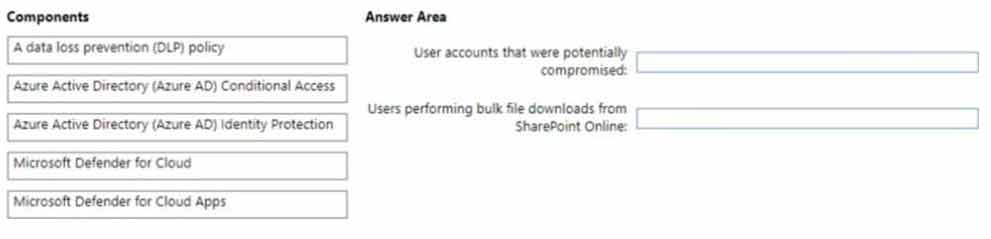
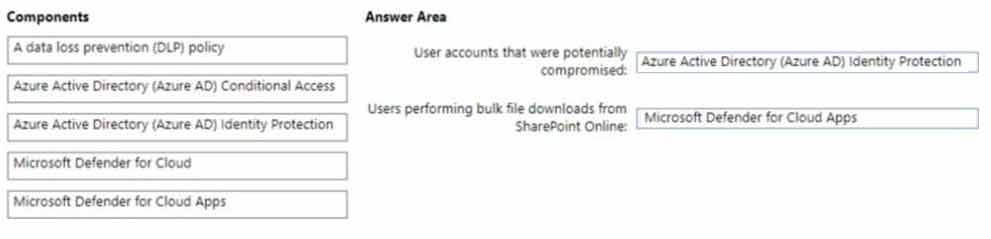
You need to recommend a security solution to monitor the following activities:
– User accounts that were potentially compromised
– Users performing bulk file downloads from Microsoft SharePoint Online
What should you include in the recommendation for each activity? To answer, drag the appropriate components to the correct activities. Each component may be used once, more than once, or not at all. You may need to drag the split bar between panes or scroll to view content.
NOTE: Each correct selection is worth one point.
Select and Place:
Reference: Anomaly detection policies in Microsoft Defender for Cloud Apps
Question 70
Your company finalizes the adoption of Azure and is implementing Microsoft Defender for Cloud.
You receive the following recommendations in Defender for Cloud
– Access to storage accounts with firewall and virtual network configurations should be restricted.
– Storage accounts should restrict network access using virtual network rules.
– Storage account should use a private link connection.
– Storage account public access should be disallowed.
You need to recommend a service to mitigate identified risks that relate to the recommendations.
What should you recommend?
Reference: Azure Policy regulatory compliance controls for Azure Storage
SC-100 Practice Questions 71-75
Question 71
You receive a security alert in Microsoft Defender for Cloud as shown in the exhibit. (Click the Exhibit tab.)
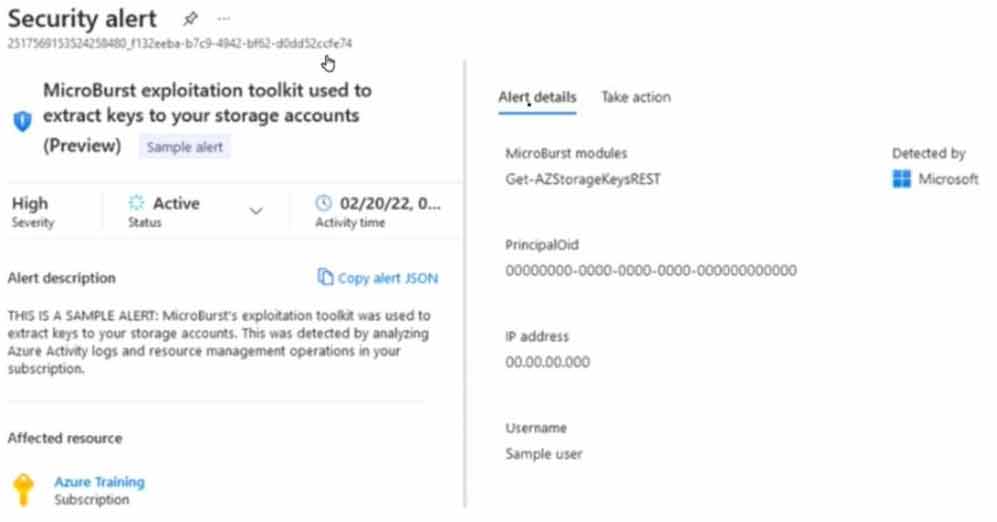
After remediating the threat, which policy definition should you assign to prevent the threat from reoccurring?
Reference: Prevent anonymous public read access to containers and blobs
Question 72
You have 50 Azure subscriptions.
You need to monitor the resource in the subscriptions for compliance with the ISO 27001:2013 standards. The solution must minimize the effort required to modify the list of monitored policy definitions for the subscriptions.
What are two ways to achieve the goal? Each correct answer presents a complete solution.
NOTE: Each correct selection is worth one point.
Reference: Azure management groups overview
Question 73
HOTSPOT
You open Microsoft Defender for Cloud as shown in the following exhibit.
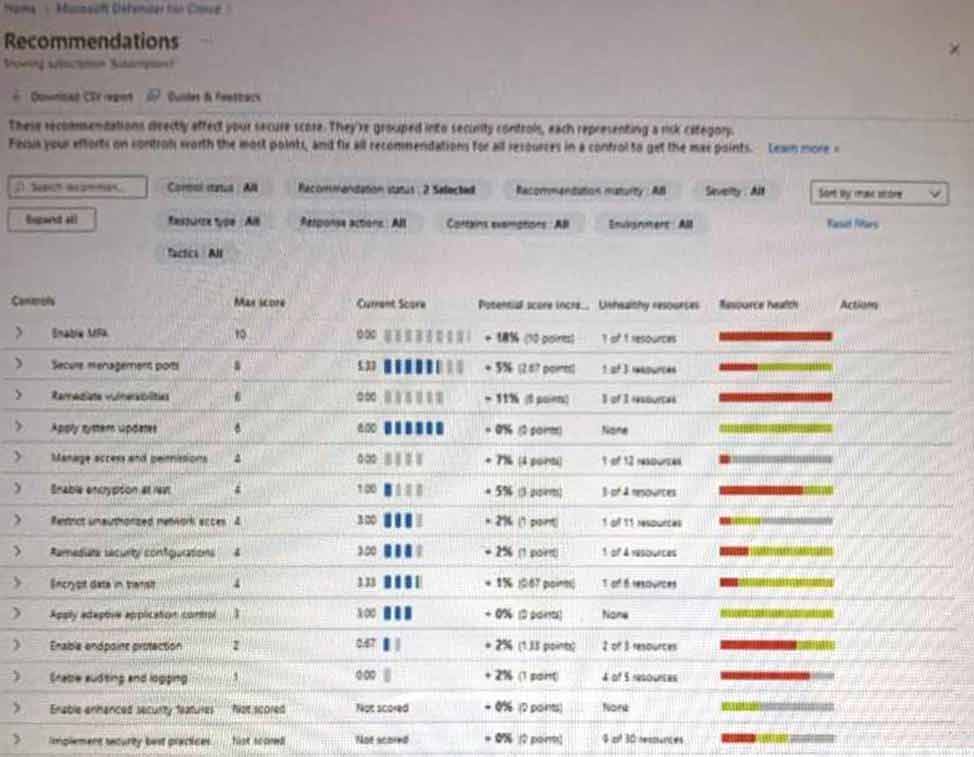
Use the drop-down menus to select the answer choice that completes each statement based on the information presented in the graphic.
NOTE: Each correct selection is worth one point.
Hot Area:
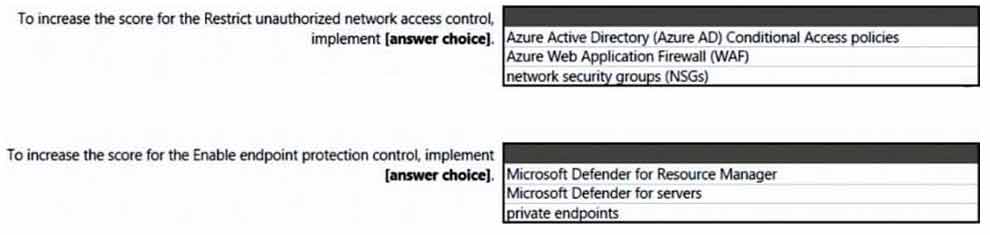
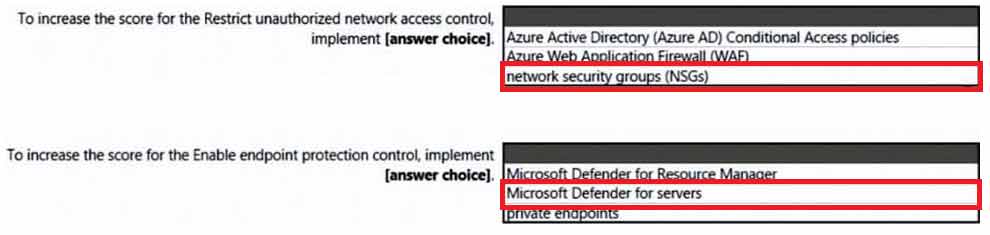
Reference: What is Microsoft Defender for Cloud?
Question 74
Note: This question is part of a series of questions that present the same scenario. Each question in the series contains a unique solution that might meet the stated goals. Some question sets might have more than one correct solution, while others might not have a correct solution.
After you answer a question in this section, you will NOT be able to return to it. As a result, these questions will not appear in the review screen.
You have an Azure subscription that has Microsoft Defender for Cloud enabled.
You are evaluating the Azure Security Benchmark V3 report.
In the Secure management ports controls, you discover that you have 0 out of a potential 8 points.
You need to recommend configurations to increase the score of the Secure management ports controls.
Solution: You recommend enabling the VMAccess extension on all virtual machines.
Does this meet the goal?
Reference: Just-in-time VM access in Defender for Cloud
Question 75
Note: This question is part of a series of questions that present the same scenario. Each question in the series contains a unique solution that might meet the stated goals. Some question sets might have more than one correct solution, while others might not have a correct solution.
After you answer a question in this section, you will NOT be able to return to it. As a result, these questions will not appear in the review screen.
You have an Azure subscription that has Microsoft Defender for Cloud enabled.
You are evaluating the Azure Security Benchmark V3 report.
In the Secure management ports controls, you discover that you have 0 out of a potential 8 points.
You need to recommend configurations to increase the score of the Secure management ports controls.
Solution: You recommend enabling adaptive network hardening.
Does this meet the goal?
Reference: Just-in-time VM access in Defender for Cloud
Question 76
Note: This question is part of a series of questions that present the same scenario. Each question in the series contains a unique solution that might meet the stated goals. Some question sets might have more than one correct solution, while others might not have a correct solution.
After you answer a question in this section, you will NOT be able to return to it. As a result, these questions will not appear in the review screen.
You have an Azure subscription that has Microsoft Defender for Cloud enabled.
You are evaluating the Azure Security Benchmark V3 report.
In the Secure management ports controls, you discover that you have 0 out of a potential 8 points.
You need to recommend configurations to increase the score of the Secure management ports controls.
Solution: You recommend enabling just-in-time (JIT) VM access on all virtual machines.
Does this meet the goal?
Reference: Just-in-time VM access in Defender for Cloud
Question 77
Note: This question is part of a series of questions that present the same scenario. Each question in the series contains a unique solution that might meet the stated goals. Some question sets might have more than one correct solution, while others might not have a correct solution.
After you answer a question in this section, you will NOT be able to return to it. As a result, these questions will not appear in the review screen.
Your on-premises network contains an e-commerce web app that was developed in Angular and Node,js. The web app uses a MongoDB database.
You plan to migrate the web app to Azure. The solution architecture team proposes the following architecture as an Azure landing zone.

You need to provide recommendations to secure the connection between the web app and the database. The solution must follow the Zero Trust model.
Solution: You recommend creating private endpoints for the web app and the database layer.
Does this meet the goal?
Reference: Azure Private Endpoint overview
Question 78
Note: This question is part of a series of questions that present the same scenario. Each question in the series contains a unique solution that might meet the stated goals. Some question sets might have more than one correct solution, while others might not have a correct solution.
After you answer a question in this section, you will NOT be able to return to it. As a result, these questions will not appear in the review screen.
Your on-premises network contains an e-commerce web app that was developed in Angular and Node,js. The web app uses a MongoDB database.
You plan to migrate the web app to Azure. The solution architecture team proposes the following architecture as an Azure landing zone.
You need to provide recommendations to secure the connection between the web app and the database. The solution must follow the Zero Trust model.
Solution: You recommend implementing Azure Key Vault to store credentials.
Does this meet the goal?
Reference: Azure Private Endpoint overview
Question 79
Note: This question is part of a series of questions that present the same scenario. Each question in the series contains a unique solution that might meet the stated goals. Some question sets might have more than one correct solution, while others might not have a correct solution.
After you answer a question in this section, you will NOT be able to return to it. As a result, these questions will not appear in the review screen.
Your on-premises network contains an e-commerce web app that was developed in Angular and Node,js. The web app uses a MongoDB database.
You plan to migrate the web app to Azure. The solution architecture team proposes the following architecture as an Azure landing zone.
You need to provide recommendations to secure the connection between the web app and the database. The solution must follow the Zero Trust model.
Solution: You recommend implementing Azure Application Gateway with Azure Web Application Firewall (WAF).
Does this meet the goal?
Reference: Azure Web Application Firewall on Application Gateway
Question 80
You have a Microsoft 365 subscription and an Azure subscription. Microsoft 365 Defender and Microsoft Defender for Cloud are enabled.
The Azure subscription contains 50 virtual machines. Each virtual machine runs different applications on Windows Server 2019.
You need to recommend a solution to ensure that only authorized applications can run on the virtual machines. If an unauthorized application attempts to run or be installed, the application must be blocked automatically until an administrator authorizes the application.
Which security control should you recommend?
Reference: Adaptive application controls in Defender for Cloud