


Microsoft SC-100 Free Exam Questions 161-180 with Answers
Scenario-based practice questions for the Microsoft SC-100 Cybersecurity Architect exam. Each question includes a clear answer, a plain-English explanation, and a reference link to official Microsoft documentation. Work through them as a diagnostic, then focus your study time on the gaps they reveal.
SC-100 Practice Questions 161-165
Question 161
You have a Microsoft 365 subscription that contains 1,000 users and a group named Group1. All the users have Windows 11 devices. The users sign in to their devices by using their Microsoft Entra account The users do NOT have administrative rights to their devices.
The members of Group1 remotely assist the users by taking control of user sessions. The remote control sessions run in the security context of the users they are assisting.
You need to recommend a solution that will enable the Group1 members to run apps that require administrative rights to the users’ devices. The solution must ensure that the apps are run in the context of each signed-in standard user.
What should you include in the recommendation?
Reference: Endpoint Privilege Management overview
Question 162
You have a Microsoft Sentinel deployment.
You are developing a solution to ensure that compliance with the MITRE ATT&CK framework is maintained as the framework evolves.
You need to recommend a solution to identify which MITRE ATT&CK techniques are NOT addressed by the current Microsoft Sentinel deployment.
What should you include in the recommendation?
Reference: MITRE ATT&CK coverage in Microsoft Sentinel
Question 163
You have Microsoft Defender for Cloud assigned to Azure management groups.
You have a Microsoft Sentinel deployment.
During the triage of alerts, you require additional information about the security events, including suggestions for remediation.
Which two components can you use to achieve the goal? Each correct answer presents a complete solution.
NOTE: Each correct selection is worth one point.
Reference: Jupyter notebooks in Microsoft Sentinel
Question 164
A customer is deploying Docker images to 10 Azure Kubernetes Service (AKS) resources across four Azure subscriptions.
You are evaluating the security posture of the customer.
You discover that the AKS resources are excluded from the secure score recommendations.
You need to produce accurate recommendations and update the secure score.
Which two actions should you recommend in Microsoft Defender for Cloud? Each correct answer presents part of the solution.
NOTE: Each correct selection is worth one point.
Reference: Auto-provisioning for AKS in Defender for Cloud
Question 165
Your company has an office in Seattle.
The company has two Azure virtual machine scale sets hosted on different virtual networks.
The company plans to contract developers in India.
You need to recommend a solution provide the developers with the ability to connect to the virtual machines over SSL from the Azure portal. The solution must meet the following requirements:
– Prevent exposing the public IP addresses of the virtual machines.
– Provide the ability to connect without using a VPN.
– Minimize costs.
Which two actions should you perform? Each correct answer presents part of the solution.
NOTE: Each correct selection is worth one point.
Reference: What is Azure Bastion?
SC-100 Practice Questions 166-170
Question 166
HOTSPOT
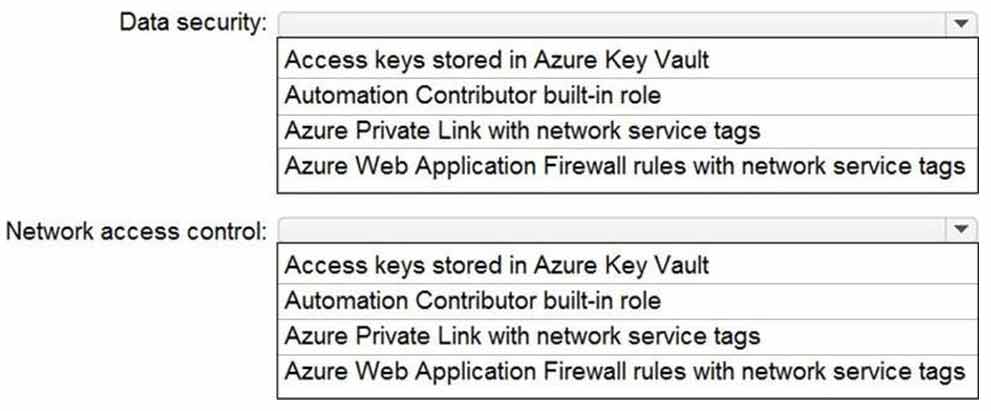
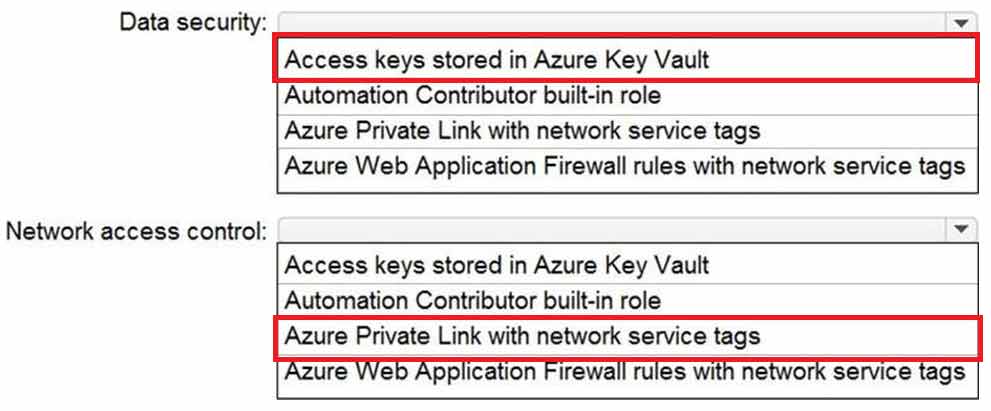
You are designing security for a runbook in an Azure Automation account. The runbook will copy data to Azure Data Lake Storage Gen2.
You need to recommend a solution to secure the components of the copy process.
What should you include in the recommendation for each component? To answer, select the appropriate options in the answer area.
NOTE: Each correct selection is worth one point.
Hot Area:
Reference: Azure Automation security overview
Question 167
You have Windows 11 devices and Microsoft 365 E5 licenses.
You need to recommend a solution to prevent users from accessing websites that contain adult content such as gambling sites.
What should you include in the recommendation?
Reference: Web content filtering in Microsoft Defender for Endpoint
Question 168
Your company has a Microsoft 365 E5 subscription.
The company plans to deploy 45 mobile self-service kiosks that will run Windows 10.
You need to provide recommendations to secure the kiosks. The solution must meet the following requirements:
✑ Ensure that only authorized applications can run on the kiosks.
✑ Regularly harden the kiosks against new threats.
Which two actions should you include in the recommendations? Each correct answer presents part of the solution.
NOTE: Each correct selection is worth one point.
Reference: Threat and vulnerability management in Defender for Endpoint
Question 169
You have a Microsoft 365 E5 subscription.
You need to recommend a solution to add a watermark to email attachments that contain sensitive data.
What should you include in the recommendation?
Reference: Sensitivity labels in Microsoft Purview
Question 170
Your company plans to deploy several Azure App Service web apps. The web apps will be deployed to the West Europe Azure region. The web apps will be accessed only by customers in Europe and the United States.
You need to recommend a solution to prevent malicious bots from scanning the web apps for vulnerabilities. The solution must minimize the attack surface.
What should you include in the recommendation?
Reference: Azure Web Application Firewall on Application Gateway
SC-100 Practice Questions 171-175
Question 171
Note: This question is part of a series of questions that present the same scenario. Each question in the series contains a unique solution that might meet the stated goals. Some question sets might have more than one correct solution, while others might not have a correct solution.
After you answer a question in this section, you will NOT be able to return to it. As a result, these questions will not appear in the review screen.
You are designing the encryption standards for data at rest for an Azure resource.
You need to provide recommendations to ensure that the data at rest is encrypted by using AES-256 keys. The solution must support rotating the encryption keys monthly.
Solution: For blob containers in Azure Storage, you recommend encryption that uses Microsoft-managed keys within an encryption scope.
Does this meet the goal?
Reference: Customer-managed keys for Azure Storage encryption
Question 172
Note: This question is part of a series of questions that present the same scenario. Each question in the series contains a unique solution that might meet the stated goals. Some question sets might have more than one correct solution, while others might not have a correct solution.
After you answer a question in this section, you will NOT be able to return to it. As a result, these questions will not appear in the review screen.
You are designing the encryption standards for data at rest for an Azure resource.
You need to provide recommendations to ensure that the data at rest is encrypted by using AES-256 keys. The solution must support rotating the encryption keys monthly.
Solution: For Azure SQL databases, you recommend Transparent Data Encryption (TDE) that uses Microsoft-managed keys.
Does this meet the goal?
Reference: TDE with customer-managed keys
Question 173
Note: This question is part of a series of questions that present the same scenario. Each question in the series contains a unique solution that might meet the stated goals. Some question sets might have more than one correct solution, while others might not have a correct solution.
After you answer a question in this section, you will NOT be able to return to it. As a result, these questions will not appear in the review screen.
You are designing the encryption standards for data at rest for an Azure resource.
You need to provide recommendations to ensure that the data at rest is encrypted by using AES-256 keys. The solution must support rotating the encryption keys monthly.
Solution: For blob containers in Azure Storage, you recommend encryption that uses customer-managed keys (CMKs).
Does this meet the goal?
Reference: Customer-managed keys for Azure Storage encryption
Question 174
Note: This question is part of a series of questions that present the same scenario. Each question in the series contains a unique solution that might meet the stated goals. Some question sets might have more than one correct solution, while others might not have a correct solution.
After you answer a question in this section, you will NOT be able to return to it. As a result, these questions will not appear in the review screen.
You are designing a security strategy for providing access to Azure App Service web apps through an Azure Front Door instance.
You need to recommend a solution to ensure that the web apps only allow access through the Front Door instance.
Solution: You recommend access restrictions to allow traffic from the backend IP address of the Front Door instance.
Does this meet the goal?
Reference: Azure Front Door FAQ
Question 175
Note: This question is part of a series of questions that present the same scenario. Each question in the series contains a unique solution that might meet the stated goals. Some question sets might have more than one correct solution, while others might not have a correct solution.
After you answer a question in this section, you will NOT be able to return to it. As a result, these questions will not appear in the review screen.
You are designing a security strategy for providing access to Azure App Service web apps through an Azure Front Door instance.
You need to recommend a solution to ensure that the web apps only allow access through the Front Door instance.
Solution: You recommend access restrictions that allow traffic from the Front Door service tags.
Does this meet the goal?
Reference: Azure Front Door FAQ
SC-100 Practice Questions 176-180
Question 176
Note: This question is part of a series of questions that present the same scenario. Each question in the series contains a unique solution that might meet the stated goals. Some question sets might have more than one correct solution, while others might not have a correct solution.
After you answer a question in this section, you will NOT be able to return to it. As a result, these questions will not appear in the review screen.
You are designing a security strategy for providing access to Azure App Service web apps through an Azure Front Door instance.
You need to recommend a solution to ensure that the web apps only allow access through the Front Door instance.
Solution: You recommend access restrictions based on HTTP headers that have the Front Door ID.
Does this meet the goal?
Reference: Azure Front Door FAQ
Question 177
Your company is designing an application architecture for Azure App Service Environment (ASE) web apps as shown in the exhibit. (Click the Exhibit tab.)
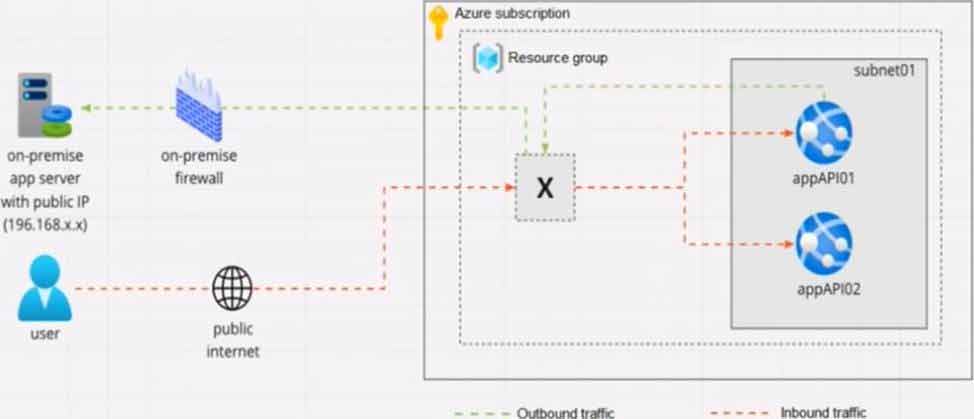
Communication between the on-premises network and Azure uses an ExpressRoute connection.
You need to recommend a solution to ensure that the web apps can communicate with the on-premises application server. The solution must minimize the number of public IP addresses that are allowed to access the on-premises network.
What should you include in the recommendation?
Reference: What is Azure Front Door?
Question 178
You are planning the security requirements for Azure Cosmos DB Core (SQL) API accounts.
You need to recommend a solution to audit all users that access the data in the Azure Cosmos DB accounts.
Which two configurations should you include in the recommendation? Each correct answer presents part of the solution.
NOTE: Each correct selection is worth one point.
Reference: Azure Cosmos DB role-based access control with Entra ID
Question 179
You have an Azure subscription that contains several storage accounts. The storage accounts are accessed by legacy applications that are authenticated by using access keys.
You need to recommend a solution to prevent new applications from obtaining the access keys of the storage accounts. The solution must minimize the impact on the legacy applications.
What should you include in the recommendation?
Reference: Lock resources to prevent changes
Question 180
You are designing the security standards for containerized applications onboarded to Azure.
You are evaluating the use of Microsoft Defender for Containers.
In which two environments can you use Defender for Containers to scan for known vulnerabilities? Each correct answer presents a complete solution.
NOTE: Each correct selection is worth one point.
Reference: Microsoft Defender for Containers overview